
Mexico 50-Peso José María Morelos Note (2012): Value & Facts
Familia F · polímero
Period: México Contemporáneo
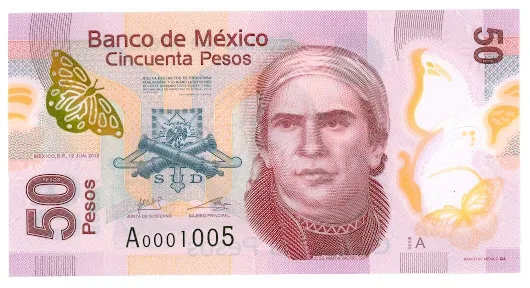
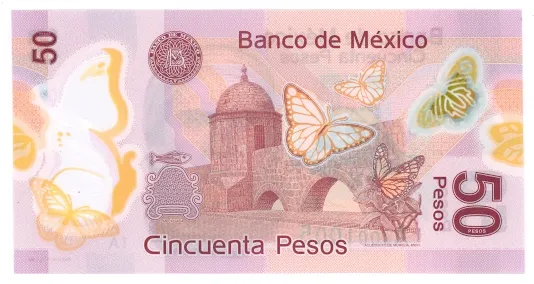
Design
Banxico
Obverse
José María Morelos y Pavón
Portrait of José María Morelos with two opposing cannons, the standard of his forces, and a bow with an arrow and the word SUD
Reverse
The aqueduct of Morelia and a monarch butterfly
About this banknote
Most Mexican 50-peso Morelos notes are worth exactly 50 pesos, about 2.50 to 3 US dollars at current exchange rates. A plain circulated example is not a collectible windfall. But a crisp uncirculated note, a low or radar serial number, or a genuine printing error can sell for several times face. Here is how to tell which one you have.
The pink 50-peso note from the Banco de México Series F features José María Morelos y Pavón, the insurgent priest who convened the Congress of Chilpancingo in 1813 during Mexico's War of Independence. This version was printed on polymer (plastic) rather than paper, with a clear transparent window that became its signature feature. The back shows the aqueduct of Morelia in the state of Michoacán, an 18th-century structure, along with three monarch butterflies, which migrate each winter to the forests of Michoacán.
What it's actually worth in 2026
If the note is still in circulation condition, it is worth its face value of 50 pesos, roughly 2.50 to 3 USD depending on the exchange rate. That is the honest answer for the vast majority of these notes. Collector premiums come from three things, and only these three:
- Uncirculated condition. No folds, no creases, no stains, corners sharp. A note graded UNC by collectors, or slabbed by PMG at 64 and above, carries a premium over a worn one.
- A special serial number. Low serials (like AA0000123), radar/palindrome serials that read the same both ways (like 1234321), solid serials (all same digit), or repeater patterns. Collectors of world paper money (notaphily) pay real money for these.
- A genuine printing error. Misaligned cuts, ink smears, missing print, mismatched serials, or foldovers from the factory. These turn a common note into a rarity.
One detail specific to this note: the size of the monarch butterfly varies by print year (a smaller version versus a larger one), and that variation is exactly what specialists check. It can matter for the more sought-after printings.
Outside of those factors, a used Series F note is worth face value and nothing more. There is no hidden fortune in an ordinary circulated example. What does shift demand is timing: as the Banco de México phases a denomination out of circulation, collectors start hunting for clean, unused examples, and that is when uncirculated notes gain their small premium.
Note at a glance
| Feature | Detail |
|---|---|
| Denomination | 50 pesos |
| Series / family | Banco de México, Series F |
| Substrate | Polymer (plastic) with transparent window |
| Front | José María Morelos y Pavón |
| Back | Aqueduct of Morelia, Michoacán; three monarch butterflies |
| Dominant color | Pink |
| Status | Being withdrawn from circulation |
| Face value in USD | About 2.50 to 3 USD |
How to tell if yours is genuine
Handle the note and check the built-in security features, since counterfeits usually fail on the physical ones:
- Transparent window. The polymer note has a genuine clear plastic window that is part of the substrate, not a printed patch. You can see through it.
- Raised print (intaglio). Run your finger over the main design. Real notes have texture you can feel. Fakes tend to feel flat and smooth.
- Watermark and thread. On paper-based Series F notes, the watermark and security thread are embedded in the paper, not printed on top. A printed "watermark" is a red flag.
- Microprinting. Tiny text that stays sharp under magnification.
A counterfeit typically feels slick, lacks relief, and shows a watermark that was printed rather than incorporated into the substrate. If you are unsure, post clear photos of both sides in the Pesoteca forum and the community will help you judge it.
Where to sell it
For a note worth face value or a small premium, the cleanest options are:
- A verified numismatic dealer from the Pesoteca shop directory, who can appraise it in person without a middleman markup.
- The Pesoteca buy-and-sell forum, where collectors trade directly.
Before accepting any offer, photograph both the front and back in good light, and check the serial number and the exact condition. If you have a low serial, a radar serial, or a possible error, mention it, since those are what push the price above face. Do not dump it on social media to the first buyer who messages you.
To put this note in context, read why Mexico's 20-peso note is leaving circulation and Mexico's most counterfeited banknotes by the numbers.
Got one with an odd serial or a suspected printing error? Post it in the forum and let the community weigh in before you sell.
Historical context
Issued in 2012, this 50-peso note keeps on its obverse the figure of José María Morelos y Pavón, one of the most brilliant strategists of the War of Independence. After the fall of Hidalgo, Morelos organized a movement with both political and military structure, broke the siege of Cuautla, and laid the ideological foundations of the nation with the Sentimientos de la Nación of 1813. Captured and executed in 1815, he became a martyr of the insurgent cause.
The reverse takes up the aqueduct of Morelia, a monument of colonial Michoacán that ties the figure to his native land.
Within the F family, this cotton-paper issue circulated widely throughout the 2010s. It represents the maturity of a series that, soon after, would hand over this denomination to the polymer version, part of the gradual renewal of Mexican currency in circulation.
Frequently asked questions
How much is the Mexico 50-peso José María Morelos note (2012) worth?
If it is still in circulation condition, it is worth its face value of 50 pesos, about 2.50 to 3 US dollars at current rates. As a collectible, an uncirculated example, a note with a special serial number (low, radar, or solid), or one with a genuine printing error can sell for several times face. Condition and rarity drive the price.
Is the 50-peso Morelos note rare?
The ordinary note is common and worth face value. Rarity comes from specific factors: uncirculated condition, a low or palindrome serial number, or a factory printing error. There is also a variation in the size of the monarch butterfly on the back by print year, which specialists watch. Everyday wear or damage is not an error and adds no value.
Where can I sell my 50-peso Morelos note?
The safest routes are a verified dealer from the [Pesoteca shop directory](/tiendas), who can appraise it on the spot, or the [Pesoteca buy-and-sell forum](/foro/compra-venta) among collectors. Photograph both sides in good light and check the serial number and condition first, since a low serial, radar serial, or error is what raises the price above face value.
How do I tell if my 50-peso Morelos note is genuine?
Check the security features: the transparent window on the polymer version, raised print you can feel with your finger, an embedded watermark and security thread on paper notes, and sharp microprinting. A fake usually feels smooth and flat, with a watermark that was printed rather than built into the substrate. When in doubt, post photos in the [Pesoteca forum](/foro).
Familia F
This banknote belongs to the BIL-F family within the Sistema PSM . Explore all the banknotes that share origin, era and design with this piece.
Ver todos los billetes de la familia F →