
5 Pesos Banknote (1915): Carranza Constitutionalist Note Value
Familia REV · algodón
Period: Revolución Mexicana
Design
Banxico
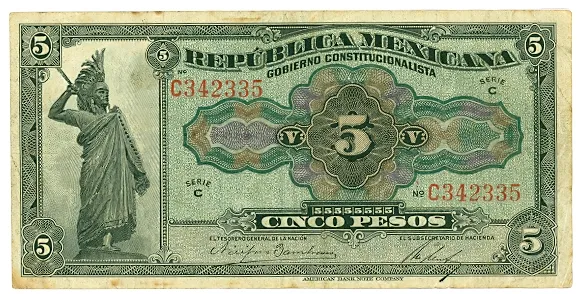
Obverse
Gobierno Constitucionalista
An engraved historical portrait in the center with the legend República Mexicana
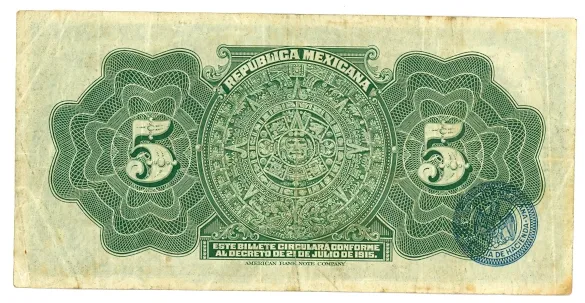
Reverse
The Sun Stone or Aztec Calendar
About this banknote
Most 1915 Mexican 5 pesos banknotes are worth a few US dollars in worn condition, but crisp uncirculated examples from scarcer issuing banks can bring 50 to 300 USD or more. The value comes entirely from collectors, not from the old face value. Here is what actually drives the price of yours.
This is a note from the Gobierno Constitucionalista of Venustiano Carranza (the Constitutionalist government), issued under the decree of 1915 during the Mexican Revolution. Carranza's faction printed its own paper money to fund the war against Victoriano Huerta and to bring order to the chaos of competing revolutionary currencies. The design pushed a message: with the emblem of the Mexican Republic and patriotic imagery, it claimed legitimacy as the real government against rival leaders like Pancho Villa and Emiliano Zapata.
What it looks like
- Obverse (front): an engraved historical portrait at center, with the legend República Mexicana (Mexican Republic).
- Reverse (back): the Piedra del Sol, the Aztec calendar stone, one of the most recognized symbols of Mexican iconography.
Because 1915 was a period of many competing issuers (the federal Constitutionalist government, state governments, banks, and even local businesses), "1915 five pesos" is not a single note. There are dozens of varieties. The issuing authority printed on your note is what determines whether it is common or genuinely scarce.
What it's worth today
This is historic paper money, more than a century old, so its value is purely collector-driven. Face value means nothing here. What matters is:
- Issuer. Notes from the central Constitutionalist government are the most available. Private-bank notes and small local scrip (called vales or cartones) from the Revolution have their own market, and some are very rare.
- Condition (grade). A crisp, uncirculated note with sharp corners and no folds is worth many times a soft, stained, torn example. Revolution-era notes often circulated hard and survived in poor shape, which makes clean examples desirable.
- Rarity and survivors. Many of these notes circulated so briefly, or were withdrawn and destroyed, that complete, intact examples are hard to find today.
| Note | Year | Typical condition | Approx. value (USD) |
|---|---|---|---|
| 5 Pesos, Constitutionalist government | 1915 | Well-worn, common issuer | 3 to 15 |
| 5 Pesos, Constitutionalist government | 1915 | Crisp uncirculated | 30 to 150 |
| 5 Pesos, scarcer bank / local issue | 1915 | Higher grade or rare issuer | 100 to 400+ |
These are collector-market ranges, not a fixed price. A note that looks identical to your eye can be worth ten times another one because of a different issuer name or a much higher grade.
The myth: "it's from 1915, so it's worth a fortune"
Age alone does not make a banknote valuable. Millions of Revolution-era notes were printed, and many types are common precisely because so many were saved. A worn, common-issuer 1915 five pesos is worth a few dollars, and that is the honest answer for most people who inherited one. The exceptions are the scarce issuers, the top-grade survivors, and genuine printing errors.
What can make yours worth more
- A scarce or private-bank issuer printed on the note.
- Uncirculated condition, no folds, full body, bright color.
- Low or repeating (radar) serial numbers.
- Genuine printing errors (misaligned cuts, ink smears, inverted elements). Normal wear and use damage is not an error.
How to check what yours is worth
- Read the issuer. The name of the issuing government or bank is the single most important detail. Photograph it clearly.
- Grade it honestly. Look for folds, tears, stains, and pinholes. Collectors pay for eye appeal.
- Check authenticity. Compare the paper, engraving, and signatures against known reference images. Reproductions tend to have smooth modern paper, flat color, and no engraved relief. Genuine notes show fine engraved lines.
- Get a second opinion before you sell. Post clear photos of both sides in the Pesoteca forum or ask a serious paper-money dealer. For high-value or questionable notes, third-party grading from PMG (Paper Money Guaranty) both authenticates and grades.
Where to sell it
World paper money is an active English-language collecting field, so you have real options. For a fair price, use a verified numismatic dealer or auction house that handles world banknotes, or trade directly with collectors in the Pesoteca buy-and-sell forum. Photograph both sides in good light, note the issuer and any special serial number, and never dump it to the first buyer on social media.
Related reading on Pesoteca: our guides to Mexican Revolution-era paper money, the numismatic dealer directory, and the collector buy-and-sell forum.
Have one in hand and not sure which issuer you're holding? Post a photo of both sides in the Pesoteca forum and the community can help you pin down the exact variety and a realistic value.
Historical context
This 5-peso note of 1915 belongs to the issues of the República Mexicana, Gobierno Constitucionalista, the faction led by Venustiano Carranza during the Revolution. After confronting the regime of Victoriano Huerta, the Constitutionalists needed money to pay their troops and sustain the administration in the territories they controlled, and the solution was to print their own paper money.
The design sought to project an air of national legitimacy: a historical portrait engraved at the center and the legend República Mexicana, so the paper would read as money of the country and not of a faction. On the reverse appears the Sun Stone (the misnamed Aztec Calendar), a symbol of Mexican identity that reinforced that idea of legitimate authority.
The underlying problem was confidence. With so many factions issuing notes at the same time (Villa, Zapata, state governments, Carranza himself), the paper depreciated quickly and people hid their metal coins. That is why 1915 is remembered as one of the most chaotic years for Mexican money, and these Constitutionalist notes are its most emblematic face.
Frequently asked questions
How much is the 1915 Mexican 5 pesos banknote worth?
It depends almost entirely on the issuer and condition. A worn, common-issuer example is worth roughly 3 to 15 USD. A crisp uncirculated note runs about 30 to 150 USD, and scarce bank or local issues in high grade can bring 100 to 400 USD or more. Face value is irrelevant; this is a collector item over a century old.
Is the 1915 5 pesos note rare?
Some varieties are common and some are genuinely scarce. "1915 five pesos" covers many different issuers from the Revolution, from the central Constitutionalist government to private banks and local scrip. Central-government notes are the most available; private-bank and local issues, and any note in uncirculated grade, are much harder to find and worth more.
Where can I sell my 1915 5 pesos banknote?
Use a verified numismatic dealer or a world-paper-money auction house, or trade with collectors in the [Pesoteca buy-and-sell forum](/foro/compra-venta). Photograph both sides in good light, record the issuer name and any special serial number, and avoid selling to the first bidder on social media before you know what you have.
How do I tell if my 1915 5 pesos note is genuine?
Compare the paper, engraving, and signatures to official reference images. Genuine notes show fine engraved lines and slight relief; reproductions usually have smooth modern paper and flat, printed-looking color. For valuable or doubtful notes, third-party grading from PMG both authenticates and grades. When in doubt, post clear photos in the [Pesoteca forum](/foro).
Características Banxico
Infalsificables
Familia REV
This banknote belongs to the BIL-REV family within the Sistema PSM . Explore all the banknotes that share origin, era and design with this piece.
Ver todos los billetes de la familia REV →