
Mexican 5 Pesos Revolution Treasury Note (Obligación Provisional del Erario)
Familia REV · algodón
Period: Revolución Mexicana
Design
Banxico
Obverse
Erario Federal
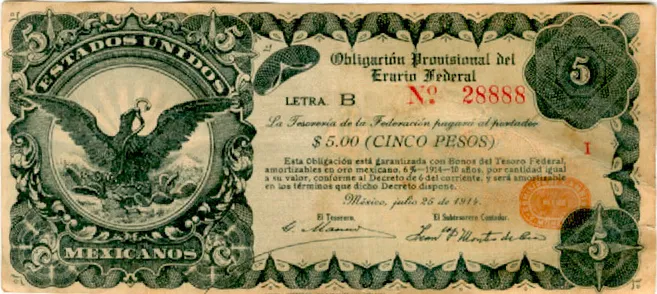
The Mexican eagle and the text of the provisional obligation of the Federal Treasury
Reverse
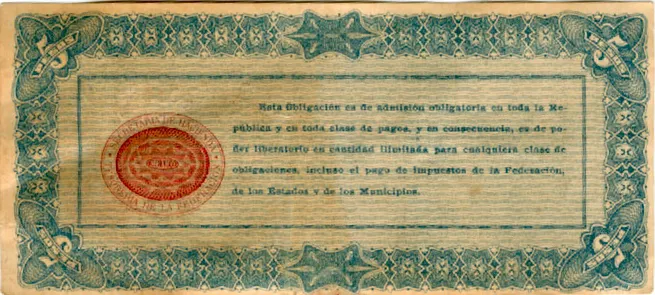
Text of the obligation, guaranteed by Federal Treasury bonds
About this banknote
Most people who inherit an old Mexican banknote assume it's a lost fortune. This one usually isn't. The 5 pesos Obligación Provisional del Erario Federal is a genuine Mexican Revolution piece, and depending on condition and the issuing entity it trades from a few dollars to a few hundred USD in the world paper money market. Records for the rarest emergency issues can climb higher, but that is the exception.
What it actually is
The Obligación Provisional del Erario Federal ("Provisional Obligation of the Federal Treasury") was government debt turned into circulating paper. During the Mexican Revolution, cash was scarce, so the Federal Treasury issued these obligations backed by Treasury bonds, and ordinary people spent them like banknotes. That is why the line between public debt and paper money blurred: this note is a debt instrument that worked as currency out of pure necessity.
The front shows the Mexican eagle and the text of the provisional Treasury obligation. The back carries the obligation wording, stating the note is guaranteed by Federal Treasury bonds.
How much is it worth in 2026
This is historic paper money, more than a century old, so its value is purely collector value. Two things drive it: condition and how scarce the specific issue is.
- Circulated, worn, folded: these are the most common examples. Expect a modest figure, often in the low tens of dollars, sometimes less if heavily damaged.
- Crisp, uncirculated, no folds: condition is everything in world paper money. A clean example can be worth several times a worn one.
- Scarce issue or serial: some Revolution-era emergency issues circulated so little, or survived in such small numbers, that complete examples are genuinely hard to find. Those command real premiums.
Mexican Revolution paper is an active English-language collecting field (notaphily). Values vary widely because dozens of issuers, states, and provisional emissions exist, and each has its own survival rate.
| Note | Era | Condition | Typical collector range (USD) |
|---|---|---|---|
| 5 pesos Obligación Provisional del Erario | Revolution | Circulated | roughly 10 to 40 |
| 5 pesos Obligación Provisional del Erario | Revolution | Uncirculated | roughly 40 to 150+ |
| Scarce provisional issues (varies) | Revolution | Any | can reach several hundred |
These are indicative collector ranges for the general type, not a guaranteed price for your specific note. A firm valuation requires seeing the exact issuer, series, and grade.
The myth: "it's over 100 years old, so it's worth a fortune"
Age alone does not make paper money valuable. Millions of Revolution-era notes were printed, and a lot survived. What actually moves value is rarity (how many exist today), condition, demand for that specific issuer, and any error or special serial. A worn, common issue from 1913 to 1915 can be worth less than a modern collectible. Don't trust the first inflated price you see online.
What makes yours worth more
- Uncirculated condition: no folds, no soft corners, original crispness.
- Low serial number: single or double-digit serials (like 00000012) attract collectors.
- Radar / palindrome serial: a serial that reads the same forwards and backwards.
- Genuine printing errors: misaligned cuts, ink smears, factory folds, mismatched or off-center serials. A real error turns a common note into a scarce one. Normal wear and use damage is not an error.
How to check what yours is worth
- Photograph both sides in good, even light. Collectors need to see the full design, serials, and any flaws.
- Read the fine print: the issuer name, series letter, and dates are printed on the note. These identify the exact emission, which determines rarity.
- Grade it honestly: compare against a grading scale. Folds, stains, tears, and pinholes all lower value.
- Compare to sold listings, not asking prices. Check recent auction results for Mexican Revolution paper on Heritage Auctions and Stack's Bowers, and look at completed listings rather than optimistic sellers.
Is it genuine?
For a note this old, forensic security threads and polymer windows don't apply. Instead:
- Compare the design, paper texture, and signatures against official Banco de México and archival images of the same issue.
- Genuine period paper has texture and slightly uneven, aged ink tone. Reproductions and reprints tend to have smooth, glossy paper and flat, uniform colors.
- Watch for modern printing on modern stock, a common giveaway on souvenir copies.
- When in doubt, post clear photos in the Pesoteca forum so the community can weigh in.
Where to sell it
- A verified numismatic dealer from the Pesoteca shop directory can appraise it in person and give you a real offer.
- The Pesoteca buy-and-sell forum connects you directly with collectors who want Revolution paper.
- For higher-value or scarce issues, an established world paper money auction (Heritage, Stack's Bowers) reaches the global collector base.
Always document both sides with clear photos, note the issuer and serial, and avoid dumping it to the first buyer on social media.
Have one of these Treasury obligations, or an unusual serial or possible error? Post the front and back in the Pesoteca forum and let collectors help you pin down exactly what you're holding.
Historical context
Another Provisional Obligation of the Federal Treasury, this time for 5 pesos, within the tangled system of emergency money produced by the Mexican Revolution. More than a bank note, it is a State debt instrument that people used as if it were cash, backed by Federal Treasury bonds.
The context explains everything: between 1913 and 1916 there was no single, trustworthy national currency. The country was at war, silver was being hoarded, and the authorities issued paper to cover expenses they could not pay any other way. On the obverse, the Mexican eagle and the legal text of the obligation; on the reverse, the promise of payment guaranteed by bonds. Everything revolved around one word: trust, which was precisely what was most lacking.
These obligations circulated alongside constitutionalist, Villista, and local-government notes, feeding an inflation that made the paper lose value almost as fast as it was printed. As a piece, it represents the ingenuity and urgency of a State trying to finance a revolution with promises printed on paper instead of metal.
Frequently asked questions
How much is the Mexican 5 pesos Treasury note worth?
As collector paper money, a worn example typically sells in the low tens of US dollars, while a crisp uncirculated note can bring 40 to 150 USD or more. Scarce provisional issues, low serials, or genuine errors can reach several hundred dollars. Condition and rarity of the specific issuer decide the price.
Is the 5 pesos Obligación Provisional del Erario rare?
It depends on the exact issue. Many Revolution-era Treasury obligations were printed in quantity and survive today, so they are common. Others circulated so little, or survived in such small numbers, that complete examples are genuinely hard to find and command real premiums. The printed issuer and series letter tell you which you have.
Where can I sell my Mexican Revolution 5 pesos note?
The safest routes are a verified dealer from the [Pesoteca shop directory](/tiendas), who can appraise it on the spot, or the [Pesoteca buy-and-sell forum](/foro/compra-venta) among collectors. For scarce or high-grade notes, a world paper money auction like Heritage or Stack's Bowers reaches global buyers. Photograph both sides first and check for low or radar serials that raise value.
How can I tell if the 5 pesos Treasury note is genuine?
Compare the design, paper texture, and signatures against official Banco de México and archival images of the same issue. Genuine period notes have textured paper and slightly aged, uneven ink; reproductions usually have smooth, glossy paper and flat colors. When unsure, post clear photos of both sides in the [Pesoteca forum](/foro) for a second opinion.
Características Banxico
I
Familia REV
This banknote belongs to the BIL-REV family within the Sistema PSM . Explore all the banknotes that share origin, era and design with this piece.
Ver todos los billetes de la familia REV →