
Banco Yucateco 5 Pesos (1891): Value & How to Sell
Familia PRIV · algodón
Period: Bancos privados de emisión
Design
Banxico
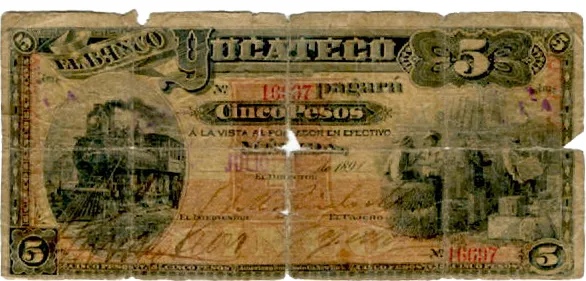
Obverse
Banco Yucateco
Seated female allegories making a toast and the figure of a young man, with a locomotive vignette
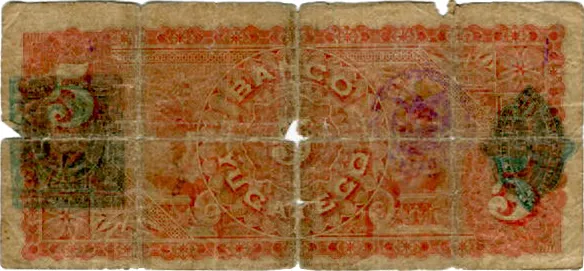
Reverse
Engraved ornamental design with the denomination and the name of the bank
About this banknote
Most Mexican banknotes from the 1800s are worth from 20 to a few hundred US dollars, not thousands. The 1891 Banco Yucateco 5 pesos note is a collector item from Mexico's private state-bank era, and its price depends almost entirely on condition and how scarce that specific bank's surviving notes are. Here is what yours is actually worth in 2026 and how to check it.
What this note is
The 5 pesos of the Banco Yucateco was issued in Mérida, Yucatán, during the Porfiriato (the long rule of Porfirio Díaz, roughly 1876 to 1911). At that time Mexico had no single national currency. Dozens of private state banks printed their own notes, backed by their own reserves. The Banco Yucateco was one of them, and it operated at the height of the henequén boom, when Yucatán's "green gold" (the agave fiber used to make rope and twine) made the region one of the wealthiest in the country.
The locomotive shown in the vignette is not decoration. It referenced the railway progress that carried henequén to port for export. The face of the note carries seated female allegories raising a toast and the figure of a young man, with the locomotive vignette. The back shows an engraved ornamental design with the denomination and the bank's name.
Many surviving examples carry a red overprint reading "Banco Peninsular Mexicano." That stamp is the result of the bank's 1908 merger with the Banco Mercantil de Yucatán. The overprint is a genuine historical feature, not damage, and collectors treat overprinted and non-overprinted notes as distinct varieties.
What it's worth today
This is historic paper money, more than a century old, so its value is purely collectible. There is no face value to redeem. Private-bank notes from the Porfiriato and the paper scrip of the Mexican Revolution have their own active market among world-paper-money collectors (the hobby is called notaphily). Some issues are common and some are extremely scarce, and many circulated so little, or were redeemed and destroyed after the banks closed, that intact examples are hard to find.
As a general guide for Banco Yucateco notes:
| Condition | Typical value (USD) |
|---|---|
| Well-worn, tears, missing corners | 15 to 40 |
| Circulated, complete, legible | 40 to 120 |
| High grade, crisp, minimal handling | 120 to 400+ |
| Rare variety or top certified grade | Several hundred and up |
These are ranges, not guarantees. The exact figure for your note depends on the signatures, the presence or absence of the Banco Peninsular Mexicano overprint, and above all its condition. A note graded by a service such as PMG (Paper Money Guaranty) will sell for more than an ungraded one, because a buyer knows exactly what they are getting.
What drives the price
Four things decide whether your note is worth 20 dollars or several hundred:
- Condition. Folds, tears, stains and missing corners cut the value fast. A crisp, uncreased note can be worth several times a worn one.
- The specific bank and variety. Notes from banks that issued small quantities, or whose paper was mostly redeemed, are scarcer today. The overprint variety can shift demand.
- Whether it's genuine and unaltered. Reproductions and "remainder" notes (never issued, no serial numbers or signatures) are worth far less than fully issued examples.
- Certification. A PMG holder with a grade removes doubt and widens your pool of buyers.
How to tell if yours is genuine
Compare the paper, the engraving and the signatures against reference images of Banco Yucateco issues. Genuine period notes were printed on quality banknote paper with fine, sharp engraved lines. Reproductions tend to have flat, smooth paper and dull, printed color instead of engraved detail. Check the serial number and the hand-applied or stamped signatures. If a red "Banco Peninsular Mexicano" overprint is present, confirm it looks aged and consistent with the ink of the era. When in doubt, post clear photos of both sides in the Pesoteca forum for a second opinion.
Where to sell it
The safest options are a verified numismatic dealer from the Pesoteca dealer directory, who can appraise it in person, or the Pesoteca buy-and-sell forum among collectors. For a note like this, world-paper-money auction houses and specialist dealers who handle Mexican provisional and bank issues will reach the right buyers. Photograph both faces in good, even light before you list anything, and note the serial number, any overprint, and the exact condition.
Don't dump it on a general marketplace for the first offer. A worn common note and a crisp rare variety can look nearly identical to an untrained eye, and the price gap between them is large.
Have one of these in an old family box? Post photos of the front and back in the Pesoteca forum and let collectors help you identify the bank, variety and grade before you decide what to do with it.
Historical context
The Banco Yucateco opened its doors in Mérida on February 1, 1890, following the concession granted to Nicanor Ancona the year before. Financed by the powerful commercial house of Olegario Molina, it became one of the key institutions for the henequen planters, who exchanged for its notes the gold obtained from exporting the fiber.
This 1891 5-peso note belongs to the very first issues of the bank, barely a year after its opening. Its obverse brings together female allegories offering a toast and the figure of a young man, alongside a locomotive vignette: the image of the railway was not decorative but a symbol of progress and of the rail network that carried henequen toward the port of Progreso.
Its notes were engraved by the American Bank Note Company of New York. The 5-peso denomination was among the most manageable, meant to circulate in the commerce of a Mérida enriched by the green gold.
Frequently asked questions
How much is the 1891 Banco Yucateco 5 pesos note worth?
As a collector item it typically runs from about 15 to 40 USD for a worn example, 40 to 120 USD for a complete circulated note, and 120 to 400 USD or more for a crisp, high-grade piece. Rare varieties or top certified grades can bring several hundred and up. Condition and the specific variety decide the figure.
Is this a rare banknote?
It depends on the variety. Private state-bank notes from the Porfiriato range from common to very scarce. Many Banco Yucateco notes were redeemed or destroyed after the bank's 1908 merger, so intact, high-grade examples are harder to find. The version with the red "Banco Peninsular Mexicano" overprint is a distinct variety collectors track separately.
Where can I sell my Banco Yucateco 5 pesos note?
The safest routes are a verified dealer from the [Pesoteca dealer directory](/tiendas), who can value it on the spot, or the [Pesoteca buy-and-sell forum](/foro/compra-venta) among collectors. Specialist world-paper-money auction houses that handle Mexican issues also reach the right buyers. Photograph both sides in good light and record the serial number and any overprint first.
How can I tell if it's genuine?
Compare the paper, engraving and signatures to reference images of Banco Yucateco notes. Real period notes used quality banknote paper with sharp engraved lines; reproductions look flat with dull printed color. Check the serial number and any red "Banco Peninsular Mexicano" overprint for age-consistent ink. If unsure, post clear photos of both sides in the [Pesoteca forum](/foro).
Familia PRIV
This banknote belongs to the BIL-PRIV family within the Sistema PSM . Explore all the banknotes that share origin, era and design with this piece.
Ver todos los billetes de la familia PRIV →