
5 Pesos Banco de Zacatecas (1912) Banknote Value
Familia PRIV · algodón
Period: Bancos privados de emisión
Design
Banxico
Obverse
Banco de Zacatecas
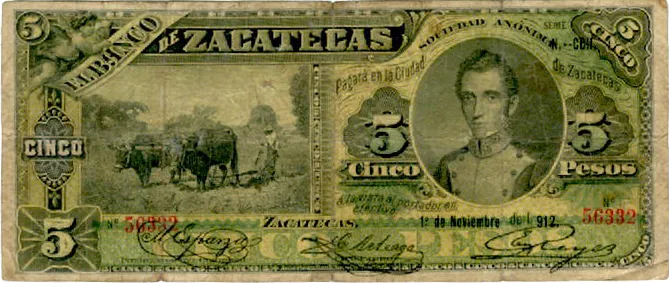
Engraved allegorical vignettes: a miner on the left, a female figure with goods in the center, and the profile portrait of a young man on the right
Reverse
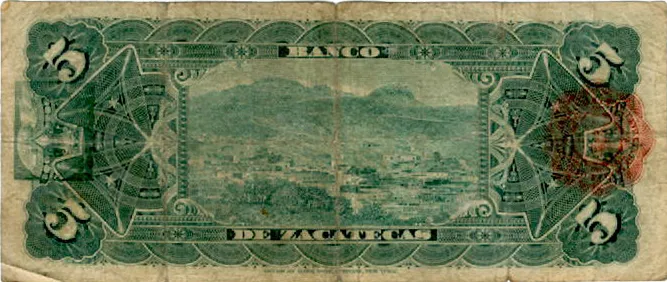
Scenes of mining and labor, or a monument set against the mountainous landscape of Zacatecas
About this banknote
Most people who inherit a stack of old Mexican notes find they are worth a few dollars each. The 1912 Banco de Zacatecas 5 pesos is different: it is a genuine piece of pre-central-bank Mexico, and depending on condition it trades from roughly 15 USD for a heavily worn example to a few hundred USD for a crisp, high-grade note. Here is what actually drives that number, and how to check yours.
What this note actually is
Before Mexico had a single central bank, individual states licensed private banks to print their own paper money, each note backed by silver. This system of multiple issuing banks ran through the Porfiriato (the long rule of Porfirio Díaz) and ended when the Banco de México was founded in 1925.
The Banco de Zacatecas was one of those state issuers. Zacatecas was mining country, so the vignettes on the note point straight to mining: the silver ore was the guarantee behind the paper. On the face you see engraved allegorical vignettes, a miner on the left, a female figure with goods at the center, and the profile portrait of a young man on the right. The back shows scenes of mining and labor, or a monument set against the mountainous Zacatecas landscape.
Because it was issued by a private regional bank and not a national government, this is a category collectors call "broken bank" or private-issue notes. That has a real effect on value: some issuers are common, others are genuinely scarce, and many notes circulated so little (or were redeemed and destroyed) that intact survivors are hard to find today.
How much is a 1912 Banco de Zacatecas 5 pesos worth
This is historic paper money, over a century old, so it has no spending value. Its worth is purely collector value, and it swings on two things: condition (grade) and how scarce that specific bank and denomination are.
As a working guide for the current 2026 market:
| Condition | Typical value (USD) |
|---|---|
| Heavily circulated, tears, staining | 10 to 25 |
| Circulated but complete, moderate wear | 25 to 75 |
| Lightly circulated, strong color | 75 to 200 |
| Uncirculated / gem quality | 200 to 500+ |
These are ranges, not fixed prices, because the private-bank market is thin and each sale depends on the buyer in the room that day. Mexican revolutionary and Porfiriato-era private notes have their own dedicated collecting base, and prices for the scarcer banks have climbed steadily over the last decade. A note in genuinely uncirculated shape, or with an unusual serial number, can outrun the ranges above.
Do not trust the first price you see on a general marketplace. Sellers who do not know what they hold routinely list these notes far too low or wildly too high.
What makes yours worth more
Three things push the value above the base range:
- Grade. No folds, no pinholes, no stains, sharp corners. A crisp uncirculated note can be worth several times a worn one of the same type. Third-party grading (PMG is the standard for world paper money) adds trust and price.
- Serial numbers. A very low serial, a repeating pattern, or a palindrome (a folio that reads the same both ways) draws extra demand.
- Printing errors. Misaligned cuts, ink smears, factory folds, or off-center printing turn a common note into a rarity. Note the difference: ordinary wear and handling damage is not a factory error and does not add value.
The ones people think are worth a fortune but aren't
Age alone does not make a banknote valuable. A tired, folded, stained 5 pesos from 1912 is still worth more for its history than its condition, and no amount of age turns a damaged common note into a jackpot. The value lives in scarcity and grade, not in the calendar. If someone tells you a worn century-old peso note is worth thousands with no grading and no auction record behind the claim, treat it as sales talk.
How to check what yours is worth
- Photograph both sides in flat, even light. Show the full note, all four corners, and any serial numbers.
- Grade it honestly. Look for folds, tears, holes, tape, and discoloration. Be strict; buyers will be.
- Compare against official references for the Banco de Zacatecas issues to confirm the type and denomination.
- Get a second opinion before you sell. Post clear photos in the Pesoteca forum or ask a serious dealer.
How to tell if it's genuine
On notes this old, authentication is about the paper and the engraving, not modern security threads. Genuine private-bank notes were printed by specialist banknote firms on quality paper with fine, sharp engraving and hand-numbered serials. Reproductions and reprints usually show flat, printed color, smooth modern paper, and soft or fuzzy line work. Compare the design, signatures, and paper texture against verified reference images. If anything looks off, ask before you buy or sell in the forum.
Have a Banco de Zacatecas note (or any state-bank issue from this era) sitting in a drawer? Post front-and-back photos in the Pesoteca forum and let collectors who track these private issues tell you what you're really holding.
Historical context
The Banco de Zacatecas continued issuing notes even after the Revolution disrupted the country's economic life. Granted a concession in 1891, it kept up its production of paper money until 1914, always backed and with circulation intended for the state and its surrounding mining areas.
This 5-peso note of 1912 already bears the date of a Mexico in upheaval: Madero had reached the presidency and private banking was beginning to feel the instability. Even so, the design keeps the bank's classic hallmark: a miner on the left, the female allegory of commerce in the center, and the young man in profile on the right, with mining labor motifs and Zacatecan landscape on the reverse. Engraved by the American Bank Note Company of New York, it reflects the aesthetic continuity of an institution that sought to convey solidity in difficult times. The end of this era would come with the reforms begun in 1913 and, finally, with the creation of the Banco de México in 1925, which put an end to the plurality of issuers.
Frequently asked questions
How much is the 1912 Banco de Zacatecas 5 pesos worth?
As a collector item it typically runs from about 10 to 25 USD for a heavily worn example up to 200 to 500 USD or more for a crisp, uncirculated note. This is a private-bank note with a thin market, so condition and the scarcity of the specific issuer drive the price. A low or palindromic serial number, or a genuine printing error, can push it higher.
Is the 1912 Banco de Zacatecas note rare?
It depends on grade. Worn examples surface fairly often, but genuinely uncirculated survivors are hard to find, since these state-bank notes circulated then were largely redeemed and destroyed after the Banco de México was founded in 1925. High-grade, error, or special-serial notes are the scarce ones collectors chase.
Where can I sell a 1912 Banco de Zacatecas 5 pesos note?
Your safest options are a verified numismatic dealer who can value it in person or the collector-to-collector marketplace in the [Pesoteca forum](/foro/compra-venta). Photograph both sides in good light and note the serial number and any errors before you list. Avoid dumping it to the first bidder on a general social marketplace.
How do I tell if my 1912 note is genuine?
Check the paper and engraving. Real private-bank notes used quality paper with fine, sharp engraving and hand-numbered serials. Reprints and reproductions usually have smooth modern paper and flat, printed color. Compare the design, signatures, and paper against verified reference images, and if you're unsure post clear photos in the [Pesoteca forum](/foro).
Familia PRIV
This banknote belongs to the BIL-PRIV family within the Sistema PSM . Explore all the banknotes that share origin, era and design with this piece.
Ver todos los billetes de la familia PRIV →