
5 Pesos Note, Banco de Zacatecas (1908)
Familia PRIV · algodón
Period: Bancos privados de emisión
Design
Banxico
Obverse
Banco de Zacatecas
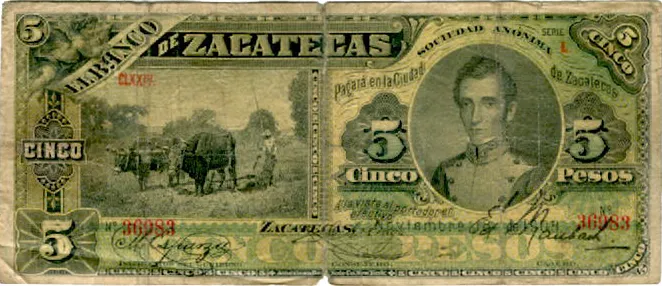
Engraved allegorical vignettes: a miner on the left, a female figure with goods in the center, and the profile portrait of a young man on the right
Reverse
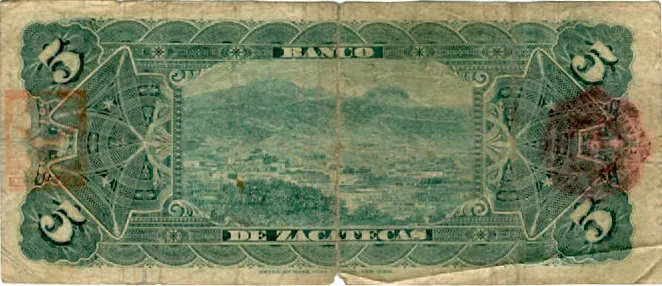
Scenes of mining and labor, or a monument set against the mountainous landscape of Zacatecas
About this banknote
If you inherited a Mexican 5 pesos note from the Banco de Zacatecas dated 1908, here is the honest answer: it is a collectible, not a modern currency note, and its value depends almost entirely on condition and rarity. A well-worn common example may fetch a few dollars, while a crisp, uncirculated survivor of a scarce issuer can bring several hundred dollars in the notaphily (paper-money collecting) market in 2026.
This is a private state bank note from Mexico's Porfiriato, the long rule of Porfirio Díaz. Before Mexico had a single central bank, individual states licensed private banks to print their own paper money, each backed by silver. Zacatecas, one of the great silver-mining regions of the Americas, had its own Banco de Zacatecas. That is why the vignettes on the note reference mining: the silver in the ground was literally the collateral. This system of multiple issuing banks ended when the Banco de México was founded in 1925, which makes these older private notes finite historical artifacts.
What the note looks like
- Issuer: Banco de Zacatecas (a licensed private issuing bank, not the federal government)
- Denomination: 5 pesos
- Era: Porfiriato, dated 1908
- Front (obverse): Engraved allegorical vignettes. A miner on the left, a female figure with goods at the center, and the profile portrait of a young man on the right.
- Back (reverse): Mining and labor scenes, or a monument set against the mountainous landscape of Zacatecas.
The engraving quality on these Porfiriato bank notes is high. Many were produced by major security printers of the period, so genuine examples show fine line work, subtle color, and paper with real texture.
What it's actually worth
This is historical paper money more than a century old, so any value is collector value, not spending value. Two things drive the price: condition and the rarity of the issuing bank.
Porfiriato private bank notes and the emergency notes of the Mexican Revolution form their own collecting field. Some issuers printed large runs that survive in quantity and stay cheap. Others are genuinely scarce, and many notes circulated so little (or were redeemed and destroyed) that intact, high-grade survivors are hard to find today. The Banco de Zacatecas is a recognized regional issuer with an active following among collectors of Mexican and Latin American paper money.
| Note | Date | Condition | Approx. value (USD) |
|---|---|---|---|
| 5 pesos, Banco de Zacatecas | 1908 | Heavily circulated, tears/repairs | 5 to 25 |
| 5 pesos, Banco de Zacatecas | 1908 | Circulated, complete, no repairs | 30 to 120 |
| 5 pesos, Banco de Zacatecas | 1908 | About uncirculated / uncirculated | 150 to 400+ |
These are working ranges for the general market. A rare signature combination, an unlisted variety, or a professionally graded high-grade example (PMG) can push well above the top figure. Do not trust the first price you see online. Confirm the issuer, condition, and any variety before you buy or sell.
What raises the value
- Condition above all. Paper money is graded on crispness and eye appeal. A note with no folds, no pinholes, and bright color can be worth many times a limp, soiled one.
- Professional grading. A note certified by PMG (Paper Money Guaranty) sells for more and removes doubt about authenticity, especially for buyers overseas.
- Scarce signatures or varieties. Private bank notes often exist with different signature pairs and print runs; some are far scarcer than others.
- Printing errors. Misaligned cuts, ink smears, or factory folds turn a common note into a curiosity worth a premium. Normal wear is not an error.
How to tell if yours is genuine
Genuine Porfiriato notes have real paper texture, sharp intaglio (raised) engraving you can sometimes feel, and layered ink color. Reproductions and reprints tend to have smooth, flat paper and solid, printed-looking color with no depth. Compare your note's design, portraits, and signatures against reference images of documented Banco de Zacatecas issues. Watch for modern souvenir reprints and photocopies, which are common for attractive historical notes. If anything looks off, post clear photos of both sides in the Pesoteca forum for a second opinion before you pay.
Where to sell it
To sell an 1908 Banco de Zacatecas 5 pesos note safely:
- Use a verified numismatic dealer from the Pesoteca directory, who can appraise it in person.
- List it in the Pesoteca buy-and-sell forum, where collectors who actually want these notes will see it.
- For a valuable or high-grade example, consider PMG certification first; graded notes reach a wider international audience and sell for more.
Photograph both sides in good, even light before offering it. Avoid dumping it to the first buyer on a general marketplace, where these historical notes are routinely undervalued.
Think you have a scarce variety or a printing error on your Banco de Zacatecas note? Post both sides in the Pesoteca forum and let collectors who specialize in Porfiriato paper money weigh in.
Historical context
The Banco de Zacatecas was among the best-rooted banks of issue in the north-central part of the country. Granted a concession in 1891, it printed notes of 1, 5, 10, 20, 50, 100, and 500 pesos between that date and 1914, always under the seal of the American Bank Note Company of New York. Its strength rested on Zacatecas's mining economy, one of Mexico's great silver districts.
This 5-peso note of 1908 falls in the last quiet years before the revolutionary outbreak. The 5-peso denomination was among the most manageable for regional commerce. Its obverse repeats the bank's iconographic program: a miner on the left, a female allegory of commerce in the center, and the portrait of a young man in profile on the right, with mining and mountain motifs on the reverse. These vignettes were not mere ornament: they projected the bank's solvency by linking it to the activity that sustained the region. That entire system of state issuance would disappear when currency was centralized in the Banco de México in 1925.
Frequently asked questions
How much is the 1908 5 pesos Banco de Zacatecas note worth?
It is a collector item, not spendable currency, so value depends on condition and rarity. A heavily circulated example runs roughly 5 to 25 USD, a clean complete note 30 to 120 USD, and a crisp uncirculated survivor 150 to 400 USD or more. A rare variety or a PMG-graded high-grade note can exceed that.
Is the Banco de Zacatecas 5 pesos note rare?
It is a genuine scarcity in high grade. This is a private state bank note from the Porfiriato, printed before the Banco de México existed. Many were redeemed and destroyed after 1925, so intact, well-preserved examples are hard to find. Common issuers stay cheap; scarcer signatures and varieties command real premiums.
Where can I sell my 1908 5 pesos note?
The safest options are a verified dealer from the [Pesoteca directory](/tiendas), who can appraise it on the spot, or the [Pesoteca buy-and-sell forum](/foro/compra-venta) among collectors. For a high-grade example, consider PMG certification first to reach international buyers. Photograph both sides in good light and never sell to the first bidder on a general marketplace.
How can I tell if my Banco de Zacatecas note is genuine?
Genuine notes have textured paper, sharp intaglio engraving you can sometimes feel, and layered ink color. Reproductions look flat, with smooth paper and solid printed color. Compare the portraits, vignettes, and signatures against documented Banco de Zacatecas images, and watch for modern souvenir reprints. If in doubt, post clear photos of both sides in the [Pesoteca forum](/foro).
Características Banxico
CLXXI.
Familia PRIV
This banknote belongs to the BIL-PRIV family within the Sistema PSM . Explore all the banknotes that share origin, era and design with this piece.
Ver todos los billetes de la familia PRIV →