
5 Pesos Banco de Zacatecas (1900): Value & Collector Guide
Familia PRIV · algodón
Period: Bancos privados de emisión
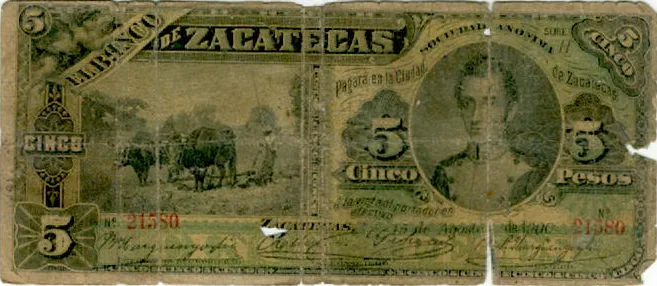
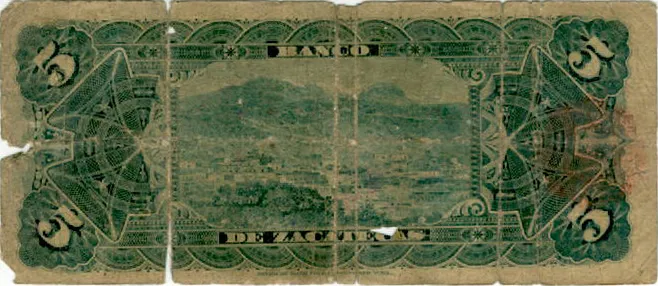
Design
Banxico
Obverse
Banco de Zacatecas
Engraved allegorical vignettes: a miner on the left, a female figure with goods in the center, and the profile portrait of a young man on the right
Reverse
Scenes of mining and labor, or a monument set against the mountainous landscape of Zacatecas
About this banknote
Most old Mexican banknotes from the Porfiriato era are worth from a few dollars to a couple hundred, depending on condition and how many survived. The 5 pesos note from the Banco de Zacatecas (1900) is a private-bank issue with a genuine collector market, but it is not a lottery ticket. Here is what actually drives its price in USD, and how to check what yours is worth.
What this note actually is
Before Mexico had a single central bank, individual states ran private banks licensed to print their own paper money, each note backed by silver. Zacatecas, one of the great silver-mining regions of Mexico, had its own: the Banco de Zacatecas. That mining wealth was the collateral behind the paper, which is why the note's engravings show mining scenes. This system of multiple issuing banks ended when the Banco de México was founded in 1925, so anything from the Banco de Zacatecas predates the modern peso entirely.
The front (anverso) carries allegorical vignettes: a miner on the left, a female figure with goods at center, and the profile portrait of a young man on the right. The back (reverso) shows mining and labor scenes, or a monument set against the mountainous Zacatecas landscape. These are large, ornate, engraved notes typical of turn-of-the-century private banking, printed by security firms of the period.
How much is it worth in 2026
This is historical paper money, over a century old, so its value is purely collector value. There is no face value to fall back on, since the peso it was denominated in no longer circulates. Two things drive the price: condition and rarity of the specific bank and denomination.
As a general guide for genuine, collectible examples:
| Condition | What it looks like | Typical range (USD) |
|---|---|---|
| Well-worn / damaged | Heavy folds, tears, stains, missing corners | 5 to 30 |
| Circulated (VF) | Folds and handling but intact and legible | 30 to 100 |
| About uncirculated / crisp | Bright, minimal handling, full margins | 100 to 300+ |
| Rare variety or exceptional grade | Scarce bank/signature, top grade, low serial | Several hundred and up |
Private-bank notes of the Porfiriato and the paper scrip of the Revolution have their own collecting market. Some issues are common; others are genuinely scarce because they circulated briefly or few complete examples survived. Condition is unforgiving with paper: a note that has been folded into quarters, taped, or trimmed can lose most of its value versus the same note kept flat and crisp.
Be skeptical of the first price you see online. Sellers pricing a beat-up example at hundreds of dollars are hoping you do not know the difference. Get a second opinion before you buy or sell.
Note specs
- Denomination: 5 pesos
- Issuer: Banco de Zacatecas (state private issuing bank)
- Era: circa 1900, Porfiriato
- Backing: silver
- Front: miner, allegorical female figure with goods, young man's profile portrait
- Back: mining and labor scenes / Zacatecas monument and landscape
How to tell if yours is genuine
Reproductions and modern reprints of these old notes exist. Check the paper and printing against official reference images:
- Paper: period notes use a textured, quality banknote paper. Reproductions often feel smooth or glossy.
- Engraving: genuine notes show fine engraved lines with real depth. Reprints look flat, with dot patterns visible under magnification.
- Color: originals have layered, subtle inks. Fakes tend to look flat and uniform.
- Signatures and serials: period notes were often hand-signed or carry engraved signatures and printed serial numbers. Compare placement and style with verified examples.
If you have any doubt, post clear photos of both sides in the Pesoteca forum so the community can weigh in before you commit money.
What raises the value
- Condition above all. Crisp, unfolded, full-margin notes command a large premium over worn ones.
- Low or fancy serial numbers. A low serial or a palindrome (radar) serial adds collector interest.
- Genuine printing errors. Misaligned cuts, ink smears, or factory folds can turn a common note into a scarce one. Normal wear and use damage is not an error.
- Scarce bank or signature variety. Some issuing banks and signature combinations are much harder to find than others.
Where to sell it
To sell a Banco de Zacatecas 5 pesos note, use channels where the buyer knows what they are looking at:
- A verified dealer from the Pesoteca shop directory, who can appraise it in person.
- The Pesoteca buy-and-sell forum, where collectors trade directly.
Photograph both sides in good, even light. Note any low or repeating serial and any error. Avoid dumping it to the first bidder on a general social media marketplace, where you are unlikely to reach an informed buyer.
Have a Banco de Zacatecas note or another Porfiriato private-bank issue you cannot identify? Post it in the Pesoteca forum and let collectors help you place it and price it.
Historical context
The Banco de Zacatecas received its concession on March 3, 1891, and was formally established in December of that year, with a capital of 600,000 pesos divided into six thousand shares. It was one of the state issuing banks that flourished during the Porfiriato, when each state could have an institution authorized to print backed notes with circulation limited to its territory.
This 5-peso note of 1900 belongs to the start of the new century, with the bank now consolidated and with branches in Aguascalientes and San Juan de los Lagos. Its iconography is typical of the house: a miner on the left, direct symbol of Zacatecas's silver-mining vocation, a female figure with merchandise at the center alluding to commerce, and the portrait of a young man in profile on the right. All the bank's notes were engraved and printed by the American Bank Note Company of New York, which explains the fineness of the vignettes. The right to issue would be extinguished with the birth of Banco de México in 1925.
Frequently asked questions
How much is the 1900 Banco de Zacatecas 5 pesos note worth?
As a collector item, genuine examples typically run from about 5 to 30 USD for worn notes, 30 to 100 USD for cleaner circulated ones, and 100 to 300 USD or more for crisp, uncirculated pieces. Rare varieties or top grades can bring several hundred dollars. Condition and rarity drive the price.
Is the Banco de Zacatecas 5 pesos note rare?
It depends on the specific issue. Some Porfiriato private-bank notes are common; others are genuinely scarce because they circulated briefly or few survived intact. A low or fancy serial number, a scarce signature variety, or a genuine printing error makes yours more sought after.
How can I tell if my note is genuine?
Check the paper and printing against official reference images. Period notes use textured banknote paper with fine engraved lines and layered inks. Reproductions usually feel smooth or glossy and show flat, uniform color. If in doubt, post clear photos of both sides in the Pesoteca forum for a second opinion.
Where can I sell an 1900 Banco de Zacatecas 5 pesos note?
The safest options are a verified dealer from the Pesoteca shop directory, who can appraise it on the spot, or the Pesoteca buy-and-sell forum where collectors trade directly. Photograph both sides in good light and note any low serial or printing error, which can raise the value.
Familia PRIV
This banknote belongs to the BIL-PRIV family within the Sistema PSM . Explore all the banknotes that share origin, era and design with this piece.
Ver todos los billetes de la familia PRIV →