
Mexico 2,000 Pesos Banknote (1983): Value Guide
Familia A · algodón
Period: México Contemporáneo
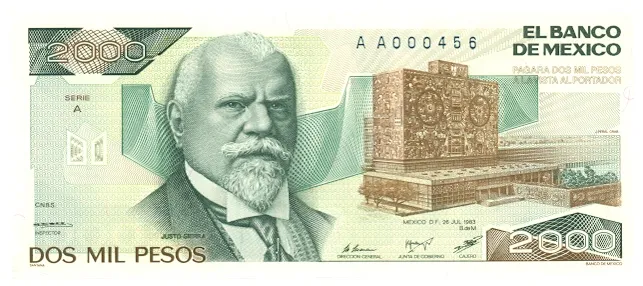
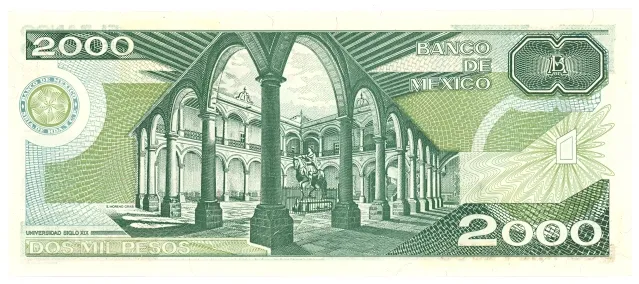
Design
Banxico
Obverse
Justo Sierra
Portrait of Justo Sierra and the Central Library building of the UNAM at University City
Reverse
The arcade of the courtyard of the old 19th-century University of Mexico, when the statue of Charles IV stood there
About this banknote
Most 1983 Mexican 2,000 pesos notes are worth a few dollars, not a fortune. This was a common circulating banknote, and the internet listings asking hundreds of dollars are usually optimistic. But an uncirculated example, a low or radar serial number, or a genuine printing error can push the value several times higher. Here is what actually drives the price, and how to check yours.
This note belongs to the Banco de México Family A series, the last generation of high-denomination peso notes before Mexico revalued its currency in 1993 (lopping three zeros off, so 2,000 old pesos became 2 new pesos). It is no longer legal tender and cannot be spent, so any value now is collector value.
What it's worth today
Because the note is demonetized, it carries no face value. Its worth is entirely driven by condition and rarity.
- Circulated (folds, soft corners, light soiling): typically a few US dollars. These are common.
- Uncirculated (crisp, no folds, sharp corners): more desirable, often several times the value of a worn note, but still modest for standard serials.
- Low serial numbers, radar/palindrome serials (reads the same both ways), or early prefixes: a premium on top of the grade.
- Genuine printing errors (miscuts, ink smears, misaligned or missing serials): the real prize. These turn a common note into something collectors chase, worth many times a normal example.
Do not confuse wear and damage with an error. A fold, a stain, or use damage is not a factory mistake and does not add value. Only genuine production flaws command a premium.
| Note | Series | Typical circulated value | Uncirculated / special |
|---|---|---|---|
| 2,000 pesos, 1983 | Family A | A few USD | Several times higher; more for errors or special serials |
What the note pictures
The front features Justo Sierra, the writer, historian, and politician who drove the 1910 refounding of Mexico's National University. Beside him is the Central Library of the UNAM in Ciudad Universitaria, the famous windowless block wrapped in the stone mosaic mural by Juan O'Gorman.
The back shows, per Banco de México's own description, the arcade of the courtyard of the 19th-century old University of Mexico, where the equestrian statue of Carlos IV (El Caballito) once stood. The note ties together the university across two eras.
The myth of the fortune
Search listings will show this note priced high, and that inflates expectations. The Family A series was printed in large quantities, and the 2,000 pesos denomination is not scarce. Unless yours is uncirculated, carries a special serial, or shows a true error, expect a modest figure. Honesty here saves you from overpaying and from being disappointed at sale.
How to tell if yours is genuine
Check the security features against official Banco de México imagery:
- Watermark: hold it to the light and look for the portrait or design showing through the paper.
- Security thread: an embedded strip visible when backlit.
- Intaglio relief: genuine notes have a tactile, raised feel to the printed portrait and text.
- Paper and color: authentic notes use crisp cotton-based paper with layered color. Reproductions tend to have smooth, flat paper and flat, printed-looking color.
Compare the design, signatures, and paper feel to reference images. If anything looks off, post clear photos in the Pesoteca forum for a second opinion.
Where to sell it
To sell for a fair price, your safest routes are a verified numismatic dealer from the Pesoteca shop directory, who can appraise it on the spot, or the Pesoteca buy-and-sell forum among collectors who know the series. Photograph both sides in good light, note the serial number, and flag anything unusual (low serial, radar, or a possible error) before you sell. Avoid dumping it on social media to the first buyer.
If you want context on what actually gets counterfeited in Mexico, see the most-forged Mexican banknotes.
Got one with an odd serial or in a sealed sleeve? Post it in the forum and let the community weigh in.
Historical context
The 1983 2,000-peso note pays tribute to Justo Sierra, writer, historian, and Minister of Public Instruction during the Porfiriato, remembered as the great champion of Mexican education and the founder of the National University in 1910, the forerunner of today's UNAM. His portrait is accompanied by the Central Library of UNAM in University City, with its famous murals by Juan O'Gorman.
The reverse looks to the nineteenth century: the arcade of the courtyard of the old University of Mexico, when the equestrian statue of Charles IV, a work by Manuel Tolsá, stood there.
This denomination was born amid full crisis. In 1983, after the devaluation and debacle of 1982, inflation ran wild and forced the Banco de México to introduce ever higher values. The 2,000-peso note inaugurates the series of large denominations that would characterize the last "old pesos" before the 1993 reform.
Frequently asked questions
How much is the 1983 Mexican 2,000 pesos note worth?
It is demonetized, so it has no spendable value. As a collector item, a worn note is worth a few US dollars. An uncirculated example, a note with a low or radar serial number, or one with a genuine printing error can be worth several times more. Condition and rarity decide the price.
Is the 1983 2,000 pesos note rare?
No. It belongs to Banco de México Family A, printed in large numbers, so standard examples are common. Only specific variants (uncirculated grade, special serial numbers, or authentic factory errors) are genuinely sought after and command a premium.
Where can I sell my 1983 2,000 pesos note?
The safest options are a verified numismatic dealer from the [Pesoteca shop directory](/tiendas), which values it in person, or the [Pesoteca buy-and-sell forum](/foro/compra-venta) among collectors. Photograph both sides in good light and note the serial number and any errors before selling, and avoid selling to the first random buyer on social media.
How can I tell if my 2,000 pesos note is genuine?
Check the security features: hold it to the light for the watermark and embedded security thread, feel for the raised intaglio printing, and inspect the paper and color. Genuine notes use crisp cotton paper with layered color; reproductions tend to feel smooth and look flat. Compare the design and signatures to official Banco de México images, and if unsure, post photos in the [Pesoteca forum](/foro).
Familia A
This banknote belongs to the BIL-A family within the Sistema PSM . Explore all the banknotes that share origin, era and design with this piece.
Ver todos los billetes de la familia A →