
Mexican 200 Pesos Sor Juana Note (Series F, 2007): Value Guide
Familia F · algodón
Period: México Contemporáneo
Design
Banxico
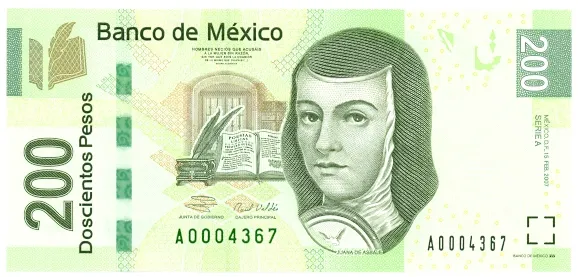
Obverse
Sor Juana Inés de la Cruz
Portrait of Sor Juana Inés de la Cruz, the Tenth Muse
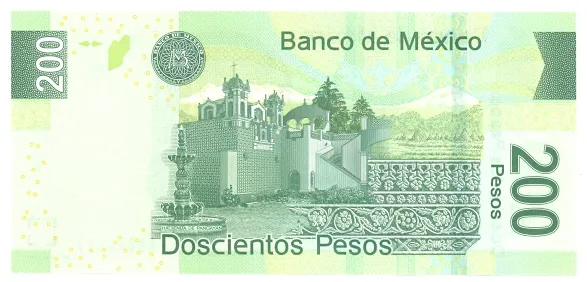
Reverse
The Panoayan hacienda and the Popocatépetl volcano
About this banknote
Most Mexican 200 pesos notes showing Sor Juana Inés de la Cruz are worth exactly their face value: about 10 to 12 US dollars at the exchange rate, whatever that happens to be in 2026. A crisp uncirculated copy, a low or radar (palindrome) serial number, or a genuine printing error is what turns a common note into something collectors actually pay a premium for. Here is how to tell which one you have.
What this note is
This is a 200 pesos banknote from the Banco de México, Series F ("familia F" in Spanish, meaning the note family issued from the mid-2000s). The front features Sor Juana Inés de la Cruz (1651-1695), a Mexican nun, poet and scholar known as the Tenth Muse. Beside her portrait sits a book, two quills in an inkwell, and library shelves in the background.
The back shows the Hacienda de Panoaya, near Amecameca, where Sor Juana lived between the ages of three and eight, along with the baptismal font of the Chimalhuacán church and the volcanoes Popocatépetl and Iztaccíhuatl in the distance. The dominant color is green. Many people keep this note simply because it looks good, not because it is rare.
What it is actually worth
Let's be direct. If the note still circulates, it is worth its 200 pesos face value, roughly 10 to 12 US dollars depending on the exchange rate. Age alone does not make a modern banknote valuable, and a 2007 note is not old by collecting standards.
The premium comes from three things:
- Condition. An uncirculated note (no folds, no stains, sharp corners, original crispness) is what collectors want. A worn, soft, folded note is worth face value and nothing more.
- Serial number. A low serial number (leading zeros, like 00000123), a radar / palindrome serial (reads the same forward and backward, like 1234321), a solid or repeater serial (7777777 or 123123), or a matched pair carries a premium.
- Printing errors. Genuine factory errors (misaligned cuts, ink smears, foldovers, missing print, off-center serials, mismatched serial numbers) turn a common note into a rarity that can sell for several times face value.
| Note | Type | Estimated value (USD) |
|---|---|---|
| 200 pesos Sor Juana, circulated | Worn, folded | Face value, about 10-12 |
| 200 pesos Sor Juana, uncirculated | Crisp, no folds | Small premium over face |
| 200 pesos Sor Juana, low/radar serial | Special serial | 2 to several times face |
| 200 pesos Sor Juana, genuine error | Misprint, misalignment | Several times face, sometimes more |
Demand for a denomination usually picks up once it starts being withdrawn from circulation, when collectors begin hunting for pristine, unused examples. Series F is being gradually replaced by newer note families, so keeping a genuinely uncirculated copy is not a bad idea.
The myth: "it's old, so it must be worth a lot"
A 2007 banknote is not rare and not old. Millions were printed. Normal wear and everyday damage are not "errors," and a bent corner or a coffee stain lowers the value, it does not raise it. Ignore listings that price a plain circulated copy at wild sums. The real drivers are condition, serial number, and factory errors, in that order.
How to check yours
Hold the note up to the light and look at the security features: the watermark built into the paper, the security thread, microprinting, and raised intaglio printing you can feel with your fingertips. A fake usually feels smooth and flat, with a watermark that is printed onto the surface instead of embedded in the paper.
Then inspect the serial number and the print quality. If you think you have a genuine error, a low serial, or a radar serial, photograph both sides in good light before you assume a value.
To get oriented, read why the 20 pesos note is being phased out and the most counterfeited banknotes in Mexico.
Where to sell it
World paper money (notaphily) is an active English-language collecting field, so there is a real market for special Mexican notes. Your safest options are a verified numismatic dealer from the Pesoteca directory, who can appraise it on the spot, or the Pesoteca buy-and-sell forum among collectors. For higher-grade or error notes, third-party graded (PMG) examples fetch the strongest and most trusted prices in the international market.
Got a Sor Juana note with an odd serial number or a possible printing error? Post clear photos of both sides in the forum and let the community weigh in before you sell.
Historical context
The obverse of this 200-peso note pays tribute to Sor Juana Inés de la Cruz, the Hieronymite nun born in San Miguel Nepantla around 1648 and considered the greatest poet of the New Spanish Baroque. Self-taught and of prodigious intelligence, she wrote poetry, theater, and prose, and in her Reply to Sor Filotea she defended women's right to knowledge, centuries ahead of her time.
The reverse shows the Hacienda de Panoaya, near Amecameca, State of Mexico, where the writer spent part of her childhood and had her first contact with books through her grandfather's library.
Within Family F, begun in 2006, this piece is one of the few that dedicate a higher denomination to a woman and to a figure of letters, recognizing the weight of culture and thought in Mexico's historical identity.
Frequently asked questions
How much is the Mexican 200 pesos Sor Juana note (2007) worth?
If it still circulates, it is worth its face value of 200 pesos, roughly 10 to 12 US dollars depending on the exchange rate. As a collector item, an uncirculated copy, one with a special serial number, or one with a genuine printing error can be worth several times more. Condition and rarity decide everything.
Is the 200 pesos Sor Juana note rare?
No. It is a modern Series F note from the Banco de México, printed in the millions, so a plain circulated copy is common and worth face value. What makes a specific example scarce is a low or radar (palindrome) serial number, an uncirculated grade, or a genuine factory error.
Where can I sell the 200 pesos Sor Juana note?
The safest routes are a verified dealer from the [Pesoteca directory](/tiendas), who can value it in person, or the [Pesoteca buy-and-sell forum](/foro/compra-venta) among collectors. Photograph both sides in good light and check for a low serial, a radar serial, or an error, since those raise the value. Avoid dumping it to the first bidder on social media.
How can I tell if my 200 pesos Sor Juana note is genuine?
Check the security features: the watermark embedded in the paper (visible against light), the security thread, microprinting, and raised intaglio printing you can feel. A counterfeit usually feels smooth and flat, with the watermark printed on the surface instead of built into the paper. If in doubt, ask in the [forum](/foro).
Familia F
This banknote belongs to the BIL-F family within the Sistema PSM . Explore all the banknotes that share origin, era and design with this piece.
Ver todos los billetes de la familia F →