
200 Pesos 1866 Mexican Banknote: Value & Rarity
Familia ANT · algodón
Period: Antecedentes del papel moneda
Design
Banxico
Obverse
Banco de México (1866)
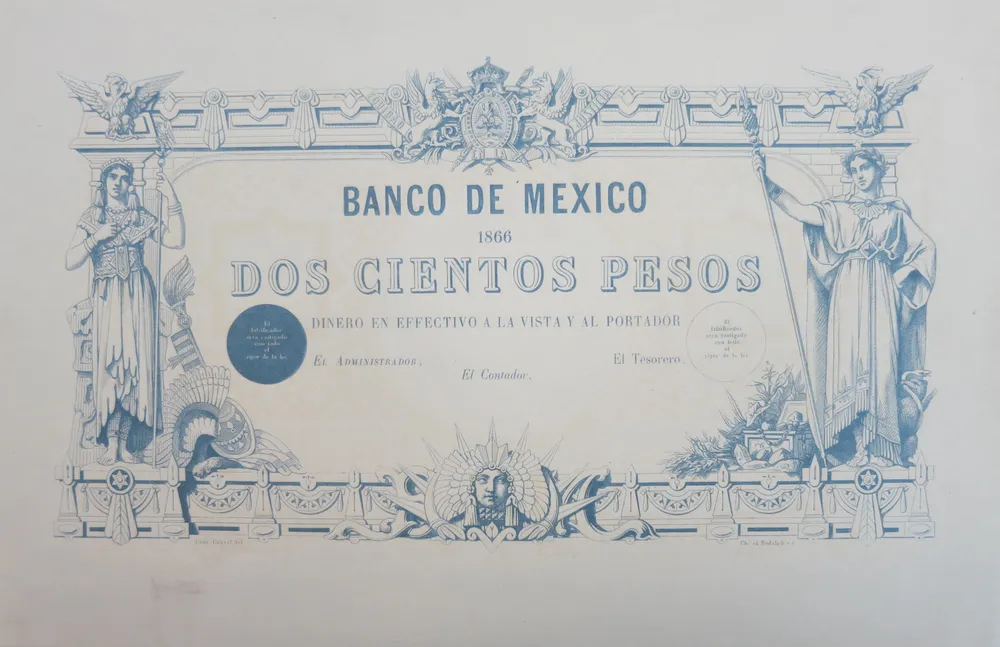
Seated female allegories and fine engraved ornaments in blue
Reverse
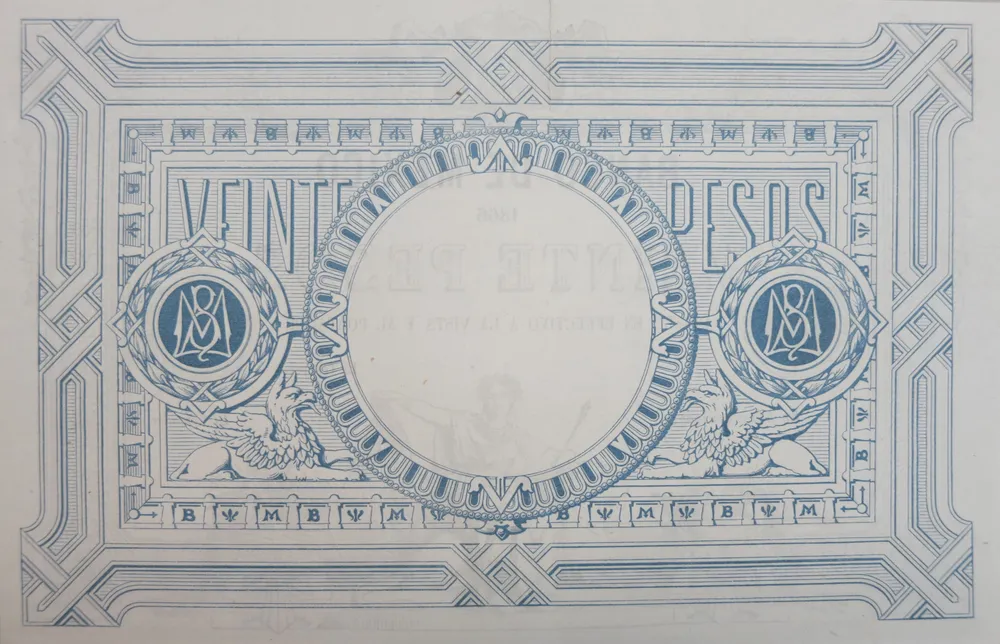
Unfinished ornamental design (bank proof), with the central oval empty
About this banknote
Most old paper money is worth a few dollars over face. The 1866 Mexican 200 pesos note is not that. This is a mid-19th-century rarity from Mexico's Second Empire, and the known examples are bank proofs or specimens, the kind of item that surfaces at major auctions and sells in the thousands, not the tens.
If you actually have one, stop and read this before you sell anything. Genuine examples are museum-tier, and there are far more reproductions and reprints floating around than real notes.
What it is
The 200 pesos note dated 1866 dates from the Segundo Imperio (Second Empire), the brief period when Maximilian ruled Mexico under French backing. It predates the modern Banco de México by decades, so this is imperial-era financial paper, not a 20th-century circulating note.
The known example is a single-sided bank proof. The front (anverso) shows seated female allegorical figures with fine engraved ornamentation in blue. The back (reverso) carries an unfinished ornamental design, the hallmark of a bank proof, with the central oval left blank where the finished vignette would sit.
What it's worth in 2026
This is not a note you value in hundreds of dollars off a price chart. It's a genuine rarity, and several of the known pieces are proofs or specimens rather than issued, circulated currency. That changes everything about how it's valued.
For a piece like this, price is driven by four things: whether it's an issued note or a proof/specimen, the state of preservation, the auction house handling the sale, and simple survivor count. Proofs and specimens from this era, when authenticated and slabbed by a service like PMG, routinely reach four figures in USD and can go well beyond that for standout examples. An unpublished or unique proof can command a strong premium over anything with multiple known survivors.
Because so few change hands, there is no clean "catalog price." The honest answer is a range that depends entirely on the specific piece: authenticated proofs and specimens from this period sell from roughly a thousand dollars into the several thousands, with exceptional or unique items reaching more. Treat any exact figure you see online with suspicion until a specialist has looked at your actual note.
| Note | Date | Type | Where it's valued | Realistic range (USD) |
|---|---|---|---|---|
| 200 pesos, Second Empire | 1866 | Bank proof / specimen | Heritage, Stack's Bowers, specialist world-paper auctions | Roughly 1,000 to several thousand, more if unique |
| Same design | 1866 | Reproduction / reprint | Not collectible currency | A few dollars as a novelty |
The reality check most people need first
Before you picture a windfall, be honest about what you have. Notes this old, this rare, and this valuable are copied constantly. If yours came from a general estate, a flea market, or a sheet of "antique money," the odds heavily favor a reproduction. Real proofs of this type have documented provenance and usually a grading service holder.
A reproduction is worth a few dollars as a decorative item. A genuine, authenticated 1866 proof is a different universe. The gap between the two is enormous, which is exactly why authentication matters more here than with almost any other Mexican note.
How to tell if yours is genuine
With a piece this early, don't rely on modern security features (there's no polymer window or holographic thread). Focus on the fundamentals:
- Paper. Genuine 19th-century bank proofs are printed on period stock, often with a distinct texture and weight. Reproductions tend to feel smooth, thin, or too white and modern.
- Engraving quality. Real intaglio engraving has crisp raised line detail you can sometimes feel. Printed copies show flat, screened color and blurred fine lines under magnification.
- Design and consistency. Compare the allegorical figures, ornament, and blank central oval against documented reference images of the issue. A proof will match a known plate.
- Provenance. Any note claiming this value should have a paper trail: prior auction record, dealer stock, or a grading service holder.
If anything is uncertain, get it in front of specialists before you spend money on it or trust an offer. Post clear, well-lit photos of both sides in the Pesoteca forum and let experienced collectors weigh in.
Where to sell it
A note in this class should not go to the first buyer on social media. Your two safest routes:
- A specialist auction house. For a genuine mid-1800s Mexican proof, world-paper-money houses such as Heritage and Stack's Bowers reach the international collectors who actually pay top numbers. They also handle authentication and grading.
- A verified dealer or the collector marketplace. A reputable numismatic dealer from the Pesoteca shop directory can appraise it in person, and the Pesoteca buy-and-sell forum connects you directly with collectors who know the series.
Whatever you do, get the note authenticated first. On a rarity like this, an unverified note is nearly impossible to sell for real money, and a slabbed, graded one can multiply your result.
Have an 1866 200 pesos note, or something else from the Second Empire you can't identify? Post both sides in the Pesoteca forum and we'll help you figure out whether it's a reproduction or the real thing before you sell.
Historical context
This 200 pesos of 1866 is part of the antecedents of Mexican paper money, within the issues bearing the name Banco de México tied to the Empire of Maximilian, an entity entirely unrelated to the Banco de México founded in 1925.
It is a bank proof, with the central oval of the reverse still empty, unfinished. The obverse presents seated female allegories and ornaments engraved with great finesse in blue ink, a sample of the refined work of the foreign printing houses of the nineteenth century.
High denominations like this were among the most ambitious of the imperial paper-money project. Its status as a proof, prior to any circulation, makes it a scarce and highly valued piece for understanding how the Mexican note was technically conceived in its origins.
Frequently asked questions
How much is the 1866 Mexican 200 pesos note worth?
It is not a common note valued in hundreds of dollars. The known examples are Second Empire bank proofs or specimens, and authenticated pieces from this era typically sell from roughly 1,000 dollars into the several thousands, with unique examples reaching more. A reproduction, by contrast, is worth only a few dollars. Authentication decides which category yours falls into.
Is the 1866 200 pesos note rare?
Yes. It is a mid-19th-century piece from Mexico's Second Empire, and the known examples are single-sided bank proofs with an unfinished ornamental back and a blank central oval. Very few genuine pieces exist, which is exactly why so many reproductions circulate. Genuine proofs are museum-tier.
How can I tell if my 1866 200 pesos note is genuine?
Check the paper (period stock feels distinct, not smooth and modern), the engraving (real intaglio has crisp raised lines, copies look flat and screened), and provenance (any real note should have an auction or dealer record). Compare the allegorical figures and blank oval to documented images. When in doubt, post clear photos of both sides in the Pesoteca forum before trusting any offer.
Where can I sell the 1866 200 pesos note?
Get it authenticated and graded first, then sell through a specialist world-paper auction house like Heritage or Stack's Bowers, a verified dealer from the Pesoteca shop directory, or the Pesoteca buy-and-sell forum. Avoid selling to the first social-media buyer, since an unverified rarity is hard to sell for its true value.
Características Banxico
Prueba del anverso. Unifaz. Cam. Chazal del./Ch. et Rodolphe. s.c.
Familia ANT
This banknote belongs to the BIL-ANT family within the Sistema PSM . Explore all the banknotes that share origin, era and design with this piece.
Ver todos los billetes de la familia ANT →