
200 Pesos Mexican Banknote (1866, Second Empire)
Familia ANT · algodón
Period: Antecedentes del papel moneda
Design
Banxico
Obverse
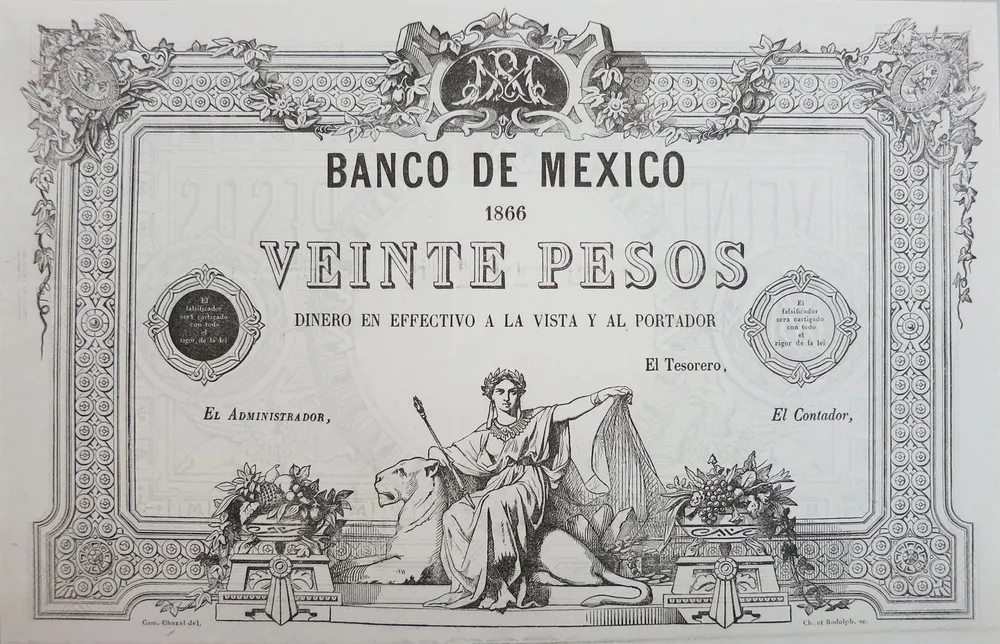
Banco de México (1866)
Seated female allegories and fine engraved ornaments in blue
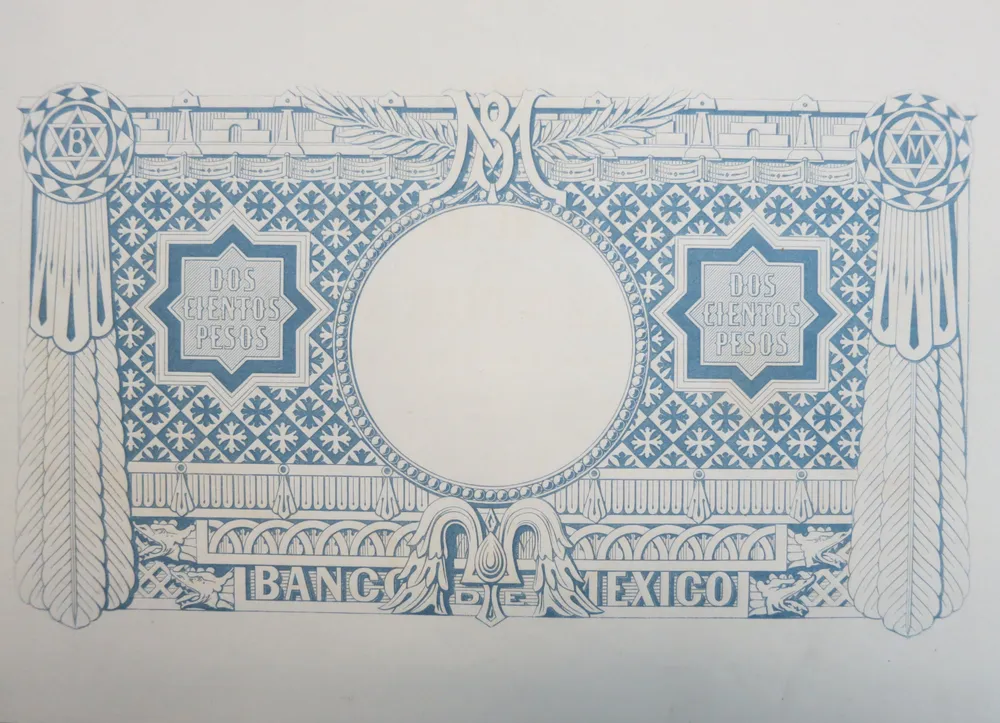
Reverse
Unfinished ornamental design (bank proof), with the central oval empty
About this banknote
Most old Mexican banknotes are worth a few dollars over face, if that. This one is different. The 200 pesos issued under the Banco de México in 1866, during the Second Mexican Empire, is a mid-19th-century rarity, and several of the surviving examples are bank proofs or specimens rather than circulated notes. If you actually have one, you are holding a museum-grade piece, not pocket change.
What this note is
This is a 200 pesos note from 1866, the era of Emperor Maximilian's short-lived Second Empire (Segundo Imperio in Spanish, the French-backed monarchy that ruled parts of Mexico from 1864 to 1867). The known examples are largely single-sided bank proofs, meaning they were printed to test and approve the design, never released into general circulation.
The face carries seated female allegorical figures with fine engraved ornamentation in blue. The reverse shows an unfinished ornamental design, typical of a bank proof, with the central oval left blank where the completed vignette would have gone.
Because this predates the modern Banco de México (founded 1925) and belongs to a failed 19th-century banking issue, it sits in a completely different category from the peso notes people usually inherit. Do not confuse it with the modern 200 peso bills still in your wallet.
What it's worth in 2026
This is not a note you price in the hundreds. A genuine 1866 Second Empire 200 pesos, especially a proof or specimen, is a serious rarity, and value depends on three things:
- Type: an issued, circulated note (if one exists) versus a bank proof or specimen. Proofs of famous rarities routinely bring four and five figures in USD at major sales.
- Condition (grade): proofs are often found in high grade because they never circulated, which pushes prices up.
- Provenance and the auction venue: where it sells matters. A specialized world-paper-money auction reaches the collectors who pay the real price.
We are not going to invent an exact figure for a piece this scarce, because each example is essentially unique in its own condition and history. What we can tell you plainly: this is a lot-by-lot, auction-house-appraisal item, and rushing it to a local buyer is how people leave thousands of dollars on the table. Rarities of this class from 19th-century Mexico have crossed the four-figure and five-figure USD line at specialist sales.
| Item | Year | Type | Where value is set |
|---|---|---|---|
| 200 pesos, Second Empire | 1866 | Bank proof / specimen | Specialist world paper money auction |
| Comparable 19th-c. Mexican proofs | 1860s | Proof | Heritage, Stack's Bowers world paper sales |
The ones people think are worth millions but aren't
Most inherited Mexican banknotes are common modern issues. A worn 20, 50 or 100 peso note from recent decades is worth its face value in pesos, no more. Age alone does not create value: a heavily circulated note from the 1970s can be worth almost nothing, while a pristine proof from the 1860s is a different world entirely. Rarity, survivors, condition and collector demand are what move the price, not the year printed on the paper.
This 1866 note is the rare exception, and only because it is a genuine 19th-century imperial-era proof. If what you have is a modern-looking 200 peso bill with a transparent polymer window, that is a current or recent circulating note, not this piece.
How to check what yours is worth
- Confirm what you actually have. A true 1866 Second Empire note is printed on period paper with fine engraved blue linework. Compare it against reference images. Modern bills, polymer notes and reproductions look and feel different.
- Assess condition honestly. Folds, tears, stains and repairs all cut value. Proofs are often crisp and high grade, which matters a lot.
- Get it authenticated. For a piece at this level, third-party grading and authentication (PMG for paper money) protects both you and any buyer.
- Sell through the right channel. Take clear, well-lit photos of both sides. A specialized world-paper-money auction house reaches the collectors who pay serious money. Do not dump a potential rarity on a general marketplace to the first bidder.
Security and authenticity checks for genuine notes include watermark, security thread, microprinting, tactile relief and, on modern polymer issues, the transparent window. A 19th-century piece like this is judged instead on paper, engraving quality, signatures and the plate details versus known references.
If you think you have an 1866 Second Empire 200 pesos, or any note you can't identify, post clear photos of both sides in the Pesoteca forum before you sell anything, or check our directory of verified numismatic shops. Not sure whether yours is a rarity or a common modern bill? Show it to the community first.
Historical context
Another bank proof of the 200-peso denomination, with the central oval of the reverse unfinished, belonging to the precursors of paper money in Mexico. It corresponds to the issues bearing the name Banco de México of Maximilian's Second Empire, which must not be confused with the current central institute, founded in 1925.
The obverse repeats the seated female allegories and the ornaments delicately engraved in blue ink, characteristic of nineteenth-century engraving by the European and American printing houses of the time.
These proofs, made before the formal issue, allow us to follow the note's creative process at a time when the printing of values was carried out outside Mexico. They document the still-experimental beginnings of paper money circulation in the country during one of its briefest and most singular political episodes.
Frequently asked questions
How much is the 1866 200 pesos Mexican banknote worth?
As a genuine Second Empire rarity, especially a bank proof or specimen, it is a four- to five-figure USD item at specialist auction, not a face-value bill. The exact price depends on type (issued vs proof), grade and the auction venue. Get it professionally appraised before selling.
Is the 1866 200 pesos note rare?
Yes. It dates to the short-lived Second Mexican Empire (1864-1867), and most surviving examples are single-sided bank proofs that never circulated. That places it in the museum-grade category, far above ordinary inherited peso notes.
Where can I sell a rare Mexican banknote like this?
Use a specialized world-paper-money auction house (such as Heritage or Stack's Bowers world sales) that reaches serious collectors, or a [verified numismatic shop from the Pesoteca directory](/tiendas). For guidance, post photos in the [Pesoteca forum](/foro) first. Avoid selling a potential rarity to the first bidder on a general marketplace.
How can I tell if my 1866 200 pesos note is genuine?
Check the paper and engraving. Period notes use fine blue engraved linework on 19th-century paper; a proof will often show an unfinished reverse with a blank central oval. Reproductions tend to have smooth paper and flat, printed color. For a piece this valuable, have it authenticated by a grading service like PMG before you buy or sell.
Características Banxico
Prueba del reverso. Unifaz.
Familia ANT
This banknote belongs to the BIL-ANT family within the Sistema PSM . Explore all the banknotes that share origin, era and design with this piece.
Ver todos los billetes de la familia ANT →