
Mexico 20 Pesos Note (1914): Value & How to Sell
Familia REV · cartón
Period: Revolución Mexicana
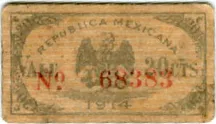
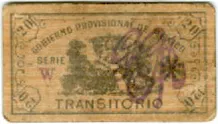
Design
Banxico
Obverse
Gobierno Provisional de México
The national eagle and the legend República Mexicana, on a small-denomination note
Reverse
The legend 'Provisional Government of Mexico - Transitional'
About this banknote
If you inherited a 1914 Mexican 20 pesos note, here is the honest answer first: most Revolution-era Mexican paper trades in the range of a few dollars to a few hundred USD, driven almost entirely by condition and which issuer printed it. A common, worn example is worth pocket change to a collector. A crisp, uncirculated survivor of a scarce issuer can reach several hundred dollars. "Worth thousands" is rare and only applies to specific varieties in top grade.
This note is not a modern Banco de México bill. It is a vale transitorio, a small-denomination emergency scrip issued during the Mexican Revolution. Banco de México did not exist until 1925, so anything dated 1914 comes from a provisional government, a state issuer, or a private bank of the era. That matters a lot for value, because some issuers are common and some are genuinely rare.
What it actually is
During the Revolution (roughly 1913-1917), small change vanished from daily commerce. To keep markets running, provisional and regional governments printed low-denomination emergency scrip that passed hand to hand. Many were printed on cardboard or cheap paper and wore out fast, which is why high-grade survivors are scarce today.
The design on this type typically shows the national eagle and the legend República Mexicana on the front. The back carries the legend Gobierno Provisional de México - Transitorio ("Provisional Government of Mexico - Transitional"). These are catalogued in the Pick World Paper Money references under Mexican revolutionary and provisional issues.
How much is it worth in 2026
There is no single price, because "1914 20 pesos" covers many different issuers and printings. What we see in the world paper money market breaks down like this:
| Condition / type | Typical value (USD) |
|---|---|
| Common issuer, circulated (folds, wear) | 3 to 15 |
| Common issuer, crisp uncirculated | 20 to 60 |
| Scarce issuer, circulated | 40 to 150 |
| Scarce issuer, uncirculated | 150 to 500+ |
| Genuine printing error or notable variety | Several times the base figure |
These are ranges for genuine notes in the world market. The single biggest factor is condition. A note with no folds, sharp corners, and full color can be worth ten times the same note that has been carried in a wallet. The second factor is the issuer: revolutionary scrip from a well-documented, high-survival issuer is common; scrip from a short-lived local government that barely circulated is where the money is.
Be realistic. Age alone does not make paper valuable. A century-old note that millions of people once held is still a common note if millions survived.
What makes yours worth more
Check three things before you assume it is common:
- Grade. Uncirculated (no folds, no soft corners, no soiling) is the top tier. Even light circulation drops value fast on paper money.
- Serial number. Very low serials and radar/palindrome serials (like 12321) draw extra collector demand.
- Printing errors. Genuine factory errors, misaligned cuts, ink smears, mismatched or shifted serials, add a real premium. Normal wear and handling damage is not an error and does not add value.
If you think you have a genuine error, get a second opinion before selling. It is easy to mistake ordinary damage for a variety.
How to tell if it is genuine
Revolution-era notes are simpler than modern currency, so authentication is about matching the real thing rather than checking a security thread. Compare paper, design, ink, and signatures against catalogued images. Reproductions and "museum copies" usually give themselves away with:
- Paper that is too smooth, too white, or too modern in feel.
- Flat, printed colors with no variation in ink density.
- Fuzzy design details from being scanned and reprinted.
- Perfectly clean edges on a note that should show age.
Genuine period paper has texture, aged tone, and printing depth you can often feel. If you are unsure, professional grading services (PMG grades and encapsulates world paper money) can authenticate and assign a grade, which also makes the note easier to sell.
Where to sell it
The world paper money (notaphily) market is active in English, so you have real options:
- Specialist auction houses (Heritage Auctions and Stack's Bowers both run world paper money sales) for scarce or high-grade notes.
- PMG-graded sales on collector marketplaces, where a certified grade removes buyer doubt.
- The Pesoteca buy/sell forum, where collectors of Mexican paper can value it and trade directly.
Before you sell anything, photograph both sides in good light, note the issuer and any serial number features, and get at least one opinion from someone who knows Mexican revolutionary paper. Avoid dumping it on a general marketplace to the first offer, which is where undervalued notes get lost.
Got a 1914 note and not sure which issuer printed it? Post clear photos of the front and back in the Pesoteca forum and let collectors who specialize in Revolution-era paper tell you what you actually have.
Historical context
This 20-peso scrip of the Provisional Government of Mexico, dated 1914, belongs to the flood of improvised paper money generated by the Mexican Revolution. The very word 'Transitorio' (Transitory) that appears on its reverse says it all: it was money meant for an emergency, not to endure.
During those years there was no single national currency. With the fall of Victoriano Huerta's government and the country fragmented among factions, various provisional authorities issued notes and scrip to cover urgent expenses. On the obverse appears the national eagle and the legend República Mexicana, an attempt to give the rank of legitimate money to paper that, in reality, depended entirely on people accepting it.
These provisional issues coexisted with the Treasury obligations, the Constitutionalist notes, and the issues of other factions, in a monetary ecosystem as varied as it was unstable. That is why they are such interesting pieces for the collector today: each scrip is physical evidence of a state improvising its economy while the course of the Revolution was still being decided.
Frequently asked questions
How much is the 1914 Mexican 20 pesos note worth?
It depends heavily on condition and issuer. A common, circulated example is worth roughly 3 to 15 USD. A crisp uncirculated note from a scarce issuer can reach several hundred dollars, and genuine printing errors or standout serial numbers push higher. Age alone does not make it valuable; grade and rarity do.
Is the 1914 20 pesos note rare?
Some issuers are common, others are genuinely scarce. These were emergency Revolution-era scrip, often printed on cheap paper or cardboard, so many wore out fast. That makes high-grade survivors of the scarcer issuers hard to find, which is where most of the value sits.
Where can I sell a 1914 Mexican 20 pesos note?
For a scarce or high-grade note, specialist auction houses like Heritage Auctions or Stack's Bowers handle world paper money. A PMG-certified grade makes it easier to sell on collector marketplaces. You can also value and trade it directly in the [Pesoteca buy/sell forum](/foro/compra-venta). Photograph both sides in good light and get an opinion before accepting any offer.
How can I tell if my 1914 note is genuine?
Compare the paper, design, ink, and signatures against catalogued images. Reproductions usually have paper that feels too smooth or too white, flat printed colors, and fuzzy details. Genuine period paper has texture, aged tone, and printing depth. For certainty, a grading service like PMG can authenticate it, or post photos in the [Pesoteca forum](/foro) for a second opinion.
Familia REV
This banknote belongs to the BIL-REV family within the Sistema PSM . Explore all the banknotes that share origin, era and design with this piece.
Ver todos los billetes de la familia REV →