
20 Pesos 1911 Banco Yucateco Banknote: Value & Guide
Familia PRIV · algodón
Period: Bancos privados de emisión
Design
Banxico
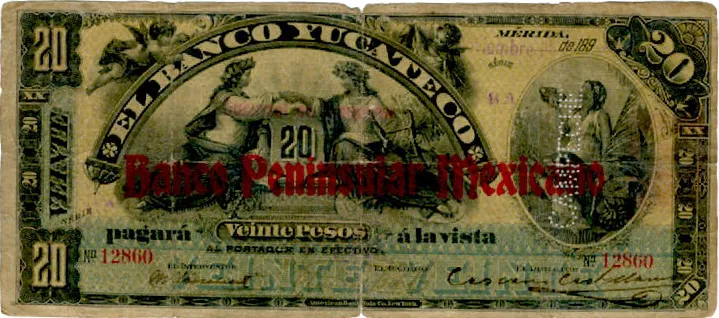
Obverse
Banco Yucateco
Seated female allegories making a toast and the figure of a young man, with a locomotive vignette
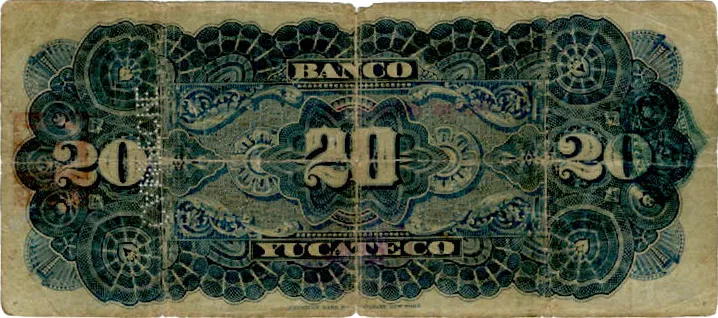
Reverse
Engraved ornamental design with the denomination and the name of the bank
About this banknote
Most private-bank notes from Mexico's Porfiriato era are worth a few dollars to a few hundred, not a fortune. The 20 pesos Banco Yucateco note (1911) is genuine collectible paper money over a century old, and its value in 2026 depends almost entirely on condition and which variety you have. A worn common example might bring 10 to 30 USD; a crisp uncirculated note or a scarce overprint variety can reach several hundred.
If you inherited or found one of these, here is what it actually is, what drives the price, and how to sell it without getting shortchanged.
What this note is
This is a 20 pesos banknote issued by the Banco Yucateco of Mérida, from the era when individual Mexican states ran their own note-issuing banks under President Porfirio Díaz (the "Porfiriato," roughly 1876 to 1911). It is not a Banco de México note. Mexico's central bank did not exist until 1925, so before then private and regional banks printed their own currency.
The Banco Yucateco operated during the henequen boom, when the Yucatán Peninsula grew rich on sisal fiber ("green gold") exported through its ports. That prosperity is stamped right into the design.
- Front (obverse): seated female allegorical figures raising a toast, a young male figure, and a vignette of a steam locomotive. The train was no accident: it symbolized the railway progress that carried henequen to the coast.
- Back (reverse): ornamental engraved design with the denomination and the bank's name.
Many surviving examples carry a red overprint reading "Banco Peninsular Mexicano." That overprint dates from the 1908 merger of the Banco Yucateco with the Banco Mercantil de Yucatán. Whether your note has that overprint matters for identification and, sometimes, for value.
What it's worth in 2026
This is historical paper money, so it has no face value in circulation. Its worth is purely collectible (notaphily, the collecting of paper money), and it comes down to three things: condition, variety, and how many survived.
| Condition | Description | Typical value (USD) |
|---|---|---|
| Well-worn / damaged | Heavy folds, tears, stains, missing corners | 5 to 20 |
| Circulated (VF) | Handled but intact, moderate folds | 20 to 75 |
| About uncirculated / crisp | Minimal handling, bright color, sharp corners | 75 to 300+ |
| Rare variety or specimen | Scarce overprint, low serial, proof/specimen | Several hundred and up |
These are guide ranges, not guarantees. Private-bank notes from the Porfiriato and the paper scrip of the Mexican Revolution have their own active market: some issues are common, others are extremely scarce because they circulated so little or so few survived intact. A note that looks identical to yours can sell for very different amounts depending on grade and the exact signatures and series.
Be honest about condition. Collectors pay for eye appeal. A note with a large tear or heavy staining drops sharply in value no matter how old it is.
What raises the value
- Uncirculated condition. A crisp, unfolded note with full original color and sharp corners can be worth many times a worn one.
- The overprint variety. Notes with (or without) the red "Banco Peninsular Mexicano" overprint can differ in scarcity. Identify which you have before pricing it.
- Low or fancy serial numbers. A very low serial number, or a palindrome ("radar") serial that reads the same forwards and backwards, adds a premium.
- Printing errors. Genuine factory errors (misaligned cuts, ink smears, off-center printing, duplicated serials) turn a common note into a rarity. Ordinary wear and handling damage is not an error.
- Specimen or proof examples. Notes marked as specimens, or unissued proofs, are sought after and priced well above issued notes.
The myth to avoid
"It's over 100 years old, so it must be worth a fortune." Age alone does not make paper money valuable. Millions of notes were printed, and survival plus demand set the price. A worn 1911 Banco Yucateco note is a nice piece of Yucatán history and a modest collectible, not a retirement fund. The ones that command real money are the high-grade survivors and the scarce varieties.
How to tell if yours is genuine
Reproductions and modern reprints of Porfiriato-era notes do exist. Check these:
- Paper and printing. Original notes were printed on quality banknote paper with engraved (intaglio) detail you can sometimes feel. Reproductions tend to have smooth, flat paper and dull, flat colors.
- Design detail. Compare the vignettes, lettering, and signatures against verified images of the same issue. Sharp, fine engraving lines are a good sign; blurry or dotted (photocopied) lines are a red flag.
- The overprint. If present, the red "Banco Peninsular Mexicano" overprint should look like genuine period ink, not a laser-printed layer sitting on top of the surface.
- Serial numbers. Original notes have typeset or hand-applied serials consistent with the issue.
If you are unsure, post clear photos of both sides in the Pesoteca forum and let experienced collectors weigh in before you buy or sell.
Where to sell it
To sell a 1911 Banco Yucateco 20 pesos note without leaving money on the table:
- Photograph both sides in good, even light, sharp and in focus, showing the corners and any overprint.
- Note the condition, serial number, and variety (with or without the red overprint).
- Get it in front of collectors, not a first-come buyer. A verified numismatic dealer from the Pesoteca directory can value it in person, or you can list it in the Pesoteca buy-and-sell forum among collectors who know the market.
Avoid dumping it to the first bidder on general marketplaces or social media. Mexican private-bank notes are specialized, and buyers who understand the series will pay more than a casual reseller who lowballs anything old. For higher-value examples, third-party grading (PMG) can confirm authenticity and grade, which widens your buyer pool internationally.
Have a 1911 Banco Yucateco note and not sure which variety you're holding? Post the serial and both faces in the Pesoteca forum and the community can help you pin down the exact issue and a fair price.
Historical context
This 20-peso note of 1911 belongs to the final stages of circulation of the Banco Yucateco design, already on the eve of the Mexican Revolution shaking the country's banking system. By then, the Yucatecan issuing stock operated under the umbrella of the Banco Peninsular Mexicano, born of the 1905 merger.
The piece preserves the iconography of the original house: female allegories toasting, the figure of a young man, and the locomotive vignette, a reminder of the railway that made possible the henequen boom on the peninsula. The reverse kept its engraved ornamentation.
Engraved by the American Bank Note Company, this 20-peso note circulated in a Yucatán that still lived off the fiber, but whose financial system would soon fall, like the rest of the country, under the shadow of the civil war and, later, under the issuing monopoly of the Banco de México in 1925.
Frequently asked questions
How much is the 1911 Banco Yucateco 20 pesos note worth?
As collectible paper money, a worn example typically sells for about 5 to 20 USD, a clean circulated note for 20 to 75 USD, and a crisp uncirculated note or scarce variety for several hundred USD or more. It has no circulating face value. Condition and rarity drive the price.
Is the 1911 Banco Yucateco 20 pesos note rare?
It depends on the variety and condition. Worn examples turn up regularly and are common, but high-grade uncirculated notes and certain overprint or specimen varieties are genuinely scarce. Notes carrying the red 'Banco Peninsular Mexicano' overprint from the 1908 merger are a distinct variety worth identifying before pricing.
Where can I sell a 1911 Banco Yucateco 20 pesos note?
The safest options are a verified dealer from the [Pesoteca directory](/tiendas), who can value it in person, or the [Pesoteca buy-and-sell forum](/foro/compra-venta) among collectors. Photograph both sides in good light and note the serial number and overprint. For valuable examples, PMG grading confirms authenticity and reaches international buyers. Avoid selling to the first bidder on social media.
How do I tell if my 1911 Banco Yucateco note is genuine?
Check the paper (originals used quality banknote paper with engraved detail; reproductions feel smooth and flat), compare the vignettes, signatures, and fine engraving lines against verified images, and inspect the red overprint if present. Blurry or dotted lines and flat colors suggest a reprint. When in doubt, post clear photos in the [Pesoteca forum](/foro).
Características Banxico
BANCO PENINSULAR MEXICANO Firma y fecha autógrafa.
Familia PRIV
This banknote belongs to the BIL-PRIV family within the Sistema PSM . Explore all the banknotes that share origin, era and design with this piece.
Ver todos los billetes de la familia PRIV →