
20 Pesos Banco Yucateco (1891): Value & Where to Sell
Familia PRIV · algodón
Period: Bancos privados de emisión
Design
Banxico
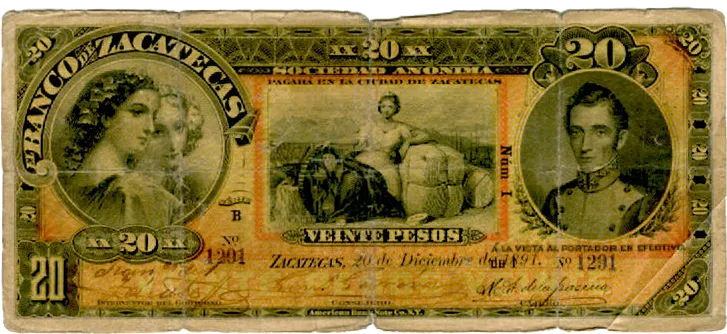
Obverse
Banco Yucateco
Seated female allegories making a toast and the figure of a young man, with a locomotive vignette
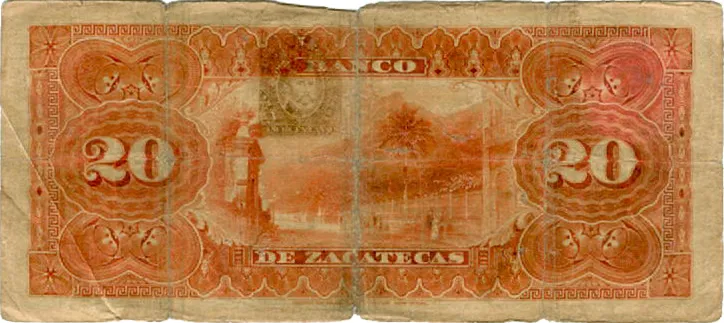
Reverse
Engraved ornamental design with the denomination and the name of the bank
About this banknote
Most people who inherit an old Mexican banknote hope it's worth thousands. The truth on the 1891 Banco Yucateco 20 pesos note: value runs from roughly 30 USD for a worn, common example to several hundred USD for a crisp, well-preserved one, with the scarcest varieties climbing higher. What drives the price is condition and rarity of the issuing bank, not just age.
This is a private-bank note from the Porfiriato era, when individual Mexican banks printed their own money. The Banco Yucateco operated out of Mérida during the henequen boom, when the fiber trade (called "green gold") made Yucatán one of the wealthiest regions in Mexico. Understanding what you have is the first step to knowing what it's worth.
What it is
The Banco Yucateco was a state issuing bank, meaning it was legally allowed to print circulating banknotes backed by its own reserves. This system existed before the Banco de México became Mexico's single note-issuing authority in 1925. Dozens of regional banks printed their own money, and collectors today value them by how many examples survived.
The design: The face (anverso) shows seated female allegorical figures raising a toast, a young male figure, and a vignette of a locomotive. That train isn't decorative. It represented the railway progress that hauled henequen fiber to port for export. The back (reverso) carries an engraved ornamental design with the denomination and the bank's name.
The red overprint that matters
Many surviving Banco Yucateco notes carry a red overprint reading "Banco Peninsular Mexicano." This came from the 1908 merger of the Banco Yucateco with the Banco Mercantil de Yucatán. If your note has this red overprint, you have a specific variety, and collectors track overprinted versus non-overprinted notes separately. Note which one you have when you go to sell, because it can change the price.
What it's worth today
This is historical paper money, over a century old, so its value is purely collectible. There is no face value to fall back on, since these notes were demonetized long ago. Value depends heavily on:
- Condition. A crisp note with no folds, tears, or stains is worth many times a soft, heavily circulated one.
- Rarity of the issuing bank. Some Porfiriato private-bank notes are common; others are genuinely scarce because so few survived.
- Variety. Overprinted, non-overprinted, and any printing anomalies each have their own market.
| Note | Year | Condition | Approx. value (USD) |
|---|---|---|---|
| Banco Yucateco 20 pesos | 1891 | Heavily circulated | 30 to 60 |
| Banco Yucateco 20 pesos | 1891 | Nice mid-grade | 80 to 200 |
| Banco Yucateco 20 pesos | 1891 | Crisp / uncirculated | 250 to 600+ |
These are collector-market ranges. A note graded by a service like PMG will always sell more confidently than an ungraded one, because buyers know exactly what they're paying for. Scarce varieties or exceptional preservation can push above these figures at specialized auction.
The myth to kill
"It's from 1891, so it must be worth a fortune." Age alone means little in notaphily (paper-money collecting). What matters is how many survived and in what shape. Many private-bank notes circulated so briefly, or were redeemed and destroyed, that finding a complete, intact example is the real challenge. But plenty of others exist in quantity, and those stay modestly priced no matter how old they are.
How to tell if yours is genuine
Reproductions and later reprints of Porfiriato bank notes do exist. Check these:
- Paper. Genuine notes are on period rag paper with texture and often some tone. Reproductions tend to feel smooth and flat.
- Engraving. Original notes were engraved, so lines have depth and crispness. Photocopies and modern prints look soft or dotted under magnification.
- Color. Flat, uniform color is a red flag. Original inks show subtle variation.
- Signatures and details. Compare against verified images of the same note before you buy or sell.
When in doubt, post clear photos of both sides in the Pesoteca forum and let collectors weigh in.
Where to sell
World paper money is an active English-language collecting market, so you have real options:
- A verified numismatic dealer from the Pesoteca directory can appraise it in person, no markup surprises.
- The Pesoteca buy-and-sell forum connects you directly with collectors.
- For a scarce, high-grade example, a specialized world-paper-money auction (Heritage and Stack's Bowers both run them) reaches the most serious buyers.
Before you sell anything: photograph both sides in good light, note whether it has the red Banco Peninsular overprint, and get an honest read on condition. Don't dump it to the first Facebook offer.
Have a Banco Yucateco note, or another Porfiriato private-bank issue you can't identify? Post it in the Pesoteca forum and we'll help you pin down the bank, the variety, and a realistic price.
Historical context
From its opening in Mérida in 1890, the Banco Yucateco issued notes of various denominations to serve the thriving henequen economy. This 20-peso example from 1891 belongs to its earliest series, when the institution backed by Olegario Molina was only beginning to spread its paper money across the peninsula.
The obverse shows the house's iconographic program: female allegories toasting, the figure of a young man, and a locomotive vignette, a nod to the railway that organized the export of the fiber toward the port of Progreso. The reverse featured the usual engraved ornamental design.
Printed by the American Bank Note Company of New York, this 20-peso note was a denomination of intermediate-to-high value, suited to commercial operations of some weight in a Mérida enriched by "green gold."
Frequently asked questions
How much is the 1891 Banco Yucateco 20 pesos note worth?
As a collectible, a heavily circulated example runs roughly 30 to 60 USD, a nice mid-grade note 80 to 200 USD, and a crisp uncirculated one 250 to 600 USD or more. It has no face value today, since these notes were demonetized long ago. Condition and the rarity of the issuing bank drive the price.
Is the Banco Yucateco 20 pesos note rare?
It depends on the variety and condition. Some Porfiriato private-bank notes survive in quantity and stay affordable; others are genuinely scarce. Notes carrying the red 'Banco Peninsular Mexicano' overprint from the 1908 merger form their own category. A crisp, intact example is much harder to find than a worn one, and that scarcity is what commands the higher prices.
Where can I sell my 1891 Banco Yucateco banknote?
Your safest options are a [verified dealer from the Pesoteca directory](/tiendas), who can appraise it on the spot, or the [Pesoteca buy-and-sell forum](/foro/compra-venta) among collectors. For a scarce, high-grade note, a specialized world-paper-money auction (Heritage or Stack's Bowers) reaches the most serious buyers. Photograph both sides and note any overprint before selling.
How can I tell if the note is genuine?
Check the paper (period rag paper has texture and tone; reproductions feel smooth and flat), the engraving (original lines have depth and crispness, while reprints look soft or dotted under magnification), and the color (flat, uniform ink is a warning sign). Compare the signatures and design against verified images. When unsure, post clear photos in the [Pesoteca forum](/foro).
Características Banxico
BANCO PENINSULAR MEXICANO Firma y fecha autógrafa.
Familia PRIV
This banknote belongs to the BIL-PRIV family within the Sistema PSM . Explore all the banknotes that share origin, era and design with this piece.
Ver todos los billetes de la familia PRIV →