
20 Pesos Banknote (1914), Banco de Zacatecas
Familia PRIV · algodón
Period: Bancos privados de emisión
Design
Banxico
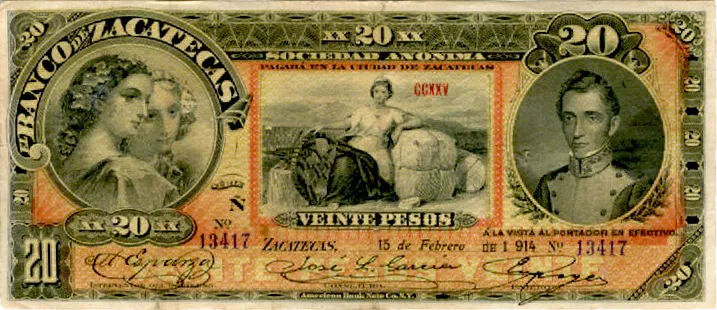
Obverse
Banco de Zacatecas
Engraved allegorical vignettes: a miner on the left, a female figure with goods in the center, and the profile portrait of a young man on the right
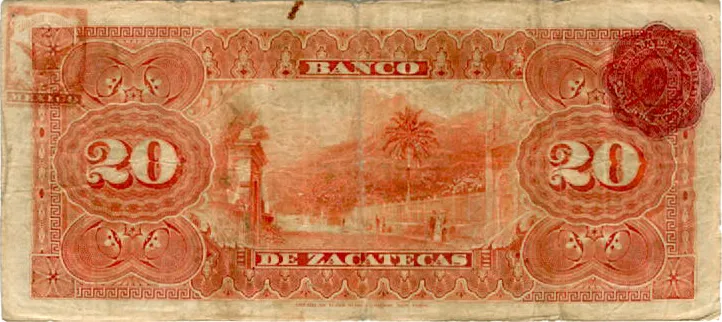
Reverse
Scenes of mining and labor, or a monument set against the mountainous landscape of Zacatecas
About this banknote
Most people who inherit a 1914 Mexican 20 pesos note expect a fortune. The honest answer: in average, circulated condition, a Banco de Zacatecas 20 pesos note usually trades in the range of 20 to 80 USD among world-paper-money collectors. Crisp, uncirculated examples or rare serial variants can reach a few hundred dollars. This is a collector item, not a lottery ticket, and grade decides almost everything.
This is not a note from the modern Bank of Mexico. It was issued by the Banco de Zacatecas, one of the private state banks that printed paper money during the Porfiriato (the long rule of Porfirio Díaz, roughly 1876 to 1911). Before Mexico had a single central bank, each state had its own chartered private banks authorized to issue notes backed by silver. That backing matters here: Zacatecas was mining country, and the note's imagery reflects it. The mineral wealth was the guarantee behind the paper.
What it is and how to identify it
The face (anverso) carries engraved allegorical vignettes: a miner on the left, a female figure with goods at the center, and the profile portrait of a young man on the right. The back (reverso) shows mining and labor scenes, or a monument set against the mountainous Zacatecas landscape. If your note names "Banco de Zacatecas" and a 20 pesos denomination with an early-1900s date, you have the right piece.
This whole system of multiple issuing banks ended when the Banco de México was founded in 1925 and took over the exclusive right to print currency. That makes any surviving state-bank note more than a century old.
What it's actually worth
This is historic paper money with no face value in circulation. Its worth is purely collector value, and it swings hard on two things: condition and the rarity of the issuing bank.
Private-bank notes from the Porfiriato and the paper scrip from the Mexican Revolution form their own active market inside world notaphily. Some issues are common; others are genuinely scarce because they circulated briefly, were redeemed, or simply did not survive. A note that looks impressive is not automatically rare.
Here is a realistic value picture for the Banco de Zacatecas 20 pesos:
| Condition | Description | Approx. value (USD) |
|---|---|---|
| Well-worn (Good/VG) | Heavy folds, soiling, small tears | 15 to 35 |
| Circulated (Fine/VF) | Clear design, moderate handling | 35 to 90 |
| About Uncirculated | Minor handling, strong color | 90 to 200 |
| Uncirculated (crisp) | No folds, bright paper | 150 to 400+ |
These are ranges, not guarantees. A specific signature combination, a low or special serial number, or a genuine printing error can push a note well past the top of this table. Prices realized at world-paper-money auctions such as Heritage and Stack's Bowers confirm that Mexican state-bank issues in top grade sell for meaningfully more than the same notes in average shape.
What raises the value
Three things turn an ordinary note into one collectors chase:
- Grade. A crisp, uncirculated note with no folds can be worth several times a soft, worn one. Never flatten, tape, or trim a note; you destroy value.
- Serial number. A very low serial number, a solid number, or a palindrome (a serial that reads the same backward, like 12321) attracts a premium.
- Printing errors. Misaligned cuts, ink smears, factory folds, or off-center printing can make a common note a rarity. Note the difference: normal wear and damage from use is not a factory error.
Is it genuine?
For a note this old, authentication is about paper, design, and printing quality rather than modern security threads. Compare your note against reference images of Banco de Zacatecas issues. Look at:
- Paper feel. Period notes use rag paper with a distinct texture. Reproductions tend to feel smooth and printed on flat stock.
- Engraving depth. Genuine notes were intaglio-printed, so the lines show fine detail and slight relief. Flat, blurry color is a red flag.
- Signatures and design registration. Original signatures and precise vignette alignment match archival examples; copies drift.
Modern reproductions and outright forgeries of famous Mexican notes exist, so if the price is high, get an opinion before you pay. Third-party grading services like PMG will authenticate and grade world paper money.
Where to sell it
To get a fair price, skip the first buyer who lowballs you on a Facebook group. Better options:
- A verified numismatic dealer from the Pesoteca shop directory, who can appraise it in person.
- The Pesoteca buy-and-sell forum, where world-paper-money collectors trade directly.
- Specialist world-paper-money auctions if your note is high grade or scarce.
Before selling, photograph both sides in good, even light, and note any low or palindrome serial and any possible error. Those details are what separate a 30-dollar sale from a 300-dollar one.
Got a Banco de Zacatecas note or another Porfiriato state-bank issue in the drawer? Post clear photos of both sides in the Pesoteca forum and let collectors help you pin down the bank, the grade, and what it's really worth.
Historical context
The year 1914 closed the long issuing cycle of the Banco de Zacatecas, which since 1891 had printed backed notes for the mining state and its area of influence. The Revolution had disrupted the economy and the reforms begun the previous year were aimed at abolishing the private banks' right of issue.
This 20-peso note of 1914 is among the last the institution managed to put into circulation. It keeps the usual iconography: a miner on the left, symbol of Zacatecan silver, a female figure with goods in the center, and the portrait of a young man in profile on the right, with mining scenes on the reverse. Engraved by the American Bank Note Company of New York, it is a testimony to the close of more than two decades of regional bank paper. Eleven years later, in 1925, the Banco de México would take over exclusive authority to issue currency, bringing the era of the private banks to a final end.
Frequently asked questions
How much is the 1914 Banco de Zacatecas 20 pesos note worth?
In circulated condition it typically sells for 20 to 80 USD among world-paper-money collectors. A crisp uncirculated example, or one with a low or palindrome serial number or a printing error, can reach a few hundred dollars. Condition and rarity drive the price, not just age.
Is the 1914 Banco de Zacatecas 20 pesos note rare?
It's collectible but not automatically rare. It was issued by a private state bank during the Porfiriato, before the Banco de México existed. Some of these state-bank notes are common in worn grades; genuinely uncirculated examples and special serials are scarce and worth much more.
Where can I sell a 1914 Mexican 20 pesos banknote?
The safest routes are a verified dealer from the [Pesoteca shop directory](/tiendas), who can appraise it on the spot, or the [Pesoteca buy-and-sell forum](/foro/compra-venta) among collectors. Photograph both sides in good light and note any low or palindrome serial or error before you sell. High-grade notes may do best at a specialist world-paper-money auction.
How do I tell if my 1914 Banco de Zacatecas note is genuine?
Check the paper feel (period rag paper has texture; copies feel smooth and flat), the depth of the engraving (originals are intaglio-printed with fine detail), and the alignment of the vignettes and signatures against reference images. If the value is high, have it authenticated by a grading service like PMG or ask in the [Pesoteca forum](/foro).
Características Banxico
CCXXIV
Familia PRIV
This banknote belongs to the BIL-PRIV family within the Sistema PSM . Explore all the banknotes that share origin, era and design with this piece.
Ver todos los billetes de la familia PRIV →