
20 Pesos Banknote (1912): Banco de Zacatecas Value Guide
Familia PRIV · algodón
Period: Bancos privados de emisión
Design
Banxico
Obverse
Banco de Zacatecas
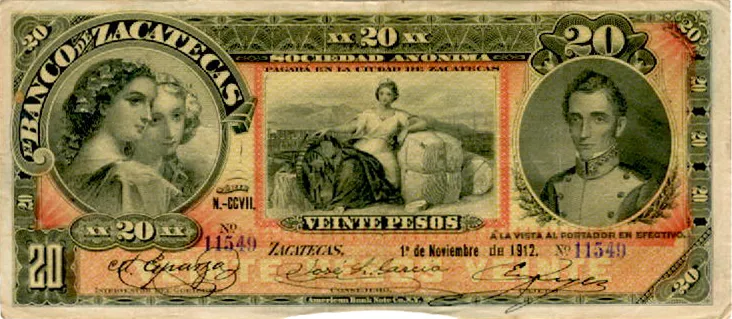
Engraved allegorical vignettes: a miner on the left, a female figure with goods in the center, and the profile portrait of a young man on the right
Reverse
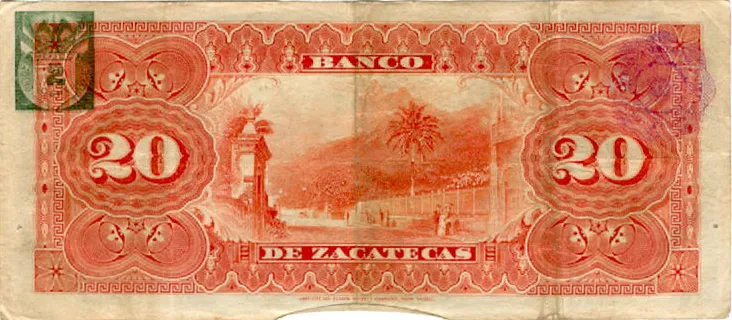
Scenes of mining and labor, or a monument set against the mountainous landscape of Zacatecas
About this banknote
Most people who inherit an old Mexican banknote expect a fortune. The reality for the 1912 20 pesos note from the Banco de Zacatecas is more grounded: common examples trade for a few dollars, while scarce well-preserved notes reach well into the hundreds of dollars. Condition and how rare the issuing bank is decide everything.
This is not a Banco de México note. It predates Mexico's central bank entirely. In 2026, collectors of world paper money (a hobby called notaphily) treat these private-bank issues from the Porfiriato era as a distinct, active market.
What it actually is
Before 1925, Mexico had no single central bank. Each state hosted privately chartered banks authorized to print their own paper money, backed by silver. The Banco de Zacatecas was one of them. Zacatecas was mining country, so silver bullion was the literal guarantee behind the paper, which is why the note's design leans on mining imagery.
The front carries engraved allegorical vignettes: a miner on the left, a female figure with goods at center, and a young man's profile portrait on the right. The back shows scenes of mining and labor, or a monument set against the mountainous Zacatecas landscape. This whole system of multiple issuing banks ended when the Banco de México was founded in 1925 and took over currency issuance.
What it's worth today
This is historic paper money, over a century old, so its value is entirely collector-driven. Two factors dominate:
- Condition (grade). A crisp, uncirculated note with no folds, tears, or staining can be worth many times a worn, limp example. Paper money is graded on a scale from Poor up to Gem Uncirculated, and the jump between grades on scarce notes is steep.
- How rare the issuing bank and denomination are. Some private-bank issues from the Porfiriato and vouchers (vales) from the Revolution are common; others are genuinely scarce. Many circulated so little, or were redeemed and destroyed, that intact survivors are hard to find.
| Note | Bank | Approx. date | Typical range (USD) | Where valued |
|---|---|---|---|---|
| 20 pesos | Banco de Zacatecas | 1912 | 5 to 300+ depending on grade | Heritage, Stack's Bowers, specialist dealers |
The wide range is honest, not evasive. A heavily circulated note with edge damage sits near the bottom. A high-grade example, or one with a low or repeating serial number, can push toward the top and occasionally beyond at specialist auction. World paper money from Mexico's revolutionary and Porfiriato periods appears regularly in Heritage Auctions and Stack's Bowers sales, which is the best public record of real hammer prices.
The features that raise the value
Beyond grade, a few specific traits make collectors pay more:
- Low serial numbers (folios), such as those in the single or double digits.
- Palindrome / radar serials (a serial that reads the same forwards and backwards).
- Genuine printing errors: misaligned cuts, ink smears, factory folds, or off-center printing. These turn a common note into a rarity. Note that ordinary wear and use damage is not a factory error and does not add value.
What it is NOT worth
Do not trust the first inflated price you see online. Being a century old does not automatically make a banknote valuable. Age is common; scarcity plus condition is not. A worn, folded example of a bank that issued heavily is worth a modest sum, no matter how antique it looks.
How to tell if yours is genuine
Reproductions and outright fakes exist for attractive early Mexican notes. Check these points against official reference images:
- Paper feel. Original notes use quality banknote paper with a distinct texture. Reproductions often feel smooth or glossy.
- Color depth. Genuine engraved printing shows layered, sharp ink. Copies tend to look flat and evenly toned.
- Design and signatures. Compare the vignettes, lettering, and signatures with documented examples of Banco de Zacatecas notes.
- Printing method. Original notes were intaglio/engraved, which can leave faint relief you can sometimes feel. A dot pattern under magnification points to a modern reprint.
When in doubt, post clear photos of both sides in the Pesoteca forum so the community can weigh in before you buy or sell.
Where to sell it
To sell the 1912 20 pesos Banco de Zacatecas note, use a channel that respects grade and authenticity:
- A verified dealer from the Pesoteca shop directory, who can value it on the spot.
- The Pesoteca buy-and-sell forum, directly among collectors.
- For a high-grade or scarce example, a specialist world paper money auction (Heritage, Stack's Bowers) will reach the buyers who pay the most.
Photograph both faces in good light, note the serial number, and flag any low folio, radar serial, or error before you accept an offer. Avoid dumping it to the first buyer on social media.
Got a Banco de Zacatecas note or another Porfiriato private-bank issue in a drawer? Post the serial number and both sides in the Pesoteca forum and let collectors tell you what you're really holding.
Historical context
The Banco de Zacatecas continued issuing notes during the first revolutionary years, even as instability threatened all of private banking. Chartered in 1891, it had made the state's mining wealth the foundation of its prestige and the central motif of its issues.
This 1912 20-peso note bears the date of a Mexico in transformation, with Madero in the presidency and the mounting tensions that would precede the collapse of the banking system. The design preserves its traditional imagery: a miner on the left as emblem of Zacatecan silver, a female figure with goods at the center, and a young man in profile on the right, with mining scenes on the reverse. Printed by the American Bank Note Company of New York, it sought to convey solidity in an increasingly uncertain environment. The banking reforms begun in 1913 and the creation of the Banco de México in 1925 would put an end to the private banks' power to issue paper money.
Frequently asked questions
How much is the 1912 20 pesos Banco de Zacatecas banknote worth?
It has no legal-tender value today, so it's worth what collectors pay. A worn example runs from a few dollars, while a crisp, uncirculated note, or one with a low or repeating serial number, can reach several hundred dollars at specialist auction. Grade and the rarity of the issuing bank decide the price.
Is this note rare?
It depends on condition and survival. Some Porfiriato private-bank issues are common; others are genuinely scarce because they circulated briefly or were redeemed and destroyed. High-grade, intact Banco de Zacatecas notes are harder to find than worn ones, and that scarcity is what drives value.
Where can I sell my 1912 20 pesos note?
Use a verified dealer from the [Pesoteca shop directory](/tiendas) for an on-the-spot valuation, or the [Pesoteca buy-and-sell forum](/foro/compra-venta) to reach collectors directly. For a high-grade or scarce example, a world paper money auction such as Heritage or Stack's Bowers will attract the strongest bids.
How do I know if my note is genuine?
Check the paper texture (originals are not smooth or glossy), the depth of the engraved colors, and the signatures and vignettes against official reference images. Original notes were engraved and can show faint relief; a visible dot pattern under magnification signals a modern reprint. When unsure, post clear photos in the [Pesoteca forum](/foro).
Familia PRIV
This banknote belongs to the BIL-PRIV family within the Sistema PSM . Explore all the banknotes that share origin, era and design with this piece.
Ver todos los billetes de la familia PRIV →