
20 Pesos Banknote (1899): Banco de Zacatecas Value
Familia PRIV · algodón
Period: Bancos privados de emisión
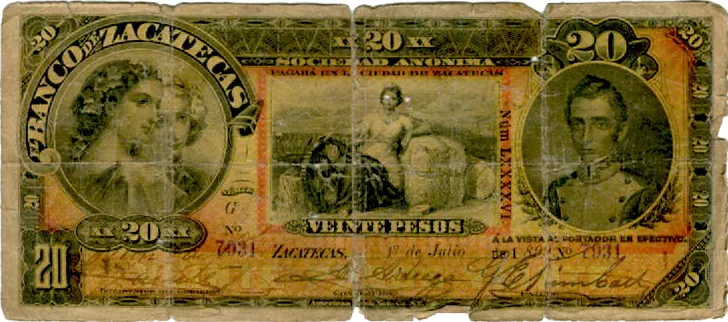
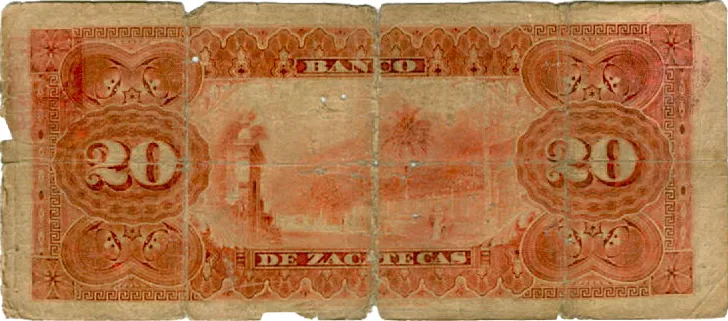
Design
Banxico
Obverse
Banco de Zacatecas
Engraved allegorical vignettes: a miner on the left, a female figure with goods in the center, and the profile portrait of a young man on the right
Reverse
Scenes of mining and labor, or a monument set against the mountainous landscape of Zacatecas
About this banknote
Most people find one of these tucked in a family album and assume it's worthless old paper. In fact, the 1899 Banco de Zacatecas 20 pesos note is a genuine collector item: a silver-backed private bank note from the Porfiriato era, and depending on condition it trades from roughly 30 USD up to several hundred for a crisp, problem-free example. It has no face value anymore. It was demonetized generations ago.
This note comes from a chapter of Mexican monetary history most US collectors have never heard of. Before Mexico had a single central bank, individual states licensed private banks to print their own paper money, each note backed by silver held in reserve. Zacatecas, one of the great silver-mining regions of the Americas, had its own bank of issue. That is why the vignettes are all about mining: the metal in the ground was the guarantee behind the paper. This system of multiple issuing banks ended in 1925 when the Banco de México was founded and took over all note issuance.
What the note looks like
The face carries engraved allegorical vignettes: a miner on the left, a female figure with goods at the center, and the profile portrait of a young man on the right. The back shows scenes of mining and labor, or a monument set against the mountainous Zacatecas landscape. These are steel-engraved designs, printed for private banks of the period, typically by specialist security printers in the United States and Europe.
What it's worth in 2026
This is historic paper money, more than a century old, so its value is entirely collector-driven. Two things decide the number: condition and how scarce that specific bank's notes are. Private-bank notes from the Porfiriato and the emergency scrip of the Mexican Revolution have their own active market among world paper money collectors. Some banks issued heavily and their notes are common; others issued little, or their notes circulated so briefly that surviving examples are genuinely hard to find intact.
As a general guide for the 1899 Banco de Zacatecas 20 pesos:
| Condition | What it looks like | Typical value (USD) |
|---|---|---|
| Well-circulated | Soft paper, folds, edge wear, maybe pinholes | 25 to 60 |
| About uncirculated | Bright paper, one light fold, no tears | 80 to 200 |
| Uncirculated / choice | Crisp, no folds, full margins | 200 to 500+ |
| Remainder / specimen | Unissued (no serial or with SPECIMEN overprint) | Varies widely, often lower |
These are broad ranges, not fixed prices. A note graded and encapsulated by PMG (Paper Money Guaranty), the leading third-party grader for world banknotes, will always sell more easily and often for more than a raw, ungraded note. Condition matters enormously with paper: a single hard fold or a repaired tear can cut the value by half or more.
Do not trust the first price you see online. A generic listing usually reflects the worst common example, not what a clean one brings at auction. If you have one, ask in the Pesoteca forum or a serious dealer before you sell.
The ones people overpay for (and shouldn't)
A heavily worn, soft, taped example is worth the low end and no more, no matter how old it looks. Age alone does not make paper money valuable; scarcity and condition do. Watch out for two traps. First, remainders and specimens (notes printed but never issued, often with no serial number) exist for several Porfiriato banks and can look pristine, but they usually sell for less than a genuinely issued, circulated note. Second, modern reproductions and "museum copies" turn up regularly. They are not worth collector money.
How to tell if yours is genuine
Genuine 1899 private-bank notes were steel-engraved on quality rag paper. Check for:
- Paper feel: real notes are printed on textured rag paper, not smooth modern stock. Reproductions feel flat and slick.
- Engraving depth: original intaglio printing has fine, sharp line work you can sometimes feel. Copies show flat, screened color.
- Serial numbers and signatures: issued notes carry hand-applied or printed serials and authorized signatures. Compare against reference images.
- Color: originals have layered, precise color. Reproductions often show muddy or blocky tones.
If you are unsure, post clear photos of both sides in the forum, or send it to PMG for authentication and grading before you buy or sell anything expensive.
Errors and special features that add value
Genuine printing errors (misaligned cuts, ink smears, misplaced overprints) can turn a common note into a scarcity worth several times the norm. Low serial numbers and interesting number patterns also attract collectors. Note that ordinary wear and use damage is not a factory error and does not add value. If you think yours has a real error, get a second opinion before assuming it's rare.
Where to sell it
For a note like this, your best options are a verified numismatic dealer, a specialist world-paper-money auction (Heritage and Stack's Bowers both run regular sessions with Mexican material), or a collector-to-collector sale through the Pesoteca buy-and-sell forum. Photograph both sides in good, even light, note any folds or repairs honestly, and check whether it has a low or patterned serial. Avoid dumping it to the first buyer on a general marketplace, where these notes are routinely undervalued.
Have one of these in a family collection and not sure what you're holding? Post the front and back in the forum and let collectors who track this exact series weigh in.
Historical context
The Banco de Zacatecas closed the 19th century as one of the most solid financial institutions in the north-central part of the country, with capital of 600,000 pesos and branches in Aguascalientes and San Juan de los Lagos. Its paper money circulated backed within the system of private banks of issue regulated by the Law of 1897.
This 20-peso note of 1899 belongs to the last year of the century, with the bank fully established. The 20-peso denomination suited commercial transactions of some weight. Its obverse brings together the characteristic iconography: a miner on the left, symbol of Zacatecas's silver wealth, a female figure with goods in the center, and a young man in profile on the right; on the reverse, mining and mountain motifs. Engraved by the American Bank Note Company of New York, it reflects the link between the note's backing and the economic activity that sustained the region. This form of issuance would end with the creation of the Banco de México in 1925.
Frequently asked questions
How much is the 1899 Banco de Zacatecas 20 pesos banknote worth?
It has no face value anymore; it's a collector item. A well-circulated example runs roughly 25 to 60 USD, while a crisp uncirculated note can reach 200 to 500 USD or more. Condition and third-party grading (PMG) drive the price, so a single hard fold or repair can cut value in half.
Is the 1899 Banco de Zacatecas note rare?
It's scarce but not impossibly rare. It comes from the Porfiriato era of private state banks, before the Banco de México existed. Some Zacatecas notes survived in decent numbers; genuinely uncirculated examples, low serial numbers, and printing errors are the hard-to-find versions that command premiums.
Where can I sell an 1899 Mexican 20 pesos banknote?
Best options are a verified numismatic dealer, a specialist world-paper-money auction such as Heritage or Stack's Bowers, or the [Pesoteca buy-and-sell forum](/foro/compra-venta). Photograph both sides in good light, disclose any folds or repairs, and don't sell to the first buyer on a general marketplace where these are undervalued.
How can I tell if my 1899 Banco de Zacatecas note is genuine?
Check the paper (real notes use textured rag paper, not smooth modern stock), the engraving (original intaglio printing shows sharp, layered line work), the serial numbers and signatures, and the color depth. Reproductions feel slick and print flat. When in doubt, post photos in the [forum](/foro) or submit it to PMG for authentication.
Características Banxico
LXXXXVI.
Familia PRIV
This banknote belongs to the BIL-PRIV family within the Sistema PSM . Explore all the banknotes that share origin, era and design with this piece.
Ver todos los billetes de la familia PRIV →