
20 Pesos Banknote (1897), Banco de Zacatecas
Familia PRIV · algodón
Period: Bancos privados de emisión
Design
Banxico
Obverse
Banco de Zacatecas
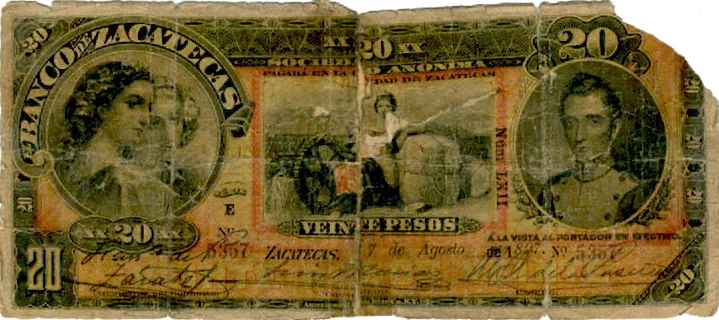
Engraved allegorical vignettes: a miner on the left, a female figure with goods in the center, and the profile portrait of a young man on the right
Reverse
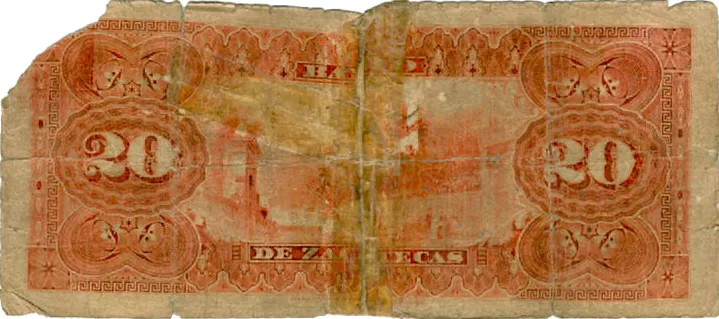
Scenes of mining and labor, or a monument set against the mountainous landscape of Zacatecas
About this banknote
Most people who inherit an old Mexican banknote assume it's a lost fortune. The 1897 Banco de Zacatecas 20 pesos note is a genuine collectible, but its value in 2026 runs from a few dollars for a worn example to a few hundred for a crisp, high-grade survivor. Here is what actually drives the number, and how to check yours.
What this note actually is
This is not a Banco de México note. It was issued by the Banco de Zacatecas, one of dozens of state chartered private banks that printed their own paper money during the Porfiriato (the long rule of Porfirio Díaz, roughly 1876 to 1911).
Before Mexico had a single central bank, each state had private banks licensed to issue paper currency backed by silver. Zacatecas was one of the great silver mining regions of the world, so the note's engraved vignettes are all about mining: the ore was the collateral. This system of multiple issuing banks ended when the Banco de México was founded in 1925.
That backstory matters for value. Collectors of world paper money (a hobby called notaphily) treat these as a distinct series, separate from later Mexican federal notes. Some banks' issues are common, others are extremely scarce, and Zacatecas notes sit somewhere in the middle depending on denomination and date.
What the note looks like
The face carries allegorical engravings: a miner on the left, a female figure with merchandise in the center, and the profile portrait of a young man on the right. The back shows mining and labor scenes, or a monument set against the mountainous Zacatecas landscape. The paper is a heavier engraved bank paper, not the smooth stock used in modern reproductions.
How much is it worth in 2026
This is historic paper money, more than a century old, so the value is purely collector value. There is no face value to fall back on; the Banco de Zacatecas has not existed for a hundred years, so you cannot spend it. Everything comes down to two things: condition and rarity of the issuing bank.
As a general guide for these Porfiriato private bank notes:
| Condition | What it means | Typical value (USD) |
|---|---|---|
| Heavily circulated | Soft paper, folds, tears, stains | 5 to 25 |
| Circulated, intact | Complete, minor folds, no repairs | 25 to 80 |
| About uncirculated | Crisp, one light fold at most | 80 to 200 |
| Uncirculated / gem | No folds, full color, original body | 200 and up |
These are ranges, not guarantees. A specimen note (marked "Especimen" or with punch cancels), a low serial number, or a scarce signature combination can push a single example well past those figures. Conversely, a torn or repaired note is worth a fraction of the top of its band. Do not trust the first price you see online; the same catalog number sells for wildly different money depending on grade.
The values that are exaggerated
A lot of listings for old Mexican bank notes carry hopeful prices in the thousands. Reality check: most surviving Porfiriato private bank notes in average circulated condition trade in the tens of dollars, not the thousands. The four figure results you sometimes see are for the rarest banks, the highest denominations, or gem uncirculated survivors, not the typical inherited note. Being old is not the same as being rare.
What makes yours worth more
- Grade above everything. A crisp, unfolded note can be worth ten times a worn one of the exact same type.
- No repairs. Tape, glue, trimmed edges, and rebuilt corners kill value for serious buyers.
- Low or unusual serial numbers. A very low serial or a repeating pattern draws extra bids.
- Specimen and proof examples. Notes marked as specimens or unissued proofs are collected separately and often bring a premium.
How to tell if it's genuine
Compare the design, paper, and signatures against reference images of Banco de Zacatecas issues. Genuine notes are printed by intaglio engraving, so the ink has a slight raised feel and the lines are razor sharp under magnification. Reproductions and modern fakes tend to have smooth, flat paper and dull, printed-looking colors with no relief. Check the back for genuine engraved detail rather than a flat photographic image. If anything looks off, post clear photos of both sides in the Pesoteca forum before you buy or sell.
Where to sell it
For a note like this, the safest routes are a verified numismatic dealer from the Pesoteca shop directory, who can appraise it in person, or the Pesoteca buy and sell forum where world paper money collectors trade directly. Photograph both faces in good, even light and note the serial number and any specimen marks before you list it. Avoid dumping it to the first buyer on a general marketplace; the right collector pays for the right note.
Have one of these Zacatecas notes, or another Porfiriato bank issue you can't identify? Post the front and back in the Pesoteca forum and let the community pin down the bank, date, and a realistic value.
Historical context
By 1897, the Banco de Zacatecas operated within the new framework of the General Law of Credit Institutions, enacted that same year, which brought legal uniformity to Mexico's issuing banks. The institution, founded in 1891, relied on the state's mining industry, a benchmark for silver in Mexico since colonial times.
This 20-peso note of 1897 coincides with that moment of order in the banking system. The 20-peso denomination served commerce of a certain scale. Its obverse shows the bank's distinctive iconographic set: a miner on the left, a female allegory of commerce at the center, and a young man in profile on the right, with mining and mountain-landscape motifs on the reverse. Engraved by the American Bank Note Company of New York, it combined economic backing with a visual narrative of regional prosperity. The plurality of state issuers to which it belonged would end with the birth of the Banco de México in 1925.
Frequently asked questions
How much is the 1897 Banco de Zacatecas 20 pesos note worth?
As a collectible it typically ranges from about 5 to 25 USD for a heavily circulated example, 25 to 80 USD for a complete circulated note, and 80 to 200 USD or more for a crisp uncirculated one. It has no spendable face value; the bank closed a century ago, so the value is purely to collectors.
Is this note rare?
It's genuinely old and collectible, but not automatically rare. Common Porfiriato private bank notes in average condition trade in the tens of dollars. True rarity comes from high grade, low or unusual serial numbers, specimen or proof status, or scarce signature combinations. Being over a century old does not by itself make it valuable.
Where can I sell it?
The safest options are a verified dealer from the [Pesoteca shop directory](/tiendas), who can grade and appraise it on the spot, or the [Pesoteca buy and sell forum](/foro/compra-venta) where world paper money collectors trade. Photograph both sides in good light and note the serial number before selling, and avoid taking the first lowball offer on a general marketplace.
How do I tell if it's genuine?
Genuine notes are intaglio engraved, so the ink feels slightly raised and the lines are sharp under magnification, with detailed engraving on both sides. Reproductions usually have smooth, flat paper and dull, printed-looking colors with no relief. Compare the design, paper, and signatures to reference images, and post clear photos in the [Pesoteca forum](/foro) if you're unsure.
Características Banxico
LXII.
Familia PRIV
This banknote belongs to the BIL-PRIV family within the Sistema PSM . Explore all the banknotes that share origin, era and design with this piece.
Ver todos los billetes de la familia PRIV →