
20 Pesos 1895, Banco de Zacatecas Banknote
Familia PRIV · algodón
Period: Bancos privados de emisión
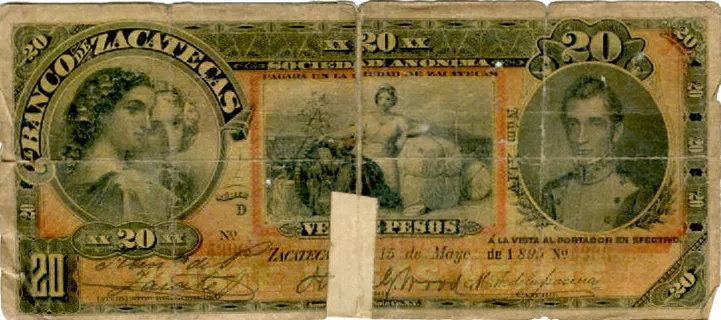
Design
Banxico
Obverse
Banco de Zacatecas
Engraved allegorical vignettes: a miner on the left, a female figure with goods in the center, and the profile portrait of a young man on the right
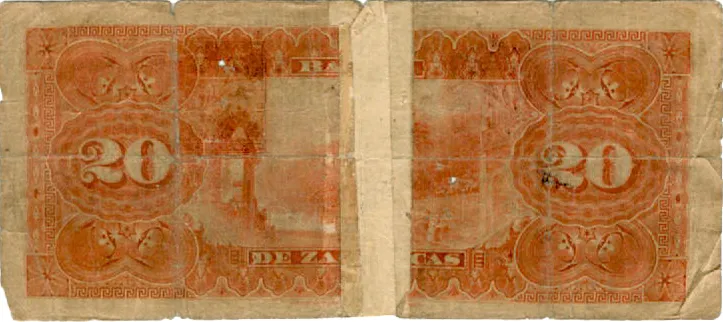
Reverse
Scenes of mining and labor, or a monument set against the mountainous landscape of Zacatecas
About this banknote
Most people assume a banknote from 1895 must be worth a fortune. Usually it is not. An 1895 Banco de Zacatecas 20 pesos note in worn, folded condition trades for roughly 40 to 90 USD among collectors. A crisp, uncirculated example, or a scarce variety, can reach several hundred dollars. Here is what actually drives the price and how to check yours.
What this note actually is
This is not a Banco de México note. It was issued by the Banco de Zacatecas, one of the private state-chartered banks that printed paper money during the Porfiriato (the long rule of Porfirio Díaz, roughly 1876 to 1911). Before Mexico had a single central bank, individual states licensed private banks to issue their own notes, each backed by silver reserves.
Zacatecas was one of the great silver-mining regions of the Americas, so its notes lean heavily on mining imagery: the ore in the ground was the real collateral behind the paper. This whole system of multiple issuing banks ended when the Banco de México was founded in 1925 and took over sole authority to print currency.
The face (anverso) carries engraved allegorical vignettes: a miner on the left, a female figure with goods at the center, and the profile portrait of a young man on the right. The back shows scenes of mining and labor, or a monument set against the mountainous Zacatecas landscape. These are 19th-century intaglio engravings, printed on the higher-quality banknote paper of the era, which is one of the first things that separates a genuine note from a modern reproduction.
What it's worth in 2026
This is historic paper money, well over a century old, so its value is entirely collector-driven. Face value means nothing here: the note has not been legal tender for a hundred years. What matters is condition, rarity of the specific bank and denomination, and whether the note is a full, complete example.
Private Porfiriato bank notes and Revolution-era emergency scrip ("vales") form their own active corner of world paper money collecting. Some issues are common and inexpensive; others are genuinely scarce because they circulated briefly, were redeemed, or were destroyed. Many that survive are cut, cancelled, or fragmentary, which is exactly why a complete, uncancelled note commands a premium.
| Item | Condition | Approx. value (USD) | Where it trades |
|---|---|---|---|
| Banco de Zacatecas 20 pesos, 1895 | Worn, folds, complete | 40 to 90 | Collector forums, dealers |
| Banco de Zacatecas 20 pesos, 1895 | Crisp, minimal handling | 120 to 250 | Notaphily auctions |
| Banco de Zacatecas 20 pesos, 1895 | Uncirculated / scarce variety | 250 to 400+ | Specialist auction houses |
| Cancelled or "remainder" (unissued) note | Any | 25 to 80 | Dealers |
Those are working ranges for the general market. A remainder note (one printed but never issued, often lacking signatures or serial numbers) usually sells for less than a genuinely circulated, fully completed note, since collectors of Mexican provincial banking often want the issued piece. Confirm the exact type before you set a price.
The myth to ignore
"It's from 1895, so it must be worth thousands." Age alone does very little. Millions of these state-bank notes were printed across dozens of banks, and survivors are not as rare as sellers claim. The premium sits with the finest surviving examples and the scarcest banks, not with any old note that happens to be a century old. Do not pay reproduction-level money for a worn common note, and do not let anyone tell you a heavily circulated example is a five-figure rarity.
How to tell if yours is genuine
Reproductions and "museum copies" of Porfiriato notes exist and are sold openly, sometimes then resold as originals. Check these:
- Paper and feel. Genuine 1890s banknote paper has texture and slight rag content. Modern copies feel smooth, thin, or glossy.
- The engraving. Original intaglio printing shows fine, raised line detail. Run a fingertip across the portrait: flat, evenly printed color usually means a reproduction.
- Colors. Originals have depth and slight variation. Photocopied or offset copies look flat and uniform.
- Serial numbers and signatures. Issued notes carry hand-applied or overprinted serials and authorizing signatures. A note with none may be a remainder (legitimate but lower value) or a copy.
- Compare against references. Match the design against catalog images for Banco de Zacatecas issues before you buy or sell.
When in doubt, post clear photos of both sides in the Pesoteca forum and let collectors who handle these notes weigh in.
Where to sell it
For the best result, use buyers who actually know Mexican provincial banking:
- A verified dealer from the Pesoteca shop directory, who can appraise it in person and quote a fair figure.
- The Pesoteca buy-and-sell forum, where you reach collectors who specialize in this exact material.
- Specialist world-paper-money auctions for higher-grade or scarce examples.
Photograph both sides in good, even light before contacting anyone. Note the bank name, denomination, date, any serial number, and the condition honestly. Avoid dumping it on a general marketplace to the first bidder, since a buyer who does not recognize the issue will underpay, and one selling a reproduction will overcharge.
Got one sitting in a family box? Post it in the Pesoteca forum with photos of the face and back, and let collectors tell you which variety you're holding and roughly what it's worth today.
Historical context
The Banco de Zacatecas offered high denominations like this one to serve the mining state's larger-volume commerce. Founded in 1891 with capital of 600,000 pesos, it was part of the first generation of state banks of issue, authorized to print backed notes with circulation limited to their region.
This 20-peso note of 1895 belongs to the bank's early years, when it was still consolidating its place in the regional economy under the Porfiriato. Twenty pesos was a considerable sum, reserved for formal transactions rather than daily spending. Its obverse brings together the house's allegorical vignettes: a miner on the left, symbol of Zacatecas's silver vocation, a female figure with goods in the center, and the portrait of a young man in profile on the right; on the reverse, scenes of mining and labor. Like the entire series, it was engraved by the American Bank Note Company of New York. This model of issuance by private banks would disappear when currency was centralized in the Banco de México in 1925.
Frequently asked questions
How much is an 1895 Banco de Zacatecas 20 pesos note worth?
It has no face value today, so it's purely a collector item. A worn, folded but complete example generally trades for about 40 to 90 USD. A crisp, uncirculated note, or a scarce variety, can reach 250 to 400 USD or more. Condition and rarity of the specific bank drive the price.
Is the 1895 Banco de Zacatecas 20 pesos note rare?
Not extremely. It was one of many private state-bank notes printed during the Porfiriato, and survivors are more common than sellers claim. The premium goes to the finest-condition examples and to genuinely issued (rather than remainder or cancelled) notes, not to any century-old piece.
Where can I sell my 1895 Banco de Zacatecas note?
Use buyers who know Mexican provincial banking: a verified dealer from the [Pesoteca directory](/tiendas), the [Pesoteca buy-and-sell forum](/foro/compra-venta), or a specialist world-paper-money auction for higher grades. Photograph both sides clearly and avoid selling to the first random online bidder.
How do I know if my note is genuine and not a reproduction?
Check the paper (genuine 1890s notes have texture, copies feel smooth or glossy), the engraving (original intaglio detail is raised, copies are flat), and the colors (originals show depth). Confirm serials and signatures, and compare against catalog images. Post photos in the [Pesoteca forum](/foro) if unsure.
Características Banxico
XLIV.
Familia PRIV
This banknote belongs to the BIL-PRIV family within the Sistema PSM . Explore all the banknotes that share origin, era and design with this piece.
Ver todos los billetes de la familia PRIV →