
Mexican 20 Pesos Banknote (1972): Value & Guide
Familia A · algodón
Period: México Contemporáneo
Design
Banxico
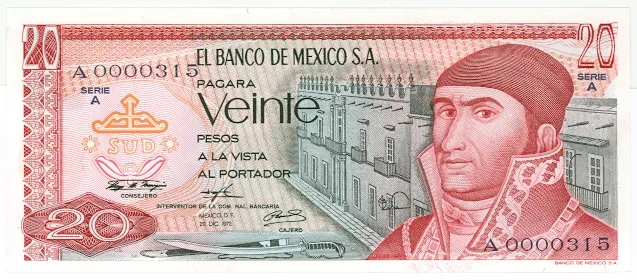
Obverse
Josefa Ortiz de Domínguez
Bust of Josefa Ortiz de Domínguez
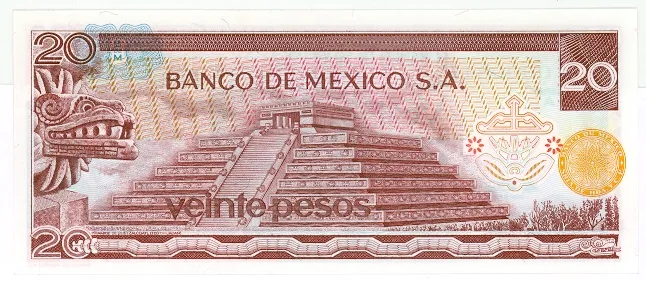
Reverse
The inner courtyard of a colonial building with arches and a fountain
About this banknote
Most 1972 Mexican 20 peso banknotes are worth only a few US dollars. This was one of the most heavily printed notes of its era, so age alone does not make it valuable. The premium comes from condition and rare serial numbers, and a crisp uncirculated example can be worth several times a well-worn one.
If you inherited or found one of these notes, here is the honest breakdown of what it is, what drives its value, and how to sell it in the world paper money (notaphily) market.
What this note is
This is the Banco de México 20 pesos note, Series A (familia A), dated 1972. The front (obverse) shows Josefa Ortiz de Domínguez, known as "la Corregidora de Querétaro," a heroine of Mexico's War of Independence. The back (reverse) depicts the courtyard of a colonial building with its arches.
The design is identical to the 1970 issue; only the date and series letter differ. Because these notes were printed in large quantities, most surviving examples are common.
What it's worth in 2026
This note is out of circulation, so its value is collector value, not face value. Condition is the single biggest factor.
- Circulated (folds, stains, worn corners): typically a few US dollars, often 2 to 5 USD depending on demand.
- Uncirculated / crisp (no folds, sharp corners, no stains): several times more, commonly 15 to 40 USD, and higher for pristine graded examples.
- Special serial numbers (low serials, radar/palindrome serials, or the very first print runs): a premium on top of the condition value.
- Genuine printing errors (misalignments, ink smears, factory folds, repeated or off-center serials): these turn a common note into a sought-after rarity worth several times its normal price.
Ignore the inflated prices you sometimes see online. The bulk of Series A notes are common. A worn 1972 20 pesos is not a small fortune; the money is in the exceptional survivors.
| Condition / feature | Approximate value (USD) |
|---|---|
| Circulated, worn | 2 to 5 |
| Uncirculated, crisp | 15 to 40 |
| Special serial (low / radar) | premium above condition |
| Genuine printing error | several times normal |
(Ranges reflect typical dealer and collector-market pricing; a formal appraisal or third-party grade sets the exact figure.)
The ones people overpay for
Most of the "rare old peso note worth thousands" listings you'll see are just common notes with an optimistic asking price. Age does not equal rarity here. A 1972 20 pesos in average circulated shape is exactly what dealers see all day. What actually moves the needle is a top grade or a genuine oddity, not the date on the note.
How to check what yours is worth
Look at three things:
- Condition. Is it flat with no folds, no stains, and sharp corners? Uncirculated notes carry the real premium. Never flatten, wash, or tape a note; that destroys value.
- Serial number. Low serials, palindromes (radar notes, e.g., 1230321), and first-series prefixes are worth more to collectors.
- Printing errors. A misaligned cut, smeared ink, a factory fold, or a repeated/off-center serial is a genuine error. Normal wear and handling damage is not an error.
For a professional opinion, third-party grading services like PMG (Paper Money Guaranty) certify and grade world banknotes, which is the standard buyers trust in the international market.
Is it genuine?
Check the security features against official Banco de México images: the watermark (hold it to the light), the security thread, the microprinting, and the raised feel of the intaglio ink. Reproductions and reprints usually have smooth, flat paper and dull, uniform colors. Compare the design, signatures, and paper texture with verified references. If you're unsure, post clear photos of both sides in the Pesoteca forum for a second opinion. See also Mexico's most counterfeited banknotes.
Where to sell it
The safest routes are a verified numismatic dealer from the Pesoteca shop directory, who can value it on the spot, or the collector-to-collector buy and sell forum. Photograph both sides in good light, and note whether it has a low serial, a radar serial, or any error, since those raise the value. Avoid dumping it on social media to the first bidder.
Got a 1972 20 pesos with an unusual serial or still sealed in original packaging? Post it in the forum and let the community weigh in on what it's really worth.
Historical context
This 20 pesos of 1972 keeps the bust of Josefa Ortiz de Domínguez, the Corregidora, whose warning to the conspirators in 1810 triggered the start of the war of Independence. The continuity of her image across several issues of Family A speaks to how firmly established her figure was on the national currency.
The reverse repeats the colonial courtyard with arches and a fountain, a view of viceregal architecture that connects the heroine with the provincial Mexico of her era. The design was kept almost identical to that of the 1970 issue, a common pattern when the denomination remained in circulation.
Minted within Family A of the "old pesos," this note precedes the 1993 monetary reform. In 1972 the country still enjoyed relative price stability; the inflationary escalation that would force the printing of five- and six-figure notes would come more than a decade later.
Frequently asked questions
¿Cuánto vale el billete de 20 pesos?
Si aún circula, vale su valor facial de 20 pesos. Como pieza de colección, un ejemplar sin circular, con número de serie especial o con error de impresión puede valer varias veces más. La conservación y la rareza mandan.
¿Quién aparece en el billete de 20 pesos?
En el anverso aparece un personaje de la historia de México. Es un billete del Banco de México, familia A.
¿Cómo sé si mi billete de 20 pesos es valioso?
Revisa tres cosas: que esté sin circular (sin dobleces), que tenga un número de serie bajo o capicúa, y que no presente errores de impresión. Cualquiera de esas lo vuelve más buscado por coleccionistas.
¿Dónde comprar el billete de 20 pesos (1972)?
Lo más seguro es una [tienda numismática verificada del directorio Pesoteca](/tiendas), por ciudad y sin sobreprecio de coyote, o el [foro de compra-venta de Pesoteca](/foro/compra-venta) entre coleccionistas. Revisa siempre el folio, el estado de conservación y las fotos del anverso y reverso antes de pagar.
¿Dónde vender el billete de 20 pesos (1972)?
Para **vender** el billete de 20 pesos (1972), lo más seguro es una [tienda numismática del directorio Pesoteca](/tiendas), que te lo valúa en el momento, o el [foro de compra-venta](/foro/compra-venta) entre coleccionistas. Fotografía ambas caras con buena luz y revisa si tiene un folio bajo, capicúa o algún error, que suben el valor. Evita rematarlo en Facebook al primer postor.
¿Cómo saber si el billete de 20 pesos (1972) es auténtico?
Revisa los **elementos de seguridad**: marca de agua a trasluz, hilo de seguridad, microimpresiones, relieve al tacto y, en los de polímero, la ventana transparente. En billetes antiguos, compara el diseño, el papel y las firmas con imágenes oficiales del Banco de México; las reproducciones suelen tener papel liso y colores planos. Ante la duda, consúltalo en el [foro](/foro).
¿El billete de 20 pesos (1972) tiene errores de impresión valiosos?
Sí, los **errores de impresión** (cortes desalineados, tinta corrida, dobleces de fábrica, folios repetidos o descentrados) convierten un billete común en una rareza que vale varias veces su facial. También los **folios bajos o capicúas** suben el valor. Ojo: el desgaste normal o el daño por uso no es un error de fábrica. Si crees que tu billete tiene un error genuino, súbelo al [foro](/foro) para que la comunidad lo revise.
Familia A
This banknote belongs to the BIL-A family within the Sistema PSM . Explore all the banknotes that share origin, era and design with this piece.
Ver todos los billetes de la familia A →