
Mexican 20 Pesos Banknote (1866 Second Empire): What It's Worth
Familia ANT · algodón
Period: Antecedentes del papel moneda
Design
Banxico
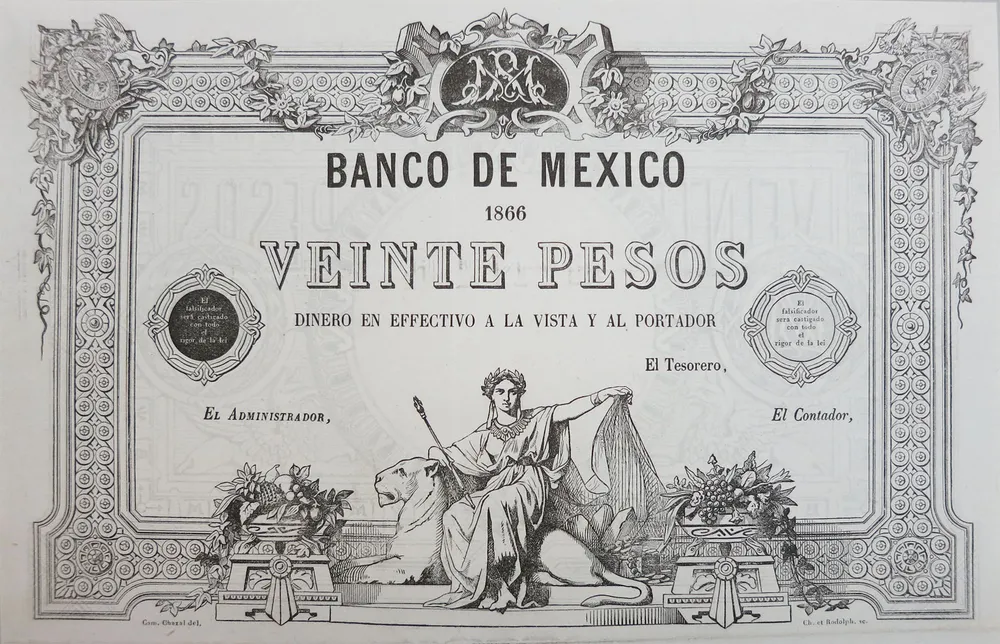
Obverse
Banco de México (1866)
A seated female allegory with a lyre and fine engraved ornaments
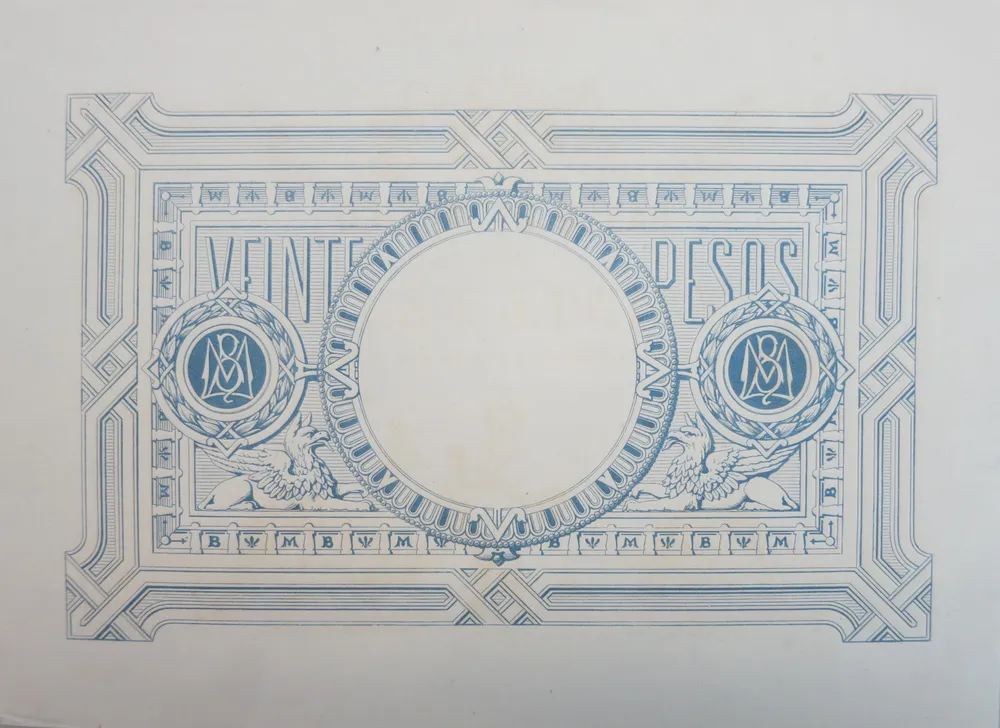
Reverse
Unfinished ornamental design (bank proof), with the central oval empty
About this banknote
The 1866 Banco de México 20 pesos from the Second Empire is not the modern 20-peso note you might have in a drawer. This is a mid-19th-century rarity, and most known examples are single-sided bank proofs or specimens. If you actually have one, it can be worth thousands of dollars, and you should not sell it to the first buyer who makes an offer.
Most people searching "Mexican 20 peso note value" have a common modern note worth its face value in pesos, a couple of dollars. This page is about the genuinely rare piece: the 1866 Second Empire issue. Two very different things share the same denomination, so the first job is figuring out which one you're holding.
What this note actually is
The 1866 Banco de México 20 pesos dates to the Second Empire, the brief rule of Emperor Maximilian in Mexico. The face shows a seated female allegory holding a lyre, surrounded by fine engraved ornamentation. The back carries an unfinished ornamental design with an empty central oval, which is the signature look of a bank proof, a test print made before the final issue.
Because so few examples survive, and because several of the known ones are proofs or specimens rather than issued, circulating notes, this piece belongs to the highest tier of Mexican paper money rarity.
What it's worth in 2026
This is not a note you price in the hundreds. Value here depends on three things: whether it's an issued note or a bank proof, its state of preservation, and which auction house is selling it. A high-grade example can bring several thousand dollars, and standout specimens go well beyond that. Because the market for 19th-century Mexican paper is thin, exact figures swing hard from one sale to the next.
| Note | Year | Type | Typical value range (USD) |
|---|---|---|---|
| Banco de México 20 pesos | 1866 | Bank proof / specimen | Low thousands, up depending on grade |
| Banco de México 20 pesos | 1866 | Issued (very few known) | Higher, sale-dependent |
We deliberately give a range rather than a single figure. With so few auction appearances, any precise number would be misleading. Get yours graded and appraised before you assume anything.
The ones people confuse with a fortune
The trap here is the denomination. The modern Banco de México 20-peso note, the one printed on polymer with a clear window, is worth its face value in pesos, roughly one dollar, unless it's uncirculated with a special serial number or a genuine printing error. A worn modern 20 is not a rare 1866 proof. Check the date and the design before you get excited. If your note has a transparent polymer window, it is not the 1866 piece.
How to check what yours is worth
Start with condition. Collectors want notes with no folds, tears, or staining. A crisp, uncirculated example is worth many times a worn one.
Next, look at the serial number. Low serial numbers and palindromic (radar) serials, where the number reads the same backward, add a premium. Printing errors, misaligned cuts, ink smears, or factory folds, can turn an ordinary note into a rarity. Normal wear and use damage is not a factory error, so don't confuse the two.
For a piece this old and this valuable, authentication is the whole game. Compare the paper, engraving, signatures, and colors against official Banco de México references. Reproductions typically have smooth paper and flat, lifeless color. Genuine 19th-century notes show the depth of intaglio engraving. If there's any doubt, get it in front of experienced eyes before money changes hands.
Where to sell it
For a rarity like the 1866 20 pesos, sell through channels that can actually value it. A verified numismatic dealer from the Pesoteca directory can appraise it in person, and the Pesoteca buy-and-sell forum connects you with collectors who know this market. Photograph both sides in good light, and never rush a sale on social media to the first offer. A single misjudged sale on a piece like this can cost you thousands.
Think you have the 1866 Second Empire 20 pesos, or just an old note you can't identify? Post clear photos of both sides in the Pesoteca forum and let collectors who handle these confirm what you've got.
Historical context
This 20-peso piece is a bank proof, a working impression in which the central oval of the reverse was left empty, unfinished. It belongs to the antecedents of Mexican paper money linked to the issues bearing the name Banco de México during the Empire of Maximilian, entirely distinct from the Banco de México founded in 1925.
The obverse shows a seated female allegory with a lyre and ornaments engraved in great detail, motifs characteristic of nineteenth-century engraving by foreign printing houses.
Bank proofs like this were trials prior to the definitive issue, and for their rarity they are especially prized by scholars. They document the note's manufacturing process at a stage when the printing of valuables was commissioned abroad, when the circulation of paper money was only beginning to consolidate.
Frequently asked questions
How much is the 1866 Mexican 20 pesos banknote worth?
The 1866 Second Empire 20 pesos is a top-tier rarity, not a note priced in the hundreds. Most known examples are bank proofs or specimens, and a high-grade piece can bring several thousand dollars in USD, with standout examples going higher. Exact value depends on grade, whether it's issued or a proof, and the auction house. A modern 20-peso note, by contrast, is worth roughly its face value in pesos.
Is the 1866 20 pesos banknote rare?
Yes, extremely. It dates to the Second Empire under Emperor Maximilian, and very few survive. Several of the known examples are single-sided bank proofs or specimens rather than issued, circulating notes, which places it among the highest tiers of Mexican paper money rarity. Do not confuse it with the common modern 20-peso polymer note.
How can I tell if my 20 pesos note is genuine?
For the 1866 note, compare the paper, engraving, signatures, and colors against official Banco de México references. Genuine 19th-century notes show deep intaglio engraving; reproductions have smooth paper and flat color. For modern notes, check security features like the watermark, security thread, microprinting, raised relief, and the clear polymer window. If in doubt, post photos in the Pesoteca forum for expert review before buying or selling.
Where can I sell a rare Mexican 20 pesos banknote?
The safest routes are a verified numismatic dealer from the Pesoteca directory, who can appraise it in person, or the Pesoteca buy-and-sell forum among collectors. Photograph both sides in good light and note any low or palindromic serial number or printing error, which raise the value. Avoid selling to the first offer on social media, especially for a rarity like the 1866 issue.
Características Banxico
Prueba del reverso. Unifaz.
Familia ANT
This banknote belongs to the BIL-ANT family within the Sistema PSM . Explore all the banknotes that share origin, era and design with this piece.
Ver todos los billetes de la familia ANT →