
100 Pesos 1904, Banco Mercantil de Yucatán
Familia PRIV · algodón
Period: Bancos privados de emisión
Design
Banxico
Obverse
Banco Mercantil de Yucatán
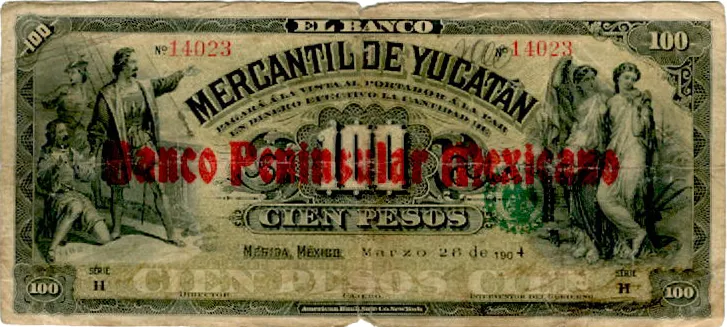
Two female allegories in ovals flanking the central denomination
Reverse
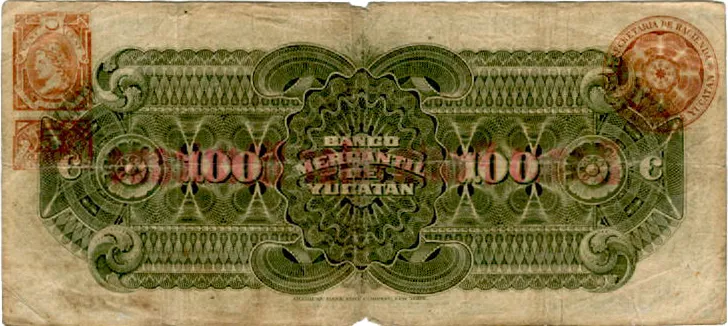
Engraved ornamental design in red with the denomination and the name of the bank
About this banknote
If you inherited an 1904 100 pesos note from the Banco Mercantil de Yucatán, here is the honest answer: this is not a modern peso bill worth face value. It is a private-bank note from Mexico's Porfiriato era, and depending on condition it can be worth anywhere from a few tens of dollars to several hundred USD. Pristine, fully signed examples of scarcer private banks are the ones that bring real money.
This note was issued in Mérida by the Banco Mercantil de Yucatán, one of dozens of private banks that printed their own currency in Mexico before the modern Banco de México monopolized note issue. It belongs to a collecting category English speakers call "world paper money" or "obsolete/private bank notes," and there is an active market for it among US and international collectors.
What it is, in plain terms
During the Porfiriato (the long rule of Porfirio Díaz, roughly 1876 to 1911), Mexican states had privately chartered banks that issued their own paper money. The Banco Mercantil de Yucatán was founded during the henequen boom, when Yucatán was one of the richest regions in the country thanks to sisal fiber exports. In 1908 it merged with the Banco Yucateco to form the Banco Peninsular Mexicano, which is why many surviving notes carry an overprint (a stamped mark) from that later bank. If yours has that overprint, it is normal and part of the history, not damage.
Design. The face (anverso) shows two allegorical female figures in oval frames flanking the central denomination. The back (reverso) carries an ornamental engraved design printed in red, with the denomination and the bank's name.
What it's actually worth
This is historic paper money more than a century old, so its value is purely collectible. Two things drive the price: condition and how scarce the issuing bank is.
- Condition (grade). A note with no folds, tears, stains, or pinholes is worth several times one that has been folded and handled. In the English market, grades run from Poor up through Very Fine, Extremely Fine, and Uncirculated (UNC). Third-party grading services like PMG (Paper Money Guaranty) assign a number from 1 to 70; a PMG-graded note sells for more because the buyer trusts the grade.
- Rarity of the bank. Some Porfiriato private-bank notes are common; others are genuinely scarce because they circulated little or few survived intact. The Yucatán banks are collected, but exact survival numbers vary by denomination and signature combination.
- Signatures and issued vs. remainder. Some of these notes exist as "remainders," printed but never signed or put into circulation. A fully issued, signed and numbered note generally sits differently in the market than an unsigned remainder. Check whether yours has handwritten signatures and a serial number.
As an honest range, a genuine, presentable example typically trades from roughly 30 to 300 USD, with exceptional high-grade or scarce-variety pieces reaching more. Anyone quoting you thousands for a common, circulated example is fishing.
| Note | Issuer | Approx. value range (USD) | Where it sells |
|---|---|---|---|
| 100 pesos, 1904 | Banco Mercantil de Yucatán | ~30 to 300+ depending on grade | Heritage Auctions, Stack's Bowers, specialist dealers |
| Same, PMG-graded UNC | Banco Mercantil de Yucatán | Premium over ungraded | Auction / graded market |
| Same, unsigned remainder | Banco Mercantil de Yucatán | Often lower than issued | Dealer / collector market |
Mexican private-bank and Revolution-era notes appear regularly in Heritage Auctions world paper money sales, which is the best public source for real hammer prices on any specific variety. Look up the exact denomination and bank there before you accept an offer.
The myth to kill
"It's over 100 years old, so it must be worth a fortune." Age alone does not make paper money valuable. Millions of Porfiriato-era notes and Revolution vales survive, and many are worth a modest sum. What moves the needle is a scarce issuer, a high grade, or an unusual variety, not the date on the note.
How to check what yours is worth
- Grade it honestly. Lay it flat and look for folds, tears, pinholes, stains, and thin spots. The fewer the better.
- Confirm it's genuine. Compare the paper, engraving, and printing to reference images. Old genuine notes use engraved intaglio printing with fine, sharp lines and rag paper with texture. Reproductions and prints tend to have smooth paper and flat, dotted color. Feel the surface: real engraving has slight relief.
- Read the details. Note the denomination, the bank name, any overprint (the Banco Peninsular Mexicano stamp), the serial number, and whether it is signed.
- Get a second opinion. Post clear, well-lit photos of both sides in the Pesoteca forum so collectors can weigh in, and check comparable sales at a major auction house before selling.
Where to sell
For a note like this, your safest routes are a specialist dealer or a reputable auction house rather than dumping it to the first buyer on social media. Options:
- A verified numismatic shop from the Pesoteca directory, which can value it in person.
- The Pesoteca buy-and-sell forum, where collectors deal directly.
- International world-paper-money auctions (Heritage, Stack's Bowers) if the note grades well or is a scarce variety, since that is where US and global buyers compete for it.
Always photograph both faces in good light and note the serial number and condition before you agree on a price.
Got the 1904 Banco Mercantil de Yucatán 100 pesos, or another Porfiriato private-bank note you can't identify? Post both sides in the Pesoteca forum and let collectors help you pin down the variety and a fair value.
Historical context
The Banco Mercantil de Yucatán was born amid the henequen boom, the fiber that made Mérida one of the richest cities in Mexico at the end of the 19th century. Founded by the group led by Eusebio Escalante Bates, it was the first of the henequen banks to open, in a region that came to support several banks of issue competing among themselves.
This 100-peso note of 1904 corresponds to the bank's high denomination and to its final years as an independent institution. The obverse presents two female allegories in ovals on either side of the figure, while the reverse displays an ornamental design engraved in red with the bank's name; a sober, elegant aesthetic proper to trusted paper money.
In 1905, pressured by the financial difficulties of regional banking, the Banco Mercantil merged with the Banco Yucateco to give life to the Banco Peninsular Mexicano. A 100-peso note represented, in that Yucatán, a sum reserved for hacienda owners and henequen exporters.
Frequently asked questions
How much is the 1904 100 pesos Banco Mercantil de Yucatán note worth?
It is worth its collector value, not face value, since it is a private-bank note over a century old. A genuine, presentable example typically ranges from about 30 to 300 USD, with high-grade or scarce varieties bringing more. Condition and the scarcity of the issuing bank set the price.
Is this note rare?
Some Porfiriato private-bank notes are common and others are genuinely scarce, depending on how much they circulated and how many survived intact. Yucatán bank notes are actively collected. Rarity depends on the exact denomination, signature combination, and whether it carries the Banco Peninsular Mexicano overprint from the 1908 merger. Check comparable sales at Heritage Auctions to gauge yours.
How can I tell if my 1904 note is genuine?
Genuine notes use engraved intaglio printing with sharp, fine lines and textured rag paper, and the engraving has slight relief you can feel. Reproductions usually have smooth paper and flat, dotted color. Compare the design, paper, and signatures to reference images, and if in doubt post photos of both sides in the Pesoteca forum for a second opinion.
Where can I sell it?
Use a verified numismatic shop from the Pesoteca directory that can value it in person, the Pesoteca buy-and-sell forum for collector-to-collector deals, or an international world-paper-money auction like Heritage or Stack's Bowers if it grades well. Photograph both faces in good light and record the serial number and condition before agreeing on a price. Avoid selling to the first social-media buyer.
Características Banxico
Firmas autógrafas, Banco Peninsular Mexicano
Familia PRIV
This banknote belongs to the BIL-PRIV family within the Sistema PSM . Explore all the banknotes that share origin, era and design with this piece.
Ver todos los billetes de la familia PRIV →