
Banco de Zacatecas 100 Pesos (1912): Value & Rarity
Familia PRIV · algodón
Period: Bancos privados de emisión
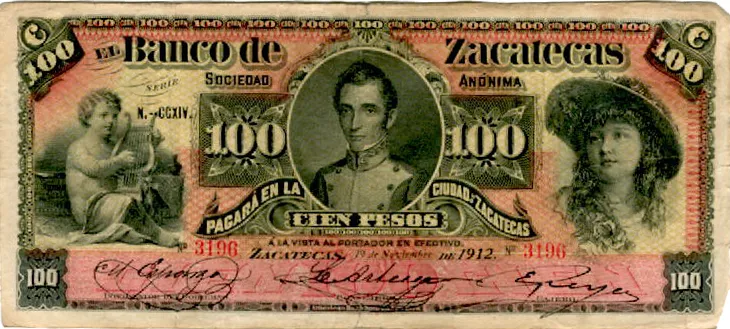
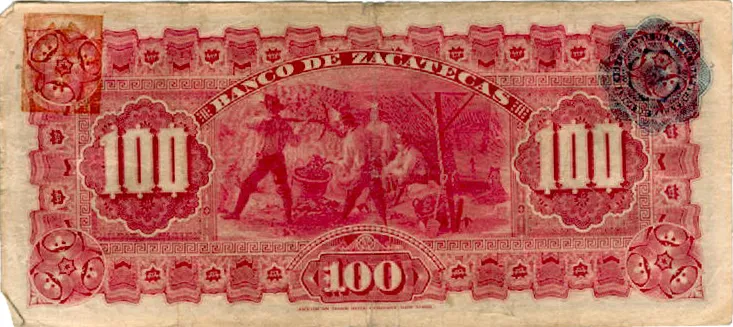
Design
Banxico
Obverse
Banco de Zacatecas
Engraved allegorical vignettes: a miner on the left, a female figure with goods in the center, and the profile portrait of a young man on the right
Reverse
Scenes of mining and labor, or a monument set against the mountainous landscape of Zacatecas
About this banknote
Most old Mexican banknotes are worth a modest premium, but a few private-bank issues from the Porfiriato era command real money among world paper money collectors. The 1912 Banco de Zacatecas 100 pesos note is one of the more sought-after types, and its value depends almost entirely on condition and how much of it survives intact. A worn example may bring 30 to 80 dollars, while a crisp, well-preserved note can reach several hundred dollars or more.
This is not a Banco de México note. It predates Mexico's central bank entirely. Before 1925, individual Mexican states hosted private banks licensed to print their own paper money, each note backed by silver. Zacatecas, one of the great silver-mining regions of the world, ran the Banco de Zacatecas, and that mining heritage shows up all over the design.
What it is
The Banco de Zacatecas was a state bank of issue during the Porfiriato, the long rule of President Porfirio Díaz (1876 to 1911). Under a system called "banca de emisión múltiple" (multiple-bank issue), dozens of private banks across Mexico printed their own currency. The silver produced in the local mines was the guarantee behind the paper. That system ended when the Banco de México was founded in 1925 and took over all note issuance.
The front (obverse) carries engraved allegorical vignettes: a miner on the left, a female figure with goods at the center, and the profile portrait of a young man on the right. The back (reverse) shows scenes of mining and labor, or a monument set against the mountainous landscape of Zacatecas. The imagery is deliberate. The mineral wealth was the reason the note had any value at all.
What it's worth in 2026
This is historic paper money, over a century old, so any value is purely collector value. Two things drive the price: condition and rarity of the issuing bank.
Private-bank notes from the Porfiriato and the paper money ("vales") of the Mexican Revolution have an active collector market of their own. Some issues are common and trade for pocket change over face; others are genuinely scarce because they circulated so little, or because so few survived intact. A large denomination like 100 pesos would have been a significant sum in 1912, so fewer were printed and fewer survived than the small change of the day.
| Note | Year | Typical collector value (USD) | Where it trades |
|---|---|---|---|
| Banco de Zacatecas 100 pesos, worn / damaged | 1912 | 30 to 80 | Dealer, collector forums |
| Banco de Zacatecas 100 pesos, clean circulated | 1912 | 100 to 300 | Auction, specialist dealers |
| Banco de Zacatecas 100 pesos, uncirculated / crisp | 1912 | 300 and up | Heritage, specialist auction |
These are guidance ranges, not fixed quotes. Condition on antique paper money swings value dramatically. A note with tears, pinholes, heavy foxing, or missing corners sits at the bottom of the range. A bright, full-margin note with strong color and no repairs sits at the top. Watch out for notes that have been "canceled": many bank-of-issue notes were punched, stamped, or cut when withdrawn from circulation, and a canceled note is worth noticeably less than an issued one of the same grade.
The ones people think are worth a fortune but aren't
Age alone does not make a banknote valuable. A century-old note is not automatically rare, and "it's from 1912" is not a selling point on its own. What actually moves the price is survival rate (how many still exist), the specific bank and denomination, and above all the state of preservation. A heavily circulated Banco de Zacatecas note is a nice historical piece, but it is not a life-changing find.
How to check what yours is worth
Before you sell, look at three things:
- Condition. Is it crisp with no folds, or soft and creased? Flatten it gently, never tape or trim it, and photograph both sides in good light.
- Serial number. Low numbers and repeating or palindrome serials add a premium among specialists.
- Cancellation. Check for punch holes, cut corners, or overprints that mark the note as redeemed.
For authenticity, compare the paper, engraving, and signatures against reference images of genuine Banco de Zacatecas issues. Real notes of this era are printed on quality banknote paper with fine engraved detail and hand-signed or printed signatures. Reproductions and reprints tend to have flat, printed-looking color, smooth modern paper, and soft detail. If you are unsure, post clear scans in a specialist forum before you buy or sell.
Where to sell it
For a note like this, the safest routes are a verified numismatic dealer from the Pesoteca directory, who can appraise it in person, or the Pesoteca buy-and-sell forum where world paper money collectors trade directly. Photograph both faces in good light, note the serial number and any cancellation, and get more than one opinion before accepting an offer. Avoid dumping it to the first buyer on social media.
Have a Banco de Zacatecas or another Porfiriato-era note and want a read on it? Post your photos in the Pesoteca forum and let the community weigh in before you sell.
Historical context
The Banco de Zacatecas lived out its final years of issuance in the midst of the Mexican Revolution. This 100-peso note dated 1912 circulated in an already convulsed country, when the role of the regional banks was beginning to falter amid political instability and the proliferation of revolutionary issues.
Despite the context, the design remains faithful to the bank's tradition: the miner as an emblem of Zacatecas's silver wealth, the female allegory of commerce, and the youthful portrait in profile, with scenes of mining and mountain landscape on the reverse. That iconography sought to project continuity and confidence just when both were in short supply.
The note was printed by the American Bank Note Company. Barely two years later, in 1914, the capture of Zacatecas by Francisco Villa's División del Norte would force the bank to close its head office and relocate to Mexico City.
Frequently asked questions
How much is the 1912 Banco de Zacatecas 100 pesos note worth?
As a collector item, a worn example typically brings 30 to 80 dollars, a clean circulated note runs 100 to 300 dollars, and a crisp uncirculated note can reach 300 dollars or more. Condition and whether the note was canceled when withdrawn are the biggest factors. These are private-bank notes, not Banco de México currency, so they have no face value today.
Is the Banco de Zacatecas 100 pesos note rare?
Some Porfiriato private-bank notes are common and others are genuinely scarce. Large denominations like the 100 pesos were printed in smaller quantities and fewer survived intact, so a well-preserved, uncanceled example is harder to find and more valuable than the small change of the era. Age alone does not make it rare; survival rate and condition do.
Where can I sell a 1912 Banco de Zacatecas 100 pesos note?
The safest options are a verified dealer from the [Pesoteca directory](/tiendas), who can appraise it on the spot, or the [Pesoteca buy-and-sell forum](/foro/compra-venta) where world paper money collectors trade directly. Photograph both sides in good light, note the serial number and any cancellation marks, and get more than one opinion before selling.
How can I tell if my Banco de Zacatecas note is genuine?
Compare the paper, engraving, and signatures against reference images of authentic issues. Genuine notes use quality banknote paper with fine engraved detail; reproductions tend to have flat printed color, smooth modern paper, and soft detail. Check for punch holes or overprints that mark a note as redeemed. If in doubt, post clear scans in the [Pesoteca forum](/foro) before you buy or sell.
Características Banxico
Firmas autógrafas
Familia PRIV
This banknote belongs to the BIL-PRIV family within the Sistema PSM . Explore all the banknotes that share origin, era and design with this piece.
Ver todos los billetes de la familia PRIV →