
100 Pesos Banknote (1906): Banco de Zacatecas Value
Familia PRIV · algodón
Period: Bancos privados de emisión
Design
Banxico
Obverse
Banco de Zacatecas
Engraved allegorical vignettes: a miner on the left, a female figure with goods in the center, and the profile portrait of a young man on the right
Reverse
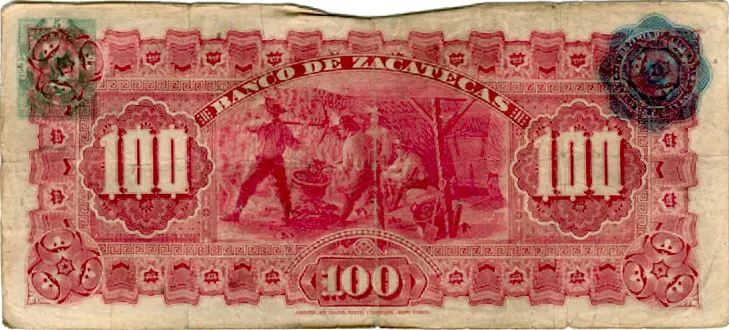
Scenes of mining and labor, or a monument set against the mountainous landscape of Zacatecas
About this banknote
Most people who inherit an old Mexican banknote assume it's a fortune. Usually it isn't, but the 1906 Banco de Zacatecas 100 pesos note is a genuine collector item, not a face-value bill. Depending on condition, real examples trade from roughly 40 USD for a worn, common note to several hundred USD for a crisp, high-grade piece. This is private-bank paper money from before Mexico had a central bank, and that history is exactly what gives it a market.
What this note actually is
Before 1925, Mexico had no single central bank. Under the government of Porfirio Díaz (the era collectors call the Porfiriato, roughly 1876 to 1911), individual states licensed private banks to print their own paper money, backed by silver. The Banco de Zacatecas was one of them. Zacatecas was mining country, so the note's imagery is all about silver: the metal in the ground was the guarantee behind the paper.
The front (anverso) carries engraved allegorical vignettes: a miner on the left, a female figure with goods at the center, and a young man's portrait in profile on the right. The back (reverso) shows mining and labor scenes, or a monument set against the mountainous Zacatecas landscape. This whole system of many issuing banks ended when the Banco de México was founded in 1925 and took over all note issuance.
Because it's private-bank issue, this is what English-speaking collectors of world paper money (notaphily) file under Mexican "emergency" and private issues, a niche but active corner of the market.
How much it's worth in 2026
This is historic paper money more than a century old, so its value is purely collector value. Face value means nothing here; these notes were demonetized generations ago. What drives price is condition, the specific issuing bank, and how many survived.
Here's the honest reality. Private-bank notes from the Porfiriato and later Revolution-era scrip vary enormously. Some banks printed heavily and their notes are common; others are genuinely scarce, and many circulated so little (or were redeemed and destroyed) that intact examples are hard to find today. A heavily circulated, common Banco de Zacatecas note might bring 40 to 80 USD. A clean, well-centered example with strong color and no tears can reach into the low hundreds. Rare denominations or top-grade certified notes go higher.
| Note | Issuer | Era | Typical value (USD) |
|---|---|---|---|
| 100 pesos (1906) | Banco de Zacatecas | Porfiriato, private bank | 40 to 80 (circulated) |
| 100 pesos (1906) | Banco de Zacatecas | Porfiriato, private bank | 150 to 400+ (crisp / high grade) |
Ranges reflect the world paper money collector market. Specific dates, signatures, and series letters can move a note within or beyond these figures, so grade and exact variety always matter more than the headline denomination.
The ones people overvalue
A common myth: "it's over 100 years old, so it must be worth thousands." Age alone does not create value. Millions of these state-bank notes were printed, and survivors in low grade are not rare. A creased, stained, torn note is worth the low end no matter how old it looks. What commands real money is a note that survived clean: no folds, no pinholes, bright ink, full margins. Condition separates a 50 USD note from a 400 USD note more than anything else.
How to check what yours is worth
Check three things before you value or sell:
- Condition (grade). Notaphily uses grades from Good up to Uncirculated. Look for folds, tears, pinholes, stains, and how sharp the corners are. An uncirculated note (no folds at all) is worth many times a worn one. For high-value pieces, third-party grading by PMG (Paper Money Guaranty) adds trust and price.
- Rarity signals. A low serial number, a repeating or palindrome (radar) serial, or a genuine printing error can multiply value. Normal wear is not an error; a factory misprint, misaligned cut, or ink shift is.
- Authenticity. Compare the paper, engraving, signatures, and colors against verified reference images of Banco de Zacatecas issues. Reproductions and modern reprints usually have smooth, flat paper and dull, printed-flat color instead of the crisp intaglio engraving of a genuine note. When in doubt, post clear photos of both sides in the Pesoteca forum for a second opinion.
For more on Mexican paper money and how the market values it, see our guide to valuable Mexican banknotes and the broader background on Mexican numismatics.
Where to sell it
If you want to sell, don't dump it to the first Facebook offer. The safer routes:
- A verified dealer from the Pesoteca shop directory, who can appraise it in person.
- The Pesoteca buy-and-sell forum, where collectors of Mexican and world paper money will make real offers.
- For a genuinely scarce or high-grade note, an international auction house that handles world paper money reaches the widest pool of specialist buyers.
Always photograph both sides in good light, note the serial number, and be honest about condition. Buyers price grade, and they will spot a hidden crease.
Got an 1906 Banco de Zacatecas note in a drawer? Post both sides in the Pesoteca forum and let collectors tell you what variety and grade you're holding before you sell.
Historical context
By 1906, the Banco de Zacatecas had been issuing notes for fifteen years as part of the framework of private banks that made up for the absence of a central bank in Mexico. This 100-peso example of 1906 belongs to a somewhat later cataloging variant (M579c), a reflection of the successive series the bank issued as its circulation grew.
Its design keeps the institution's hallmark: the miner evoking Zacatecan silver, the female figure of commerce, and the young man portrayed in profile. On the reverse, scenes of mining and labor against a mountainous background spoke of the state that backed the paper.
Like the rest of the bank's production, this note was engraved by the American Bank Note Company. Its high denomination destined it for larger transactions within a regional economy still closely tied to silver coinage.
Frequently asked questions
How much is the 1906 Banco de Zacatecas 100 pesos note worth?
It's a collector item, not a face-value bill. A worn, common example typically brings 40 to 80 USD, while a crisp, high-grade note can reach 150 to 400 USD or more. A low serial number, a radar (palindrome) serial, or a genuine printing error can push it higher. Condition drives the price.
Is the 1906 Banco de Zacatecas note rare?
It depends on grade. Worn survivors are relatively available and sit at the low end. What's genuinely scarce is a clean, uncirculated example with no folds, sharp corners, and bright ink. Age alone doesn't make it rare; a note that survived in top condition is what commands real money.
Where can I sell my 1906 Banco de Zacatecas 100 pesos note?
The safest options are a verified dealer from the [Pesoteca shop directory](/tiendas), who can appraise it in person, or the [Pesoteca buy-and-sell forum](/foro/compra-venta) among collectors. For a scarce or high-grade note, an international auction house that handles world paper money reaches the most specialist buyers. Photograph both sides and note the serial number before selling.
How do I tell if the 1906 Banco de Zacatecas note is genuine?
Compare the paper, engraving, signatures, and colors against verified reference images. Genuine notes show crisp intaglio engraving and textured paper; reproductions usually have smooth, flat paper and dull, printed-flat color. When in doubt, post clear photos of both sides in the [Pesoteca forum](/foro), or send high-value pieces to PMG for professional certification.
Características Banxico
Firmas autógrafas. CLXI Aguascalientes
Familia PRIV
This banknote belongs to the BIL-PRIV family within the Sistema PSM . Explore all the banknotes that share origin, era and design with this piece.
Ver todos los billetes de la familia PRIV →