
100 Pesos Banknote (1899): Banco de Zacatecas Value
Familia PRIV · algodón
Period: Bancos privados de emisión
Design
Banxico
Obverse
Banco de Zacatecas
Engraved allegorical vignettes: a miner on the left, a female figure with goods in the center, and the profile portrait of a young man on the right
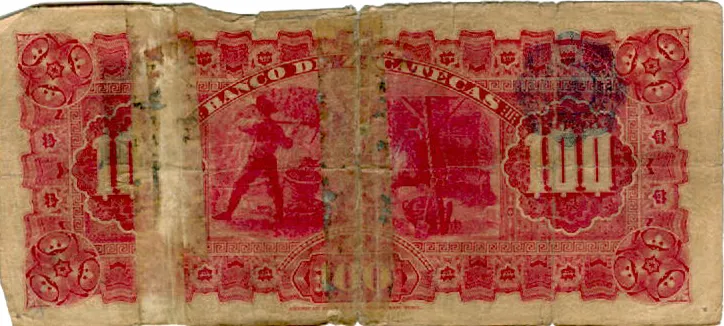
Reverse
Scenes of mining and labor, or a monument set against the mountainous landscape of Zacatecas
About this banknote
Most 19th-century Mexican banknotes are worth a modest amount to collectors, not a fortune. But the 1899 100-peso note from the Banco de Zacatecas is a genuine piece of Porfiriato history, and a clean example can sell for anywhere from roughly 50 to several hundred USD depending on condition. Here's what actually drives the price and how to check yours.
What this note actually is
This is a note from the Banco de Zacatecas, one of the state-chartered private banks that issued paper money during the Porfiriato (the long rule of President Porfirio Díaz, roughly 1876 to 1911). Before Mexico had a single central bank, individual states licensed private banks to print their own currency, each note backed by silver.
Zacatecas was mining country, so the vignettes on the note reflect that: mining was the guarantee behind the paper. This system of multiple issuing banks ended in 1925 when the Banco de México was founded as the sole national issuer. That makes these state-bank notes a distinct collecting category from anything printed after 1925.
Design details
The front (obverse) carries engraved allegorical vignettes: a miner on the left, a female figure with goods at the center, and the profile portrait of a young man on the right. The back (reverse) shows mining and labor scenes, or a monument set against the mountainous Zacatecas landscape. These are engraved intaglio designs, typical of quality 19th-century private-bank printing, often produced by major security printers of the era.
How much is it worth in 2026?
This is historical paper money more than a century old, so its value is purely collector value. It has no legal-tender worth today. Price is driven by four things:
- Condition (grade). A crisp, uncirculated note with no folds, tears, or stains is worth many times a worn, soft, heavily circulated one. This is the single biggest factor.
- Rarity of the issuing bank. Some Porfiriato private-bank notes are relatively common; others survive in tiny numbers because they circulated briefly or were redeemed and destroyed.
- Whether it was issued or remainder. Some of these notes exist as unissued "remainders" (no serial numbers or signatures applied). Fully issued, signed and serial-numbered notes usually command a premium, though for some banks the remainders are actually scarcer.
- Serial number and errors. A low serial number, a repeater, or a genuine printing error raises the value.
As an honest range: a heavily circulated common example might bring only a small amount, while a high-grade or scarce specimen can reach several hundred USD at auction. Anyone quoting you "thousands" for a common circulated note is inflating it. Do not trust the first price you see online. Ask in the Pesoteca forum or a serious dealer before you sell.
| Note | Bank | Date | Typical collector value (USD) | Where it sells |
|---|---|---|---|---|
| 100 pesos | Banco de Zacatecas | 1899 | Roughly 50 to 300+, condition-dependent | World-paper-money auctions, specialist dealers |
| 100 pesos (worn/damaged) | Banco de Zacatecas | 1899 | A few dollars to ~40 | Collector forums, general sales |
| 100 pesos (uncirculated / rare variety) | Banco de Zacatecas | 1899 | Several hundred and up | Heritage, Stack's Bowers, specialist auctions |
Figures are collector-market ranges; exact hammer prices vary by grade, variety, and demand at time of sale.
The myth: "it's over 100 years old, so it's worth a fortune"
Age alone does not make paper money valuable. Millions of Porfiriato and Revolution-era notes survive, and many trade for pocket change. What separates a valuable note from a common one is survival in high grade plus scarcity of the specific bank and denomination. A pristine note from a rarely-seen bank beats a tattered note from a famous one every time.
How to check what yours is worth
- Grade it honestly. Look for folds, tears, pinholes, stains, and how crisp the paper feels. Collectors use grades from Poor up to Uncirculated (professional services like PMG assign numeric grades). Never press or "repair" a note; that lowers value.
- Check the serial number. A low number, a repeating pattern, or a matched set adds interest.
- Look for genuine printing errors. Misaligned cuts, ink smears, or off-center printing can turn a common note into a rarity. Normal wear is not an error.
- Confirm it's authentic. Genuine engraved notes show fine raised intaglio lines you can feel, quality watermarked or laid paper, and sharp lettering. Reproductions and reprints usually have flat colors and smooth, modern paper. Compare against verified images of Banco de Zacatecas issues.
- Get a second opinion before selling. Photograph both sides in good light and post them in the Pesoteca forum or take the note to a listed dealer in the Pesoteca shop directory.
Where to sell it
For a note like this, the safest routes are a verified numismatic shop from the Pesoteca directory, which can appraise it on the spot, or the Pesoteca buy-and-sell forum among collectors. World paper money (notaphily) is an active English-language market, so international specialist auction houses are also an option for higher-grade or scarce examples. Always photograph both faces clearly and disclose any faults before agreeing on a price. Avoid dumping it to the first buyer on a general marketplace.
Got a Banco de Zacatecas note or another Porfiriato private-bank issue in the drawer? Post clear photos of both sides in the Pesoteca forum and let the community help you pin down the bank, the variety, and a realistic value.
Historical context
Founded in 1891 with capital from local owners and mining entrepreneurs, the Banco de Zacatecas was one of the many issuing banks that gave the Mexican provinces their own paper money during the Porfiriato. This 1899 100-peso note circulated at the height of that regional banking, before legislation and, later, the Banco de México centralized issuance.
The obverse displays the house's visual seal: a miner, the female allegory of commerce, and the profile portrait of a young man, a composition designed to convey solidity and local roots. The reverse, with its mining scenes and mountainous landscape, points directly to Zacatecas's chief source of wealth.
Printing was handled by the American Bank Note Company of New York. High denominations like this one rarely passed from hand to hand in daily life; they served to settle accounts among commercial houses and to back financial operations of a certain scale.
Frequently asked questions
How much is the 1899 100-peso Banco de Zacatecas note worth?
It's a collector item with no legal-tender value today. A heavily circulated example may bring only a few dollars up to around 40 USD, while a crisp uncirculated or scarce variety can reach several hundred USD. Condition and the rarity of the issuing bank drive the price more than age.
Is the 1899 100-peso Banco de Zacatecas note rare?
It depends on grade and variety. Circulated examples turn up regularly, but high-grade, fully issued, signed and serial-numbered notes are genuinely scarce because few survived in clean condition. A low serial number or a printing error makes any example harder to find and more valuable.
Where can I sell an 1899 Banco de Zacatecas banknote?
Use a verified dealer from the [Pesoteca shop directory](/tiendas) for an on-the-spot appraisal, or the [Pesoteca buy-and-sell forum](/foro/compra-venta) among collectors. For high-grade or scarce examples, international world-paper-money auction houses are also a strong option. Photograph both sides clearly and disclose any flaws before selling.
How can I tell if the note is genuine?
Genuine engraved notes have fine raised intaglio lines you can feel, quality watermarked or laid paper, and sharp lettering. Reproductions and modern reprints usually show flat colors and smooth paper. Compare the design, paper, and signatures against verified images of Banco de Zacatecas issues, and if in doubt post photos in the [Pesoteca forum](/foro).
Características Banxico
Firmas autógrafas
Familia PRIV
This banknote belongs to the BIL-PRIV family within the Sistema PSM . Explore all the banknotes that share origin, era and design with this piece.
Ver todos los billetes de la familia PRIV →