
100 Pesos 1898 Banco de Zacatecas Banknote Value
Familia PRIV · algodón
Period: Bancos privados de emisión
Design
Banxico
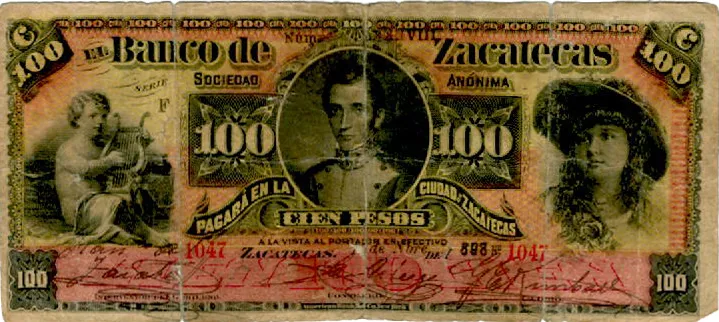
Obverse
Banco de Zacatecas
Engraved allegorical vignettes: a miner on the left, a female figure with goods in the center, and the profile portrait of a young man on the right
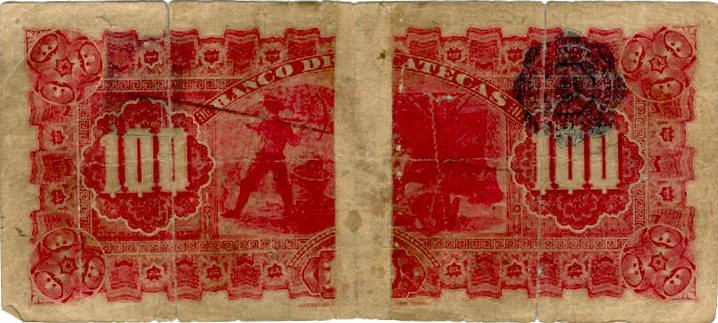
Reverse
Scenes of mining and labor, or a monument set against the mountainous landscape of Zacatecas
About this banknote
Most people who inherit an old Mexican banknote assume it's worthless paper. The 100-peso note from the Banco de Zacatecas (1898) is different: it's a genuine piece of Porfiriato-era paper money, and depending on condition and how many survived, it can be worth anywhere from about 50 USD to several hundred USD to collectors of world paper money.
This is not a Banco de México note. In 2026, collectors value it as a private-bank issue from an era before Mexico had a central bank, and that history is exactly what drives demand.
What it actually is
Before Mexico had a single central bank, each state licensed its own private banks to print paper money, backed by silver. Zacatecas, one of the great mining regions in the Americas, had the Banco de Zacatecas. That's why the vignettes on this note are all about mining: the silver in the ground was literally the guarantee behind the paper.
This system of multiple issuing banks ended when the Banco de México was founded in 1925. Notes printed under the old system, like this one, became historical artifacts overnight.
On the front (obverse): engraved allegorical vignettes. A miner on the left, a female figure with merchandise in the center, and the profile portrait of a young man on the right.
On the back (reverse): scenes of mining and labor, or a monument set against the mountainous Zacatecas landscape.
How much is it worth?
This is historical paper money, more than a century old, so its value is purely collector value. It has no face-value floor the way a modern circulating note does. Two things drive the price:
- Condition (grade). A crisp, uncirculated note with no folds, tears, or stains can be worth many times a worn, limp example that has been handled for decades.
- Rarity of the issuing bank and the specific note. Some Porfiriato private-bank notes are relatively common; others are genuinely scarce because very few survived intact.
| Item | Detail |
|---|---|
| Denomination | 100 pesos |
| Issuer | Banco de Zacatecas (private state bank) |
| Date | 1898 |
| Type | Porfiriato private-bank issue, silver-backed |
| Typical collector range | ~50 to 400+ USD depending on grade and rarity |
| Face-value floor | None (no longer legal tender) |
Be honest with yourself about condition before you get excited. A note with heavy creases, foxing (brown age spots), or pieces missing sits at the low end. A clean, well-margined, brightly printed example is what serious notaphily collectors chase.
The myth to avoid
A lot of sellers online will tell you any 100-year-old banknote is "rare" and "worth thousands." For most Porfiriato and Revolution-era notes, that's not true. Private-bank notes and Revolution scrip form their own market: a handful are extremely scarce, but many others turn up regularly and sell for modest sums. Don't trust the first inflated internet price you see. Get it looked at before you buy or sell.
How to tell if yours is genuine
Reproductions and modern fakes of these notes exist. Check the following:
- Paper feel. Original notes were printed on quality banknote paper with a distinct texture. Reproductions often use smooth, flat modern paper.
- Printing depth. Genuine engraved vignettes show fine line detail and slight relief. Fakes tend to look flat, with washed-out or overly uniform color.
- Signatures and design. Compare the layout, the vignettes, and the signatures against verified reference images of Banco de Zacatecas issues.
If anything looks off, post clear photos of both sides in the Pesoteca forum before spending money.
What makes yours worth more
- Low serial numbers and palindrome (radar) serials attract collectors.
- Genuine printing errors: misaligned cuts, ink smears, factory folds, or off-center printing. These turn a common note into a scarce one. Normal wear and handling damage is not an error.
- Top grade. An uncirculated note far outperforms a circulated one of the same type.
Where to sell it
For selling an 1898 100-peso Banco de Zacatecas note, the safest routes are a verified numismatic shop from the Pesoteca directory, which can appraise it on the spot, or the Pesoteca buy-and-sell forum where collectors of Mexican paper money gather. Photograph both faces in good light, note the serial number, and flag any low serial, radar serial, or error. Avoid dumping it on a general marketplace to the first bidder who lowballs you.
Got one of these in a shoebox or an old family collection? Post photos of the front and back in the Pesoteca forum and let the community help you pin down the grade and a fair value.
Historical context
The Banco de Zacatecas operated in a Mexico without a central bank: each authorized regional institution issued notes convertible into silver or gold, backed by its own capital. This 100-peso example dated 1898 corresponds to the bank's years of consolidation, when it had already extended its reach beyond the Zacatecas capital with offices in Aguascalientes and San Juan de los Lagos.
The iconography repeats the bank's allegorical program: the miner, emblem of the silver wealth that made Zacatecas famous from the sixteenth century onward, alongside a female figure representing commerce. On the reverse, scenes of labor and a mountainous landscape reinforced the identity of a state defined by its silver veins.
The notes came off the plates of the American Bank Note Company, a world reference in steel engraving. In an economy where most transactions were made in silver coins, a 100-peso note was an instrument of bankers, hacienda owners, and major merchants.
Frequently asked questions
How much is an 1898 100-peso Banco de Zacatecas note worth?
It has no face-value floor because it is no longer legal tender, so its value is entirely collector value. Depending on condition and rarity, examples typically range from about 50 USD for worn notes up to several hundred USD for crisp, uncirculated pieces or those with special serial numbers. Grade and survival rate drive the price.
Is the 1898 100-peso Banco de Zacatecas note rare?
Some Porfiriato private-bank notes are scarce and some are relatively common. This is a private state-bank issue from before the Banco de México existed (founded 1925), and many circulated so little or survived in such small numbers that clean, complete examples can be hard to find. Condition matters as much as age.
Where can I sell my 1898 100-peso banknote?
The safest options are a verified numismatic shop from the Pesoteca directory, which can appraise it in person, or the Pesoteca buy-and-sell forum among collectors of Mexican paper money. Photograph both sides clearly, record the serial number, and note any low or palindrome serial or printing error, since those raise the value.
How do I tell if the note is genuine?
Check the paper texture (originals use quality banknote paper, reproductions often use flat modern paper), the depth and fine detail of the engraved vignettes, and the signatures and design against verified reference images. Fakes tend to look flat with washed-out color. If in doubt, post photos of both sides in the Pesoteca forum for a second opinion.
Características Banxico
Firmas autógrafas, LXXXVII
Familia PRIV
This banknote belongs to the BIL-PRIV family within the Sistema PSM . Explore all the banknotes that share origin, era and design with this piece.
Ver todos los billetes de la familia PRIV →