
100 Pesos Banknote (1897), Banco de Zacatecas
Familia PRIV · algodón
Period: Bancos privados de emisión
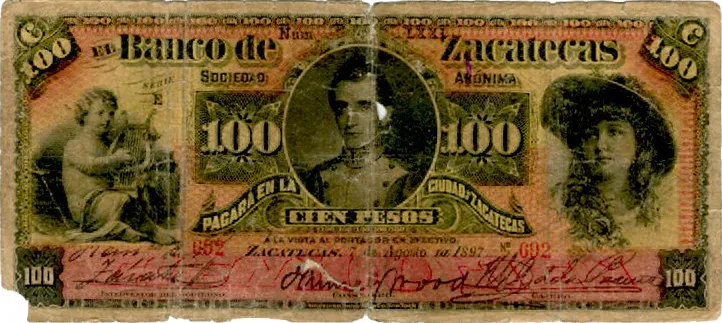
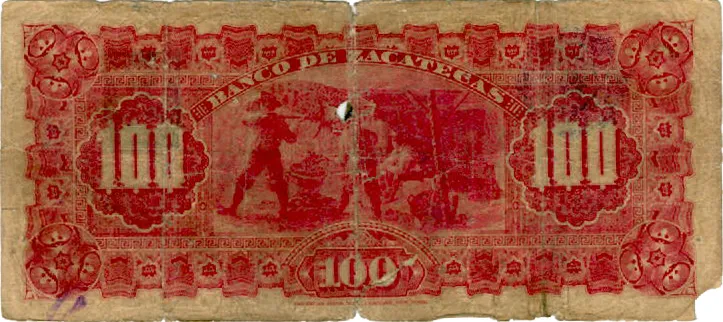
Design
Banxico
Obverse
Banco de Zacatecas
Engraved allegorical vignettes: a miner on the left, a female figure with goods in the center, and the profile portrait of a young man on the right
Reverse
Scenes of mining and labor, or a monument set against the mountainous landscape of Zacatecas
About this banknote
Most old Mexican banknotes are worth a modest premium over face value, but the 1897 100 pesos note from the Banco de Zacatecas is a different animal. This is a privately issued, silver-backed note from the Porfiriato era, more than a century old, and in collectible grades genuine examples trade for hundreds of US dollars. Condition and survival rate drive everything here.
What it actually is
Before Mexico had a single central bank, individual states licensed their own private banks to print paper money backed by silver reserves. The Banco de Zacatecas was one of them. Zacatecas is legendary mining country, so the vignettes on this note lean into that theme: the silver in the ground was the guarantee behind the paper.
This multi-bank issuing system ended when the Banco de México was founded in 1925, which makes every surviving private-bank note from this period a closed, finite population. Nothing new will ever be printed.
Design details to confirm you have the right note
- Front (obverse): engraved allegorical vignettes. A miner at left, a female figure with goods at center, and a young man's profile portrait at right.
- Back (reverse): mining and labor scenes, or a monument set against the mountainous Zacatecas landscape.
- Issuer: Banco de Zacatecas, a state-chartered bank of issue during the Porfiriato (the long rule of Porfirio Díaz).
These engraved details matter for authentication. Genuine notes from this era were printed on high-quality banknote paper with sharp, deep engraving. Reproductions and reprints tend to look flat, with smooth paper and dull, printed-looking color.
How much is it worth in 2026
This is historic paper money with no legal tender value today, so the entire worth is collector value. For Porfiriato private-bank notes, that value swings widely based on two things:
- The issuing bank's rarity. Some banks printed heavily and their notes are common. Others issued very little, or their notes barely circulated and few survived intact. Banco de Zacatecas notes fall into the scarcer, sought-after tier among world paper money collectors.
- Condition. A crisp, uncirculated note with no folds, tears, stains, or pinholes can be worth many times a worn, limp example with edge damage.
| Note | Issuer | Year | Typical collector value (USD) | Where it trades |
|---|---|---|---|---|
| 100 pesos | Banco de Zacatecas | 1897 | Low hundreds (worn) to high hundreds or more (uncirculated) | Numismatic dealers, notaphily auctions, collector forums |
We give a range here rather than a single fake number because condition and any special features move the price dramatically, and a genuine graded example can outperform a raw one significantly. If you have one, do not trust the first figure you see on a marketplace listing. Get it assessed by a serious dealer or ask the Pesoteca forum before you sell.
What can push the value up
- Uncirculated condition. No folds, crisp corners, original paper body.
- Low or repeating serial numbers. A low serial or a palindrome (radar) number is a premium feature.
- Printing errors. Misaligned cuts, ink smears, factory folds, or off-center serials can turn a common note into a rarity worth several times more. Normal wear and use damage is not a factory error.
- Third-party grading. A note certified by PMG (Paper Money Guaranty) sells for more and clears authentication doubts instantly.
The ones people overprice by mistake
Age alone does not make a banknote valuable. Plenty of century-old Mexican notes sell for very little because they survive in large numbers or in poor condition. A heavily circulated, torn, or repaired 1897 note is worth far less than the pristine figures you may see quoted online. Match your note's actual condition to the price you expect, not the best example in a headline.
Be aware that modern reprints and souvenir reproductions of Porfiriato notes exist. Smooth, uniform paper and flat color are the tells.
How to check what yours is worth
- Photograph both sides in good, even light. Sharp images of the front and back are what any buyer or appraiser needs first.
- Grade the condition honestly. Look for folds, tears, pinholes, stains, and missing corners.
- Check the serial number for a low number or palindrome.
- Authenticate. Compare the engraving, paper, and signatures against reference images. For a firm answer, consider PMG certification or ask experienced collectors.
- Get a real valuation from a verified numismatic dealer or the collector community before you sell.
Where to sell it
For world paper money at this level, your best options are a reputable numismatic dealer who handles Mexican notes, a notaphily auction house, or a direct sale to a collector through a trusted forum. Avoid dumping it to the first bidder on a general social-media marketplace, where these notes are routinely underpriced. Always show both faces, the serial number, and the true condition before agreeing on a price.
Think you have an 1897 Banco de Zacatecas note, or another Porfiriato private-bank issue? Post clear photos of both sides in the Pesoteca forum and let collectors weigh in on its rarity and value.
Historical context
Before the Banco de México monopolized issuance in 1925, the country lived through the era of the private banks of issue: regional institutions authorized by the Ministry of Finance to print their own paper money. The Banco de Zacatecas was born under that logic, with a concession granted on March 3, 1891, and backed by Zacatecan mining entrepreneurs who sought to finance the state's commerce and extractive activity.
This 100-peso note of 1897 belongs to the bank's earliest series. Its allegorical vignettes are no accident: the miner on the left pays homage to Zacatecas's vocation as one of Mexico's great silver centers, while the female figure with goods symbolizes the commerce and prosperity the bank claimed to drive.
Like almost all the serious banks of the time, the Zacatecas bank commissioned the printing of its notes from the American Bank Note Company of New York, a guarantee of fine engraving hard to counterfeit. A 100-peso piece was, in 1897, a considerable sum reserved for substantial transactions.
Frequently asked questions
How much is the 1897 Banco de Zacatecas 100 pesos note worth?
As historic paper money it has no face value today, so its worth is purely collector value. Genuine examples typically range from the low hundreds of US dollars in worn condition to high hundreds or more in uncirculated grade. A low or palindrome serial number, a printing error, or PMG certification can push it higher. Condition and rarity drive the price.
Is the 1897 Banco de Zacatecas note rare?
It comes from a private state bank of the Porfiriato era, and issuance ended for good when the Banco de México was founded in 1925, so the surviving population is fixed and finite. Banco de Zacatecas notes sit in the scarcer, more sought-after tier of Mexican paper money, especially in high grade or with special serial numbers.
Where can I sell an 1897 100 pesos Mexican banknote?
Sell through a reputable numismatic dealer who handles Mexican notes, a notaphily auction house, or a direct collector sale via a trusted forum such as the [Pesoteca forum](/foro). Photograph both sides in good light and note any low or palindrome serial or printing error, as those raise value. Avoid selling to the first bidder on a general social-media marketplace.
How can I tell if my 1897 Banco de Zacatecas note is genuine?
Genuine notes from this era were printed on quality banknote paper with sharp, deep engraving. Compare the vignettes, paper feel, signatures, and color against reference images. Reproductions usually have smooth paper and flat, printed-looking color. For a definitive answer, consider PMG certification or post clear photos of both sides in the [Pesoteca forum](/foro).
Características Banxico
Firmas autógrafas, LXXII
Familia PRIV
This banknote belongs to the BIL-PRIV family within the Sistema PSM . Explore all the banknotes that share origin, era and design with this piece.
Ver todos los billetes de la familia PRIV →