
100 Pesos Banknote (1896), Banco de Zacatecas
Familia PRIV · algodón
Period: Bancos privados de emisión
Design
Banxico
Obverse
Banco de Zacatecas
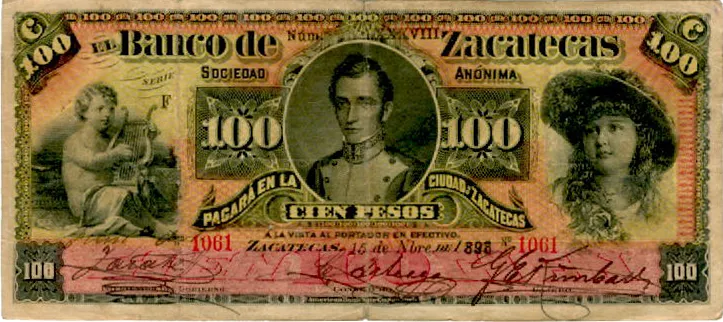
Engraved allegorical vignettes: a miner on the left, a female figure with goods in the center, and the profile portrait of a young man on the right
Reverse
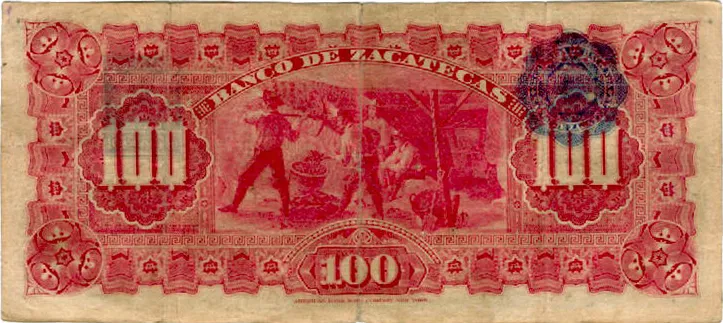
Scenes of mining and labor, or a monument set against the mountainous landscape of Zacatecas
About this banknote
If you have found an 1896 100 pesos note from the Banco de Zacatecas, it is not spendable money, it is a collectible piece of Mexican banking history. Value depends almost entirely on condition and whether the note was issued or remained unsigned. Common circulated examples trade for tens of dollars; crisp, fully issued, or rare-signature notes can reach several hundred dollars or more.
What this note actually is
Before Mexico had a single central bank, each state ran its own private banks licensed to print paper money backed by silver. The Banco de Zacatecas was one of these regional issuers during the Porfiriato, the long rule of Porfirio Díaz (roughly 1876 to 1911). Zacatecas was mining country, and the note reflects that: the silver in the ground was the guarantee behind the paper. This system of multiple issuing banks ended when the Banco de México was founded in 1925 and took over sole authority to print currency.
So a note like this predates the modern Banco de México entirely. That is the first thing US collectors get wrong: it is not a "Bank of Mexico" note, it is a private state-bank note from a completely different era.
What it looks like
The face carries engraved allegorical vignettes: a miner on the left, a female figure with goods at the center, and a portrait of a young man in profile on the right. The back shows mining and labor scenes or a monument set against the mountainous Zacatecas landscape. Because these were engraved by security printers of the period, the detail is fine and the imagery is themed around silver mining, the source of the bank's backing.
How much is it worth in 2026
This is historic paper money, over a century old, so its value is purely collectible. Two factors drive the price:
- Issued vs. remainder. Many Porfiriato private-bank notes survive as "remainders," meaning they were printed but never signed, dated, or put into circulation because the bank's charter ended or stocks were left over. Remainders are more common and cheaper. A fully issued note with genuine signatures and serial numbers is scarcer and worth more.
- Condition. A crisp, uncirculated remainder can look beautiful and still be affordable. An issued, circulated note with real history behind it carries a premium even with folds.
As a general range, common Banco de Zacatecas remainders trade from roughly 30 to 100 US dollars depending on grade. Genuinely issued, higher-grade, or scarcer denominations from this bank can run into the several hundreds. Very rare emergency or short-lived issues from the private-bank and Revolution era can go higher, but the 100 pesos type is not among the top rarities.
| Type | Era | Typical range (USD) | Notes |
|---|---|---|---|
| Unsigned remainder, uncirculated | 1896 | 30 to 100 | Most commonly seen |
| Issued, circulated | 1896 | 75 to 250 | Real signatures/serials add value |
| Issued, high grade | 1896 | 200 to 600+ | Condition and scarcity dependent |
These are collector ranges based on how Porfiriato private-bank notes trade in the notaphily (paper-money) market. Any single note should be judged from clear photos of both sides, not from a range alone.
Notes people think are worth a fortune but aren't
Age alone does not make a banknote valuable. Because these notes are 19th-century and look ornate, sellers online sometimes list them for thousands. A plain, unsigned remainder in average shape is not a thousand-dollar note. The pieces that command real money are the scarce issuing banks, the genuinely issued signed notes, and top-grade examples, not every pretty remainder that turns up in a drawer.
How to check what yours is worth
- Look for signatures and serial numbers. Handwritten or printed signatures and inked serials mean an issued note. Blank signature lines mean a remainder.
- Grade the condition. Folds, tears, stains, and pinholes lower value. Note the difference between crisp uncirculated and heavily handled.
- Confirm the bank and denomination. "Banco de Zacatecas," "100 pesos," and the 1896 series should be clearly legible.
- Compare to references. Cross-check the design, paper, and vignettes against cataloged images. Reproductions tend to have smooth modern paper and flat, printed-looking color instead of engraved relief.
Is it genuine?
For a note this old, authenticity comes down to the paper and the printing. Period security printing used engraved intaglio, so the design has slight relief you can sometimes feel and see under magnification. The paper should feel and look aged, not smooth and bright white. Watch for photographic reproductions and "museum copies" that circulate among sellers. If you are unsure, post clear, well-lit photos of both sides in the Pesoteca forum so collectors who handle these regularly can weigh in.
Where to sell it
To sell an 1896 Banco de Zacatecas 100 pesos note, your safest options are a verified dealer from the Pesoteca shop directory, who can appraise it in person, or the Pesoteca buy-and-sell forum where world-paper-money collectors trade directly. Photograph both sides in good light and note whether it is signed, whether the serial is present, and its condition. Avoid dumping it to the first offer on general marketplaces where buyers may not know Porfiriato issues.
Have one in hand? Post the front and back in the Pesoteca forum and let collectors tell you whether yours is a common remainder or a genuinely issued example worth chasing.
Historical context
The Banco de Zacatecas reserved its 100-peso notes for the largest transactions, well above everyday spending. Founded in 1891 with a capital of 600,000 pesos, it printed denominations up to 500 pesos, always backed and with circulation limited to its region within the private banknote-issuing system.
This 100-peso note of 1896 represents a very high sum for the era, suited to large-scale commercial and financial transactions. Its obverse brings together the bank's distinctive iconography: a miner on the left, emblem of Zacatecan silver, a female figure with merchandise at the center alluding to commerce, and the portrait of a young man in profile on the right; on the reverse, scenes of mining and a mountainous landscape. Engraved by the American Bank Note Company of New York, it is among the highest pieces of the series and, because of its denomination, among those that circulated and survived the least. This model of state issue would end with the creation of Banco de México in 1925.
Frequently asked questions
How much is the 1896 Banco de Zacatecas 100 pesos note worth?
As a collectible, common unsigned remainders trade for roughly 30 to 100 US dollars, while genuinely issued, high-grade examples can reach several hundred dollars. It has no spending value; condition and whether it was actually issued (signed with serial numbers) drive the price.
Is this note rare?
It is scarce but not among the top rarities of the era. Many survive as unsigned remainders, which are more common. Fully issued notes with real signatures and serial numbers, or top-grade examples, are the harder pieces to find and command a premium.
Where can I sell my 1896 100 pesos note?
The safest routes are a verified dealer from the [Pesoteca shop directory](/tiendas), who can appraise it on the spot, or the [Pesoteca buy-and-sell forum](/foro/compra-venta) among world-paper-money collectors. Photograph both sides in good light and note whether it is signed before agreeing on a price.
How can I tell if it's genuine?
Period notes used engraved intaglio printing, so the design has fine detail and slight relief, and the paper looks and feels aged rather than smooth and bright white. Reproductions have flat, printed color and modern paper. Compare against cataloged images, and post clear photos of both sides in the [Pesoteca forum](/foro) if you are unsure.
Características Banxico
Firmas autógrafas, LXXXVIII
Familia PRIV
This banknote belongs to the BIL-PRIV family within the Sistema PSM . Explore all the banknotes that share origin, era and design with this piece.
Ver todos los billetes de la familia PRIV →