
Mexico 100 Pesos (1970), Miguel Hidalgo: Value & Prices
Familia A · algodón
Period: México Contemporáneo
Design
Banxico
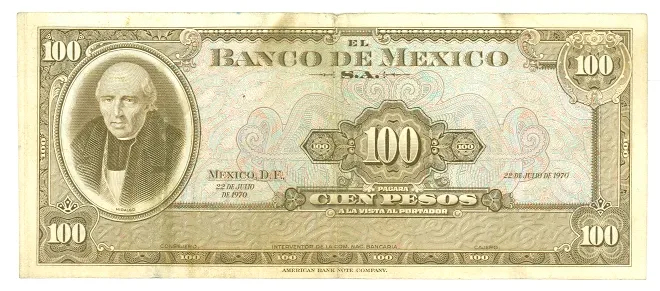
Obverse
Miguel Hidalgo
Portrait of Miguel Hidalgo y Costilla
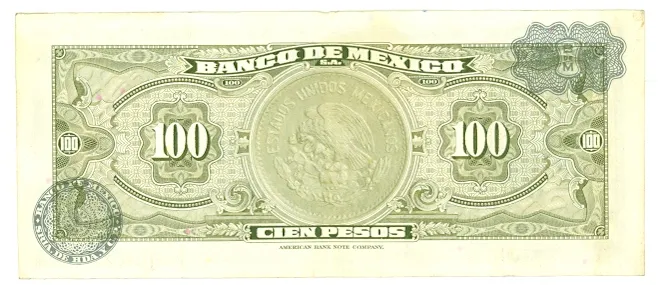
Reverse
The National Coat of Arms
About this banknote
Most 1970 Mexican 100-peso notes are worth only a few US dollars today, well above their face value but far below the fortunes some listings claim. The value that matters is collector value, and it comes down to condition, serial number, and printing errors. Here is what your note is actually worth and how to check.
This is the sepia (brown) 100-peso note from the Banco de México Family A series, featuring Miguel Hidalgo y Costilla, the parish priest of Dolores who launched Mexico's War of Independence in 1810. The classic portrait sits in the warm brown tone that defined this denomination for years.
The back shows the Mexican coat of arms: the golden eagle perched on a nopal cactus, devouring a serpent. It is a plain, formal design typical of Mexican notes from this generation.
How much is it worth in 2026
The note is no longer legal tender, so its worth is purely as a collectible, not face value. Condition drives the price more than anything else.
- Circulated (folded, soft, worn corners): typically a few US dollars, roughly 2 to 8 USD depending on how heavy the wear is.
- Crisp uncirculated (no folds, no stains, sharp corners): commonly 15 to 40 USD, and stronger for early signature combinations or scarce series.
- Special serial numbers or errors: several times the normal price. See the table below.
The honest reality: most Family A 100-peso notes are common. There are millions of them, and the majority sit in the low single-digit-dollar range. Ignore the inflated "worth thousands" listings you see online. Those are either error notes, top-grade certified examples, or wishful pricing that never sells.
Real value drivers
| Feature | Why it matters | Effect on value |
|---|---|---|
| Uncirculated grade | No folds, full crispness, sharp corners | 3x to 8x a worn note |
| Low serial number | First notes off the press (e.g. 0000123) | Adds a strong premium |
| Radar / palindrome serial | Reads the same both ways (e.g. 1234321) | Sought by specialists |
| Solid or repeated digits | e.g. 7777777 | High collector demand |
| Printing error | Miscut, ink smear, misaligned serial, factory fold | Several times face, sometimes far more |
| Early signature combination | Scarcer within the Family A run | Modest to strong premium |
Notes people think are worth a fortune (but aren't)
A plain, circulated 1970 Hidalgo note is not going to fund your retirement. Age alone does not make paper money valuable. What makes a note valuable is rarity, demand, and condition working together. A common note that happens to be old is still a common note. The pieces that command real premiums are the genuinely scarce ones: high-grade certified examples, verified error notes, and standout serial numbers.
Are printing errors valuable?
Yes. Genuine factory errors turn an ordinary note into a rarity. Look for:
- Misaligned or off-center cuts
- Ink runs or smearing
- Factory folds (creases printed into the design)
- Repeated, misaligned, or missing serial numbers
Do not confuse an error with damage. Normal wear, everyday folds, and use damage are not factory errors and add nothing. A true error is present from the moment the note leaves the press. If you think yours has a real error, post clear photos of both sides on the Pesoteca forum and the community will help confirm it.
How to tell if yours is genuine
Older notes are less faked than modern ones, but reproductions and reprints do circulate among unwary buyers. Check:
- Watermark: hold it to the light; genuine notes show a subtle image in the paper.
- Paper feel: authentic notes have textured cotton paper with slight relief you can feel; reprints are smooth and flat.
- Colors: genuine sepia tones have depth; fakes look flat and evenly colored.
- Design and signatures: compare against official Banco de México reference images for Family A.
When in doubt, ask on the forum before you buy or sell. For broader context, read our guide to the most counterfeited banknotes in Mexico.
Where to sell it
For US and international collectors, the strongest market for world paper money runs through specialized dealers, notaphily forums, and certified auction platforms. To sell a 1970 100-peso note:
- Photograph both sides in good, even light.
- Note the serial number and check for low, radar, or repeated digits.
- Grade the condition honestly, or send it for third-party certification (PMG) if it looks uncirculated or carries an error.
- List it through a verified numismatic shop from the Pesoteca directory or the collector buy-and-sell forum.
Avoid dumping it to the first offer on general marketplaces. A note with a low serial, a palindrome, or a genuine error can be worth many times what a rushed buyer will pay.
Got a 1970 Hidalgo note with an odd serial or in original packaging? Post it on the forum and let the community weigh in on what it's really worth.
Historical context
The 1970 100-peso note honors Miguel Hidalgo y Costilla, the priest of Dolores who in the early morning of September 16, 1810, gave the cry that began the war of Independence. The Father of the Nation in official memory, he led the first, massive months of the insurgency before being captured and executed in Chihuahua in 1811.
The reverse is of institutional sobriety: the National Coat of Arms, the eagle devouring the serpent on the nopal, a founding emblem that links the Mexica myth with the Mexican state. It is a solemn choice, fitting for a high denomination of its time.
The piece belongs to family A of the "old pesos," preceding the 1993 reform. In 1970 one hundred pesos represented a considerable sum; it would be years before the inflation of the 1980s forced the printing of five- and six-figure notes.
Frequently asked questions
How much is the 1970 Mexican 100-peso note worth?
A circulated example is typically worth a few US dollars, roughly 2 to 8 USD. A crisp uncirculated note usually brings 15 to 40 USD, and notes with special serial numbers or genuine printing errors can sell for several times more. Condition and rarity decide the price, not age.
Is the 1970 100-peso Hidalgo note rare?
No. It is a common Banco de México Family A note with millions printed, and most examples are worth only a few dollars. The scarce and valuable ones are high-grade certified notes, verified printing errors, and standout serial numbers such as low, radar (palindrome), or solid-digit serials.
Where can I sell a 1970 Mexican 100-peso note?
Sell through a verified [numismatic shop in the Pesoteca directory](/tiendas), which can value it on the spot, or the collector [buy-and-sell forum](/foro/compra-venta). Photograph both sides in good light and check for a low or palindrome serial and any error, all of which raise value. Avoid selling to the first offer on general marketplaces.
How do I tell if my 1970 100-peso note is genuine?
Hold it to the light to check the watermark, feel the textured cotton paper (reprints are smooth and flat), and confirm the sepia colors have depth rather than looking flat. Compare the design and signatures against official Banco de México Family A references. If you are unsure, post photos on the [forum](/foro) before buying or selling.
Características Banxico
Formaban parte del expediente relativo a la sustracción de 480 piezas, de las oficinas de la ABNC. Sin firmas, folio, prefijo, afijo, serie y contraseñas.
Familia A
This banknote belongs to the BIL-A family within the Sistema PSM . Explore all the banknotes that share origin, era and design with this piece.
Ver todos los billetes de la familia A →