
100 Nuevos Pesos of 1992 (Cuauhtémoc): Value Guide
Familia A · algodón
Period: México Contemporáneo
Design
Banxico
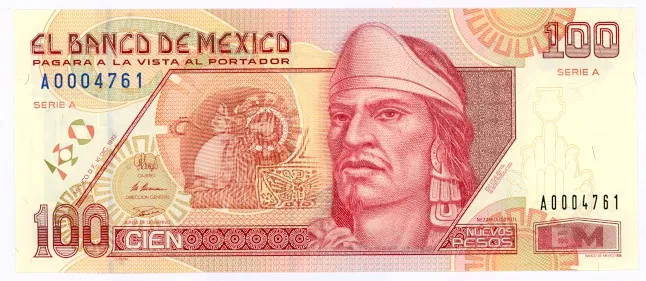
Obverse
Cuauhtémoc
Portrait of Cuauhtémoc with pre-Hispanic motifs
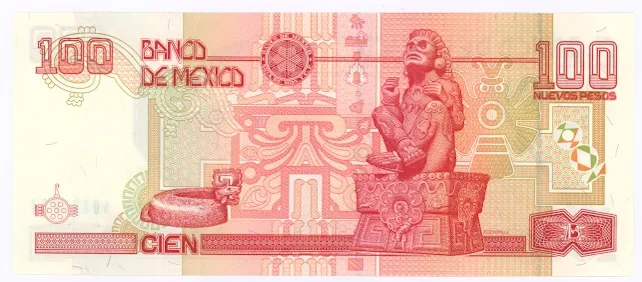
Reverse
The sculpture of Xochipilli, god of flowers
About this banknote
Most 1992 Mexican 100 nuevos pesos notes are worth a few US dollars over face, not a fortune. This is a common note from the Banco de México Family A. But an uncirculated example, a low or radar serial number, or a printing error can push it to several times that. Here is what yours is actually worth and how to check.
This note carries the portrait of Cuauhtémoc, the last Aztec ruler (tlatoani), framed by pre-Hispanic motifs on the front. The back shows the sculpture of Xochipilli, the Aztec god of flowers, music and dance, whose original figure is held at the National Museum of Anthropology in Mexico City. It belongs to the 1992 monetary reform issue, when Mexico introduced the "nuevo peso" (new peso) by removing three zeros from the old currency.
What it's worth in 2026
This note has been demonetized, so it no longer trades at face value. Its worth now is purely collector value, and condition drives everything.
- Circulated (folds, creases, soft corners): roughly 2 to 6 US dollars for a typical example.
- Uncirculated (crisp, no folds, sharp corners): commonly 8 to 25 US dollars, more for a top graded note.
- Low serial numbers, radar/palindrome serials, or early series: a premium on top, often double or more, depending on demand.
- Genuine printing errors: the real prize, these can sell for several times the normal price.
Be skeptical of inflated online listings. Most Family A notes are common, and a listing asking hundreds of dollars for a mid-grade note is fishing for an inexperienced buyer. The market floor for a plain circulated example is low.
Value at a glance
| Feature | Typical value (USD) |
|---|---|
| Circulated, common serial | 2 to 6 |
| Uncirculated, common serial | 8 to 25 |
| Low serial (e.g. 000012) | premium, often 2x+ |
| Radar/palindrome serial | premium, often 2x+ |
| Genuine printing error | several times normal price |
Figures are collector ranges for the standard Banco de México Family A note; a professionally graded (PMG) uncirculated example can exceed these.
The ones people overpay for
Wear is not an error. A note with heavy handling, ink smudges from use, or corner damage is just a used note, not a rarity. True factory errors are things like misaligned cuts, missing print, a fold that happened before printing, or a badly off-center serial. Those are scarce and command real premiums. Everyday damage does not.
How to check what yours is worth
- Grade the condition. Hold it flat under good light. Any fold, crease or rounded corner drops it out of uncirculated.
- Read the serial number. Low numbers, repeating digits, or a serial that reads the same backward (radar) add value.
- Look for errors. Compare against a normal note. Misaligned printing, missing color, or a shifted serial are worth flagging.
- Confirm it's genuine. Check the watermark against the light, the security thread, microprinting and the feel of the paper. Reproductions tend to have smooth, flat paper and dull, uniform color. Compare the design and signatures to official Banco de México images.
Got one with an unusual serial or in a factory sleeve? Post it in the Pesoteca forum and the community will take a look. For context on counterfeits, see the most forged banknotes in Mexico, and browse verified dealers in the Pesoteca shop directory.
Have a 1992 Cuauhtémoc note with a low serial or a printing quirk? Share clear photos of both sides in the buy-and-sell forum and let collectors weigh in before you sell.
Historical context
The 1992 100-peso note leaves behind the heroes of Independence and turns to the pre-Hispanic world with Cuauhtémoc, the last Mexica tlatoani. Successor to Moctezuma and Cuitláhuac, he led the defense of Tenochtitlan during the siege of 1521 and, after its fall, endured Spanish torture; his figure became a symbol of Indigenous dignity in the face of the Conquest. The note surrounds his portrait with pre-Hispanic motifs.
The reverse shows the sculpture of Xochipilli, the Mexica god of flowers, music, and dance, as preserved in the National Museum of Anthropology.
This piece belongs to the last "old pesos" of family A. Issued in 1992, it had a very brief life: the monetary reform of January 1993 removed three zeros from the peso, and the denomination reappeared afterward as 100 new pesos.
Frequently asked questions
How much is the 1992 Mexican 100 nuevos pesos note worth?
As a demonetized note, it no longer trades at face value; its worth is collector value. A common circulated example runs about 2 to 6 US dollars, while a crisp uncirculated note usually brings 8 to 25 US dollars. A low or radar serial number, or a genuine printing error, can push it to several times more.
Is the 1992 100 nuevos pesos note rare?
Not on its own. It is a common note from the Banco de México Family A issue. What makes a specific example scarce is condition (fully uncirculated), a low or palindrome serial number, an early series, or a genuine printing error. Any of those turns a common note into something collectors will pay a premium for.
Where can I sell the 1992 100 nuevos pesos note?
The safest routes are a verified dealer from the [Pesoteca shop directory](/tiendas), who can appraise it on the spot, or the [buy-and-sell forum](/foro/compra-venta) between collectors. Photograph both sides in good light and note whether it has a low, radar, or error serial, since those raise the price. Avoid dumping it to the first bidder on social media.
How can I tell if my 1992 100 nuevos pesos note is genuine?
Check the security features: the watermark held to the light, the security thread, microprinting, and the feel of the paper. Compare the design and signatures against official Banco de México images. Reproductions typically use smooth paper and flat, uniform color. If in doubt, post photos in the [Pesoteca forum](/foro) for a second opinion.
Familia A
This banknote belongs to the BIL-A family within the Sistema PSM . Explore all the banknotes that share origin, era and design with this piece.
Ver todos los billetes de la familia A →