
Banco Yucateco 10 Pesos (1903): Value & How to Sell
Familia PRIV · algodón
Period: Bancos privados de emisión
Design
Banxico
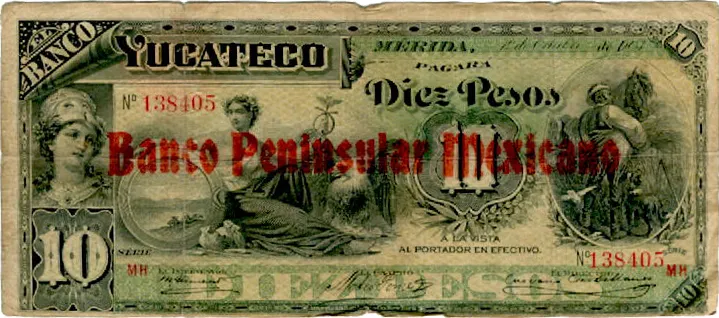
Obverse
Banco Yucateco
Seated female allegories making a toast and the figure of a young man, with a locomotive vignette
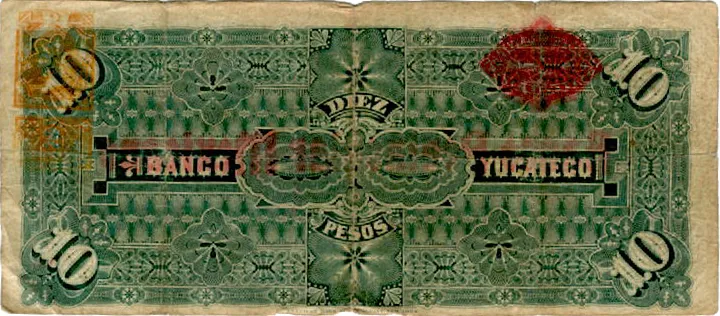
Reverse
Engraved ornamental design with the denomination and the name of the bank
About this banknote
Most people who inherit an old Mexican 10 pesos note assume they are holding a fortune. The reality: a common circulated Banco Yucateco note from 1903 sells in the range of 20 to 60 USD, while a crisp, uncirculated example with the right features can reach several hundred. Here is what actually drives the price.
This is not a Banco de México note. The Banco Yucateco of Mérida was a privately chartered issuing bank during the Porfiriato, the long presidency of Porfirio Díaz (1876 to 1911), when individual Mexican banks printed their own paper money. That alone makes it a piece of collector-grade obsolete currency (called "notaphily" in the English-language hobby), and it means the note has no face value today. Its worth is purely what a collector will pay.
What it is worth in 2026
There is no single price for this note. Value swings on three things: condition, whether it carries the red overprint, and how many survived. Broadly, in the current market:
- Heavily circulated, with folds, tears, or missing corners: roughly 15 to 50 USD.
- Clean, problem-free, lightly circulated: 60 to 150 USD.
- Crisp uncirculated, especially with the red overprint or a low serial number: 200 USD and up.
Those are collector ranges, not guarantees. A note graded by PMG (Paper Money Guaranty, the main third-party grading service for world paper money) will always sell for more than an ungraded one of the same condition, because the buyer trusts the grade.
| Note | Bank / Issuer | Year | Typical collector range (USD) | Where sold |
|---|---|---|---|---|
| 10 Pesos, circulated | Banco Yucateco, Mérida | 1903 | 15 to 60 | eBay, dealer stock |
| 10 Pesos, clean XF | Banco Yucateco, Mérida | 1903 | 60 to 150 | Heritage, Stack's Bowers |
| 10 Pesos, Unc / overprinted | Banco Yucateco, Mérida | 1903 | 200+ | Heritage world paper auctions |
Mexican bank-issued and revolutionary paper regularly crosses the block at Heritage Auctions and Stack's Bowers, so there is real, verifiable market data behind these ranges. If yours is exceptional, those are the venues that set records.
Why this note exists
The Banco Yucateco operated during the henequen boom, when the state of Yucatán got rich exporting sisal fiber, known locally as "green gold." The locomotive shown in the vignette was not decoration. It advertised the railway progress that carried henequen to the port for export.
Many surviving examples carry a red overprint reading "Banco Peninsular Mexicano." This came from the 1908 merger of the Banco Yucateco with the Banco Mercantil de Yucatán. That overprint is a genuine value factor, and collectors track it. A note with a clean, legible red overprint is more sought after than a plain one.
Design details to confirm you have the real note:
- Face (obverse): seated female allegorical figures making a toast, the figure of a young man, and the locomotive vignette.
- Back (reverse): engraved ornamental design with the denomination and the bank's name.
- Look for the red "Banco Peninsular Mexicano" overprint, present on post-1908 examples.
What makes one note worth far more than another
Condition is everything. A note with no folds, no stains, and full crisp corners can be worth five to ten times a worn one. Never flatten, tape, or "clean" an old note. Amateur repairs destroy value.
Serial numbers matter. A very low serial (like 00000012) or a repeating/palindrome number (a radar note, such as 12344321) draws extra demand from specialist collectors.
Printing errors are genuine rarities. Misaligned cuts, ink smears, or a factory fold can turn a common note into something worth several times its normal price. Note the difference: everyday wear and use damage is not a printing error.
How to tell if yours is genuine
Reproductions and modern fakes of Porfiriato bank notes exist. Compare yours to official reference images from the Banco de México archives and standard catalogs. Real notes of this era use engraved intaglio printing, so the ink has a slight raised feel and the lines are sharp. Reproductions tend to have smooth, flat paper and flat, printed-looking color. Check the signatures, the paper texture, and the fineness of the engraving. If in doubt, post clear photos of both sides in the Pesoteca forum and let the community weigh in before you buy or sell.
Where to sell it
Do not dump it on Facebook to the first buyer, and do not trust a single internet price. Your safest options:
- A verified numismatic dealer from the Pesoteca directory, who can appraise it in person.
- The Pesoteca buy-and-sell forum, directly between collectors.
- For a high-grade or overprinted example, consider consigning to a world paper money auction (Heritage or Stack's Bowers) after having it graded by PMG.
Photograph both faces in good, even light before you do anything. Note the serial number, the condition, and whether the red overprint is present, because those three things decide the price.
Got a Banco Yucateco note, or any old Mexican bank paper you can't identify? Post photos of the front and back in the Pesoteca forum and let collectors tell you what it really is and what it's worth.
Historical context
This 1903 10-peso note belongs to the final years of the Banco Yucateco as an independent issuer. By then, Yucatecan banking was beginning to feel the tensions that would precede the reorganization of the regional system, though henequen remained the engine of the peninsular economy.
The obverse keeps the bank's recognizable imagery: female allegories offering a toast, the figure of a young man, and the locomotive vignette, a symbol of the railway that connected the estates to the port of Progreso. The reverse preserved its engraved ornamental design with the institution's name.
Engraved by the American Bank Note Company of New York, this 10-peso note was among the most used denominations in Mérida's commerce. Barely two years later, in 1905, the merger with the Banco Mercantil de Yucatán would give rise to the Banco Peninsular Mexicano.
Frequently asked questions
How much is the 1903 Banco Yucateco 10 pesos note worth?
It has no face value today, only collector value. A worn, circulated example typically brings 15 to 60 USD. A clean, lightly circulated note runs 60 to 150 USD, and a crisp uncirculated one, especially with the red 'Banco Peninsular Mexicano' overprint or a low serial number, can reach 200 USD or more. Condition and rarity decide everything.
Is the Banco Yucateco 10 pesos note rare?
It is a scarce piece of obsolete private-bank paper from the Porfiriato, but not the rarest Mexican note. Common circulated examples turn up regularly. What makes a specific note rare is high grade (uncirculated), the red 1908 overprint, a low or repeating serial number, or a genuine printing error. Any of those pushes it well above the common price.
Where can I sell my 1903 Banco Yucateco note?
The safest routes are a verified dealer from the Pesoteca [directory](/tiendas) who can appraise it in person, or the Pesoteca [buy-and-sell forum](/foro/compra-venta) between collectors. For a high-grade or overprinted example, consider having it graded by PMG and consigning it to a world paper money auction like Heritage or Stack's Bowers. Photograph both sides first and never sell to the first Facebook offer.
How can I tell if the note is genuine?
Real notes of this era used engraved intaglio printing, so the ink feels slightly raised and the lines are crisp. Reproductions usually have smooth, flat paper and flat, printed-looking color. Compare the design, signatures, and paper against official Banco de México reference images. If you are unsure, post clear photos of both sides in the Pesoteca [forum](/foro) before buying or selling.
Características Banxico
Banco Peninsular Mexicano
Familia PRIV
This banknote belongs to the BIL-PRIV family within the Sistema PSM . Explore all the banknotes that share origin, era and design with this piece.
Ver todos los billetes de la familia PRIV →