
Banco Yucateco 10 Pesos (1891): Value & How to Sell
Familia PRIV · algodón
Period: Bancos privados de emisión
Design
Banxico
Obverse
Banco Yucateco
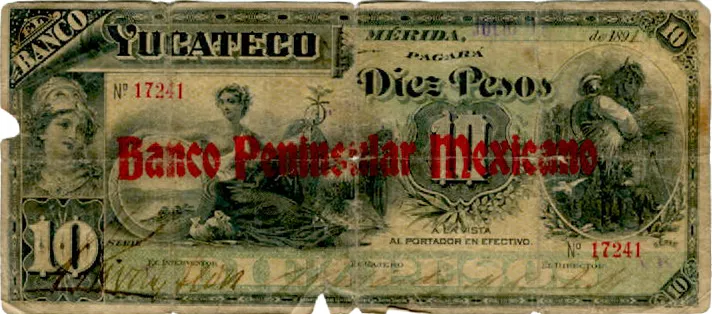
Seated female allegories making a toast and the figure of a young man, with a locomotive vignette
Reverse
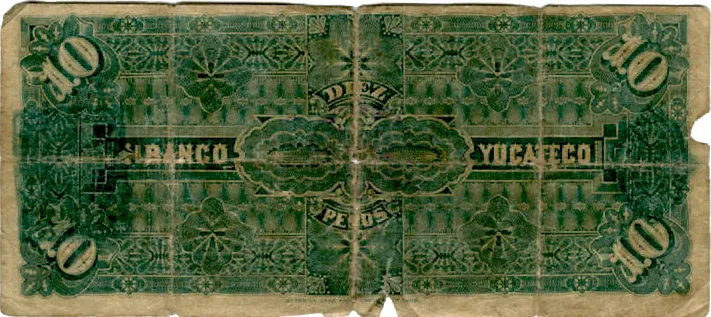
Engraved ornamental design with the denomination and the name of the bank
About this banknote
Most people who inherit an old Mexican banknote assume it's worth a fortune because it's over a century old. Age alone means very little. The 1891 Banco Yucateco 10 pesos note is worth anywhere from about 30 USD in worn condition to several hundred dollars for a crisp, uncirculated example, and the single detail that swings that range the most is a small red overprint. Here is how to tell what yours is.
What this note actually is
This is a 10 pesos note issued by the Banco Yucateco of Mérida, one of the private state-chartered banks that printed their own money during the Porfiriato, the long rule of Porfirio Díaz in Mexico (1876 to 1911). Before Mexico had a single national issuer, dozens of regional banks printed and circulated their own notes. That is why it says "Banco Yucateco" and not "Banco de México" (the national bank did not exist until 1925).
The Banco Yucateco operated during the henequén boom, when Yucatán grew rich exporting sisal fiber, known locally as "green gold." The steam locomotive shown in the vignette is not decoration: it represented the railway progress that hauled henequén to port for export. The face of the note shows seated female allegorical figures raising a toast alongside a young man, with the locomotive vignette. The back carries an engraved ornamental design with the denomination and the bank's name.
The detail that changes the value: the red overprint
Many surviving examples carry a red overprint reading "Banco Peninsular Mexicano." This came from the 1908 merger of the Banco Yucateco with the Banco Mercantil de Yucatán, which created the new Banco Peninsular Mexicano. The old Banco Yucateco stock was overstamped rather than destroyed.
For collectors, the presence or absence of that overprint matters. It creates two distinct collectible varieties from what looks like the same note, and depending on the year and the specific catalog listing, one can be noticeably scarcer than the other. If your note has that red stamp, note it clearly when you get it appraised.
What it's worth in 2026
This is historic paper money, more than 130 years old, so its value is purely to collectors. Two things drive the price: condition (called "grade") and rarity of the issuing bank and variety. Private Porfiriato bank notes and Revolution-era emergency scrip trade in their own specialist market. Some are common; others survive in tiny numbers because they circulated only briefly before the bank folded or was absorbed.
Realistic ranges for the Banco Yucateco 10 pesos:
| Condition | What it looks like | Approx. value (USD) |
|---|---|---|
| Well-worn (Good / VG) | Soft paper, folds, edge wear, maybe small tears | 25 to 60 |
| Circulated (Fine / VF) | Intact, moderate handling, still bright | 60 to 150 |
| High grade (XF / AU) | Crisp, minimal handling, strong color | 150 to 350 |
| Uncirculated (UNC) | No folds, original crisp paper | 300 to 700+ |
Proof and specimen examples (printer's samples, often marked or hole-punched) exist for some of these Mexican bank issues and can sell higher than issued notes when they turn up at specialist auctions. Because survival rates vary sharply by exact catalog number and by whether the note is a remainder (unsigned, unissued) or a fully issued and circulated note, treat any online "one price" as a starting point, not gospel.
What does NOT make it more valuable
Being old is not rare. Millions of Porfiriato-era notes and Revolution scrip pieces survive, and many are worth pocket change to a specialist. What genuinely raises the price is: an uncirculated grade, the scarcer overprint variety, a low or unusual serial number, and an intact note with no repairs, tape, or trimming. Common damage (splits, pinholes, staining) pulls value down, it does not add "character" value.
How to check what yours is worth
- Grade it honestly. Lay the note flat under good light. Any fold, tear, or soft corner drops it out of the top tiers. Do not iron, tape, or "clean" it, that destroys collector value.
- Photograph both sides flat, in daylight, filling the frame. Record the serial number and whether the red Banco Peninsular Mexicano overprint is present.
- Check authenticity. Genuine notes of this era were engraved (often by major American banknote printers), so the design has fine intaglio detail and the paper has texture. Reproductions and modern reprints tend to have flat, printed-looking color and smooth paper. Compare against verified images before buying anything.
- Get more than one opinion before you sell. A single online listing is not a valuation.
Where to sell it
World paper money (notaphily) is an active English-language market, so you have real options. For a piece like this, the safest routes are a specialist auction house that handles Mexican and Latin American paper money, or a verified dealer. Mexican collectors also use the Pesoteca dealer directory and the Pesoteca buy-and-sell forum. Wherever you go, share clear photos of both sides, the serial number, and the overprint status before agreeing to any price. Avoid dumping it on a general marketplace to the first buyer, that is how genuinely scarce varieties get sold for a fraction of their worth.
Got a Banco Yucateco note with the red overprint, or an unusually crisp one? Post clear photos of both sides in the Pesoteca forum and let collectors who track these private-bank issues weigh in on the variety and grade.
Historical context
Barely a year after opening in Mérida, the Banco Yucateco was already issuing notes of various denominations. This 1891 10-peso example belongs to those first series, when the institution, newly financed by Olegario Molina, was establishing itself as the reference bank for the flourishing henequen economy.
The obverse brings together the bank's characteristic elements: female allegories offering a toast, the figure of a young man, and a locomotive vignette. The railway held special weight in Yucatán, since the lines built in those years connected the henequen estates to the port of Progreso, the engine of the fiber's export.
Printed by the American Bank Note Company of New York, this 10-peso note was a middle denomination, useful both in Mérida's commerce and in dealings with the workers and suppliers of the henequen world.
Frequently asked questions
How much is the 1891 Banco Yucateco 10 pesos note worth?
As a collector item, roughly 25 to 60 USD if well-worn, 60 to 150 USD circulated but intact, and 300 to 700 USD or more for a crisp uncirculated example. Condition (grade) and whether it carries the scarcer red Banco Peninsular Mexicano overprint drive the price. It has no legal-tender value today; its worth is entirely to collectors.
Is the Banco Yucateco 10 pesos note rare?
It depends on the exact variety. This was a private state bank note from the Porfiriato, and survival rates vary sharply by catalog number and by whether the note is issued and circulated or an unsigned remainder. The red 'Banco Peninsular Mexicano' overprint (from the 1908 merger) creates two collectible varieties, one of which can be noticeably scarcer. Uncirculated examples of any variety are genuinely hard to find.
Where can I sell my Banco Yucateco 10 pesos note?
The safest routes are a specialist auction house that handles Mexican and Latin American paper money, or a verified dealer. You can also use the [Pesoteca dealer directory](/tiendas) for in-person appraisal or the [Pesoteca buy-and-sell forum](/foro/compra-venta) among collectors. Always share sharp photos of both sides, the serial number, and whether it has the red overprint before agreeing on a price.
How can I tell if my Banco Yucateco note is genuine?
Genuine notes of this era were engraved by professional banknote printers, so the design shows fine intaglio detail and the paper has real texture. Modern reproductions and reprints usually have flat, printed-looking color and smooth paper. Compare your note against verified images, check the design, signatures, and the overprint if present, and if you have any doubt, post photos in the [Pesoteca forum](/foro) for a second opinion.
Características Banxico
Banco Peninsular Mexicano
Familia PRIV
This banknote belongs to the BIL-PRIV family within the Sistema PSM . Explore all the banknotes that share origin, era and design with this piece.
Ver todos los billetes de la familia PRIV →