
10 Pesos Banco de Zacatecas (1906) Banknote Value
Familia PRIV · algodón
Period: Bancos privados de emisión
Design
Banxico
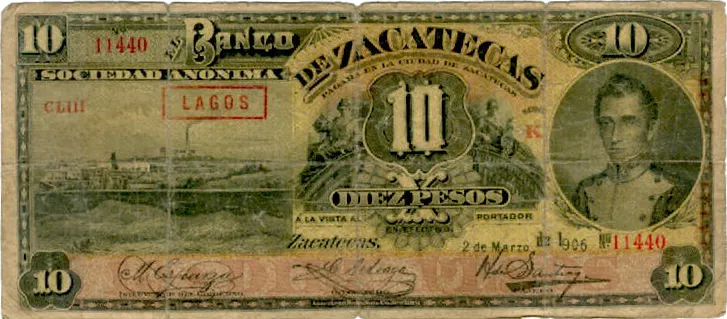
Obverse
Banco de Zacatecas
Engraved allegorical vignettes: a miner on the left, a female figure with goods in the center, and the profile portrait of a young man on the right
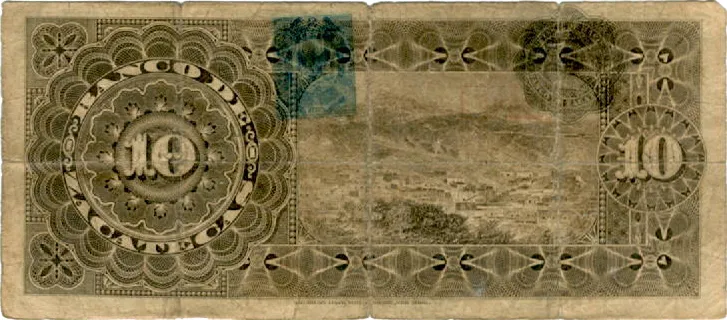
Reverse
Scenes of mining and labor, or a monument set against the mountainous landscape of Zacatecas
About this banknote
Most people who inherit an old Mexican banknote assume it's worth a fortune. This one usually isn't a jackpot, but it's a genuine collectible: a 10 pesos note from the Banco de Zacatecas dated 1906, from the era when Mexican states printed their own silver-backed money. Common examples trade in the tens of dollars; a crisp, uncirculated survivor can bring several hundred. Here is what actually drives the number.
What it is
Before Mexico had a single central bank, each state authorized private banks to issue paper money backed by silver reserves. The Banco de Zacatecas was one of them. Zacatecas was mining country, so the vignettes on the note are all about mining, because the metal in the ground was literally the guarantee behind the paper. This multi-issuer banking system ended when the Banco de México was founded in 1925, which is why these state notes are now historical artifacts rather than currency.
The face carries engraved allegorical vignettes: a miner at left, a female figure with goods at center, and a young man's profile portrait at right. The back shows scenes of mining and labor, or a monument set against the mountainous Zacatecas landscape. These are engraved intaglio designs, typical of turn-of-the-century American Bank Note Company work, which is one reason they photograph beautifully and appeal to world paper money (notaphily) collectors.
How much it's worth in 2026
This is historical paper money more than a century old. It has zero legal-tender value, so every dollar it's worth is collector value, driven by condition (grade) and how scarce the issuing bank's notes are. Private Porfiriato-era bank notes and Revolution-era scrip have their own active market: some issues are common, others are genuinely rare, and many circulated so little (or were redeemed and destroyed) that clean survivors are hard to find.
As a working range for the Banco de Zacatecas 10 pesos:
| Condition | What it looks like | Approximate value (USD) |
|---|---|---|
| Well-circulated | Folds, soiling, edge wear, maybe pinholes | 25 to 60 |
| Very Fine / Extremely Fine | Light handling, bright colors, no major damage | 75 to 200 |
| About Uncirculated / Uncirculated | Crisp, no folds, full margins | 250 to 600+ |
| Remainder / Specimen (unissued) | No serial or overprinted SPECIMEN | Varies, often 40 to 150 |
A note on remainders: many of these state-bank notes survive as unissued remainders, meaning they were never actually put into circulation and often lack signatures or serial numbers. Those are more common and generally worth less than a fully issued, hand-signed note that actually saw use. Don't assume a pristine unsigned example is automatically the most valuable one.
What makes yours worth more
Three things move the price above the base range:
- Grade. An uncirculated note with no folds and sharp corners can be worth five to ten times a worn one. Condition is the single biggest factor.
- Serial number. A low serial number (like 00000012) or a repeating/palindrome number attracts collectors and adds a premium.
- Errors. Genuine printing errors (misaligned cuts, ink smears, factory folds, off-center printing) turn a common note into a rarity. Note that normal wear and use damage is not an error.
The myth: "a 1906 note must be worth thousands"
Age alone does not make paper money valuable. There are billions of old banknotes in the world, and most trade for modest sums. What creates real value is a scarce issuer plus high grade plus collector demand. The Banco de Zacatecas 10 pesos is desirable and historic, but it is not a five-figure rarity in average condition. If a listing claims yours is "worth thousands" purely because it's from 1906, treat that as a red flag, not a valuation.
How to check what yours is worth
- Grade it honestly. Look for folds, tears, pinholes, stains and missing corners under good light. Hold it flat and compare against grading photos before you guess.
- Confirm it's issued vs. remainder. Check for hand signatures and a printed serial number. Issued and signed usually beats unissued.
- Check authenticity. Compare the engraving, paper texture and printer's imprint against reference images. Genuine intaglio notes have raised, tactile ink and fine detail; reproductions tend to have flat colors and smooth, modern paper.
- Get a second opinion before selling. Post clear photos of both sides in the Pesoteca forum or take it to a verified dealer from the Pesoteca shop directory. For higher-value examples, third-party grading (PMG) protects both buyer and seller.
Where to sell it
For a note like this, sell where informed buyers actually look. A verified numismatic shop from the Pesoteca directory can value it on the spot, and the Pesoteca buy-and-sell forum puts you in front of collectors who understand Porfiriato-era bank issues. Photograph both faces in strong light, note the serial number and any error or unusual feature, and get a sense of the going rate before you accept an offer. Avoid dumping it to the first bidder on a general marketplace, where these state-bank notes are routinely underpriced.
Have a Banco de Zacatecas note, or another Porfiriato-era state bank issue? Post both sides in the Pesoteca forum and let the community help you pin down the issuer, grade and a realistic value.
Historical context
The Banco de Zacatecas lived its best period during the first decade of the twentieth century, when the stability of the Porfiriato favored the circulation of its paper money. Founded in 1891, it printed backed notes limited to its region, always under the seal of the American Bank Note Company of New York.
This 10-peso note of 1906 corresponds to that prosperous period before the Revolution. The 10-peso denomination was in common use in the established commerce of the town. Its design gathers the allegorical vignettes of the series: a miner on the left, a direct reference to the industry that made Zacatecas famous, a female figure with merchandise at the center, and a young man in profile on the right, with mining-labor motifs on the reverse. These images tied the note's backing to the tangible wealth of the region. The system of private issuing banks, to which this piece belonged, would be replaced by the Banco de México starting in 1925.
Frequently asked questions
How much is the 1906 Banco de Zacatecas 10 pesos note worth?
It has no legal-tender value, so it's purely a collectible. A well-circulated example typically brings 25 to 60 USD, a clean Very Fine to Extremely Fine note runs 75 to 200 USD, and a crisp uncirculated survivor can reach 250 to 600 USD or more. Grade and whether it's a fully issued (signed) note versus an unissued remainder are the biggest factors.
Is the Banco de Zacatecas 10 pesos note rare?
It's genuinely collectible but not a top-tier rarity in average grades. Many survive as unissued remainders, which are more common and worth less. Fully issued, hand-signed notes that actually circulated, especially in high grade or with a low or repeating serial number, are the scarce and desirable ones.
Where can I sell the 1906 Banco de Zacatecas 10 pesos note?
Sell through a verified dealer in the [Pesoteca shop directory](/tiendas), which can value it on the spot, or the [Pesoteca buy-and-sell forum](/foro/compra-venta) where collectors of Porfiriato-era bank notes gather. Photograph both sides in good light, record the serial number and any error, and check the going rate before accepting an offer instead of selling to the first bidder on a general marketplace.
How can I tell if my Banco de Zacatecas note is genuine?
Genuine notes are printed by intaglio, so the ink feels slightly raised and the engraving is razor-sharp. The paper has age and texture, not a smooth modern feel. Compare the vignettes, printer's imprint and signatures against reference images; reproductions usually show flat colors and clean paper. If in doubt, post clear photos of both faces in the [Pesoteca forum](/foro) or have a high-value example graded by PMG.
Características Banxico
CLIII Lagos
Familia PRIV
This banknote belongs to the BIL-PRIV family within the Sistema PSM . Explore all the banknotes that share origin, era and design with this piece.
Ver todos los billetes de la familia PRIV →