
Mexico 10 Pesos Banknote (1900): Value & Guide
Familia PRIV · algodón
Period: Bancos privados de emisión
Design
Banxico
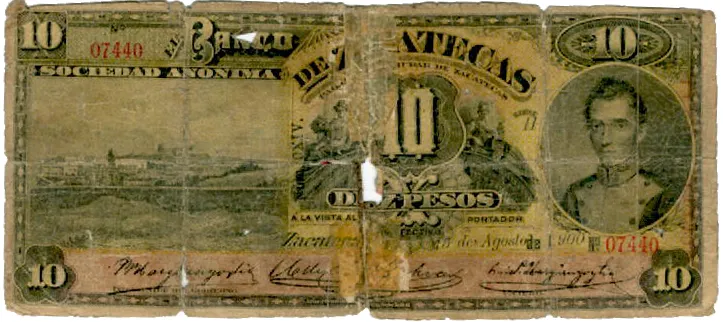
Obverse
Banco de Zacatecas
Engraved allegorical vignettes: a miner on the left, a female figure with goods in the center, and the profile portrait of a young man on the right
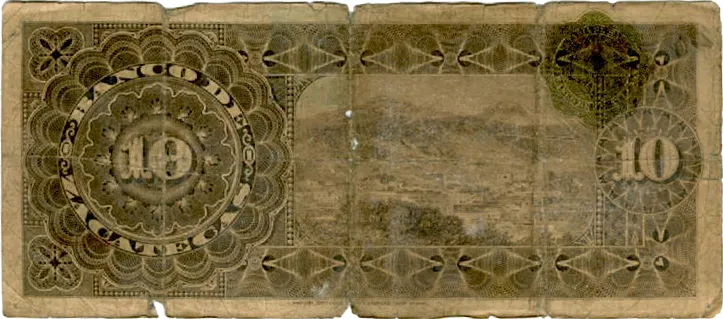
Reverse
Scenes of mining and labor, or a monument set against the mountainous landscape of Zacatecas
About this banknote
Most old Mexican banknotes people inherit are worth a modest sum, but the 10 pesos note from the Banco de Zacatecas is a real collectible from a private-bank era that ended in 1925. Depending on condition, examples trade roughly from 15 USD to a few hundred USD, and truly crisp survivors sell for more.
This is not a modern government note you can spend. It is historic paper money from the Porfiriato, the long rule of Porfirio Díaz before the Mexican Revolution, when individual states chartered private banks to print their own money backed by silver. If you found one in a family estate, here is what it is, why it exists, and how to figure out what yours is worth in 2026.
What this note actually is
Before Mexico had a single central bank, each state ran its own authorized private banks that issued paper money redeemable in silver. Zacatecas, one of the great silver-mining regions of the country, had the Banco de Zacatecas. That is why the vignettes on the note are all about mining: the metal itself was the guarantee behind the paper.
This system of multiple issuing banks ended in 1925, when the Banco de México was founded as the country's single central bank. That makes every Banco de Zacatecas note a survivor from a banking world that no longer exists, which is exactly what gives notaphily (paper-money collecting) collectors a reason to want them.
Design details to confirm you have the right note:
- Obverse (front): allegorical engraved vignettes, a miner on the left, a female figure with goods in the center, and a young man's portrait in profile on the right.
- Reverse (back): scenes of mining and labor, or a monument set against the mountainous Zacatecas landscape.
- Denomination: 10 pesos, issued by a private state bank, not the federal government.
How much is it worth
Because this is historic paper money over a century old, its value is purely collector value. It has no face-value use and it is not a bullion piece, so the price comes down to two things: condition and rarity of the issuing bank.
Porfiriato private-bank notes and Revolution-era scrip form their own market. Some issues are common and trade for pocket change, while others are genuinely scarce because so few circulated or so few survived intact. A worn, folded, torn example sits at the low end. A clean, crisp note with full margins and strong color can sell for several times as much.
| Item | Detail |
|---|---|
| Denomination | 10 pesos |
| Issuer | Banco de Zacatecas (private state bank) |
| Era | Porfiriato, circa 1900 |
| System ended | 1925 (founding of Banco de México) |
| Typical value, circulated | roughly 15 to 60 USD |
| Value, high grade / scarce | 100 to several hundred USD |
These are ranges, not fixed prices. A specific catalog number and a professional grade can move the figure significantly, so treat the table as a starting point, then verify your exact note.
What makes one worth more
Three things separate a common example from one collectors chase:
- Condition (grade). No folds, no tears, no stains, strong ink, full margins. An uncirculated note can be worth many times a well-worn one.
- Serial number. A low serial number or a palindrome (a number that reads the same both ways) adds a premium.
- Printing errors. Misaligned cuts, ink runs, factory folds, or off-center serials turn an ordinary note into a rarity worth several times face. Note that ordinary wear and handling damage is not a factory error.
The myth to avoid
Age alone does not make a banknote valuable. Being "over 100 years old" is common, not rare, for this material. Do not trust the first inflated price you see online, and do not accept a screenshot of one auction result as the value of your specific note. Grade and true scarcity drive the number, and both need to be verified on the physical piece.
How to check what yours is worth
- Photograph both sides in good, even light, flat, with the full margins visible.
- Check the serial number for a low figure or a palindrome.
- Inspect for genuine printing errors versus normal wear.
- Compare the design, paper, and signatures against official reference images. Reproductions usually show smooth paper and flat, printed-looking color instead of engraved detail.
- Get a second opinion before selling. Post it in the Pesoteca forum so other collectors can weigh in, or consult a verified numismatic shop from the Pesoteca directory.
For more on Mexican paper money and coins from this period, browse our other Mexican banknote guides and related Porfiriato listings before you decide to sell.
Have one of these Banco de Zacatecas notes sitting in a drawer? Post clear photos of the front and back in the Pesoteca buy-and-sell forum and let the community tell you what you actually have.
Historical context
By 1900, the Banco de Zacatecas had been issuing notes for nearly a decade and had become a financial pillar of the state, with branches in Aguascalientes and San Juan de los Lagos. The General Law of Credit Institutions of 1897 had given a uniform framework to these banks of issue, which operated backed by specie and with circulation limited to their territory.
This 10-peso note of 1900 marks the start of the new century with the bank in full maturity. The denomination was practical for commercial and service transactions. On the obverse appear the house's three vignettes: the miner evoking Zacatecan silver, a female figure with goods in the center, and the portrait of a young man in profile on the right; the reverse refers to mining scenes and the state's mountainous landscape. Like the entire series, it was engraved by the American Bank Note Company of New York. This plurality of state issuers would end when currency was centralized in the Banco de México in 1925.
Frequently asked questions
How much is the 1900 Mexico 10 pesos banknote worth?
As collector paper money, a Banco de Zacatecas 10 pesos note typically ranges from about 15 to 60 USD in circulated condition, and can reach 100 to several hundred USD when the note is crisp, scarce, or carries a special serial number. It has no spendable face value. Condition and rarity decide the price, so always verify the exact note before setting a figure.
Is the 1900 Mexico 10 pesos banknote rare?
It depends on the issue. This note comes from the Banco de Zacatecas, a private state bank from the Porfiriato era that ended when the Banco de México was founded in 1925. Some issues are common and others are genuinely scarce because few circulated or survived intact. A clean, uncirculated example, or one with a low or palindrome serial number, is far harder to find and worth more.
Where can I sell a 1900 Mexico 10 pesos banknote?
The safest options are a verified [numismatic shop from the Pesoteca directory](/tiendas), which can appraise it in person, or the [Pesoteca buy-and-sell forum](/foro/compra-venta) among collectors. Photograph both sides in good light, and check for a low or palindrome serial number or a genuine printing error, since those raise the value. Avoid dumping it to the first bidder on social media.
How can I tell if a 1900 Mexico 10 pesos banknote is genuine?
Compare the design, paper, and signatures against official reference images. Genuine engraved notes show fine raised detail and layered color, while reproductions usually have smooth paper and flat, printed-looking color. Examine the vignettes (miner, central female figure, portrait in profile) and the mining scenes on the back closely. If you are unsure, post clear photos in the [Pesoteca forum](/foro) for a second opinion.
Características Banxico
CXIV.
Familia PRIV
This banknote belongs to the BIL-PRIV family within the Sistema PSM . Explore all the banknotes that share origin, era and design with this piece.
Ver todos los billetes de la familia PRIV →