
Banco de Zacatecas 10 Pesos (1892) Banknote Value
Familia PRIV · algodón
Period: Bancos privados de emisión
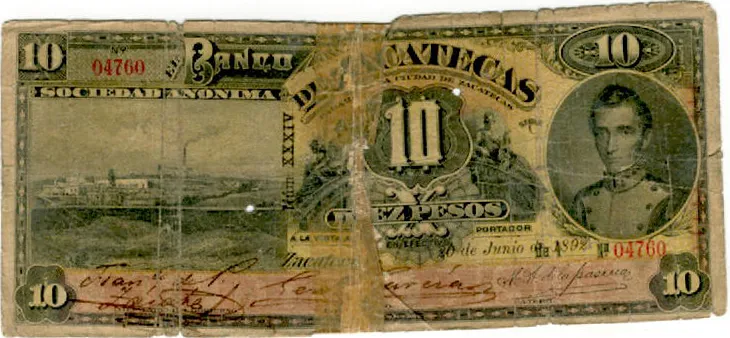
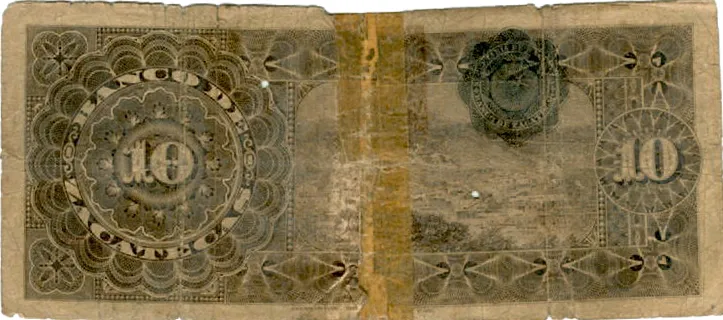
Design
Banxico
Obverse
Banco de Zacatecas
Engraved allegorical vignettes: a miner on the left, a female figure with goods in the center, and the profile portrait of a young man on the right
Reverse
Scenes of mining and labor, or a monument set against the mountainous landscape of Zacatecas
About this banknote
Most old Mexican banknotes are worth a modest premium over face, but the private-bank notes of the Porfiriato era are a different story. A genuine Banco de Zacatecas 10 pesos note from 1892 typically trades between roughly USD 50 and several hundred dollars, depending on condition, with the crispest, uncirculated examples reaching the high end. This is not currency you can spend. It is 19th-century collector paper with its own active market among world-banknote (notaphily) collectors in the US and abroad.
What this note actually is
Before Mexico had a single central bank, individual states chartered private banks that were legally allowed to print their own paper money, backed by silver. Zacatecas, one of the great silver-mining regions of Mexico, had its own bank, and the imagery on the note reflects that: the mineral wealth was the guarantee behind the paper. This system of multiple issuing banks ended when the Banco de México was founded in 1925, so any Banco de Zacatecas note is by definition pre-1925 private-bank issue.
The face (anverso) carries engraved allegorical vignettes: a miner on the left, a female figure with goods at the center, and the profile portrait of a young man on the right. The back (reverso) shows mining and labor scenes, or a monument set against the mountainous Zacatecas landscape. These are steel-engraved designs, typical of American Bank Note Company work of the period, which is part of why they photograph and grade well when preserved.
What it's worth in 2026
This is historic paper money, more than a century old, so its value is entirely collector-driven. Two factors dominate: condition and the rarity of the issuing bank. Porfiriato private-bank notes and later Revolution-era scrip form their own collecting category. Some banks issued heavily and their notes are common; others are genuinely scarce, and many circulated so little (or were redeemed and destroyed) that intact survivors are hard to find today.
As a general guide for the Banco de Zacatecas 10 pesos:
| Condition | Typical value (USD) |
|---|---|
| Heavily circulated, tears, staining | 20 to 50 |
| Circulated but complete, moderate wear | 50 to 120 |
| Lightly circulated, strong color | 120 to 250 |
| Uncirculated / near-mint | 250 and up |
Unissued remainders and proofs (notes printed but never put into circulation, sometimes without signatures or serial numbers) exist for several Porfiriato banks and can behave differently in the market. A pristine proof can outrun a worn issued note, so it pays to identify exactly which form you have before selling.
A note on grading: US and international buyers rely on professional third-party grading from PMG (Paper Money Guaranty). A PMG-graded, encapsulated example sells for more and faster than a raw note of the same quality, because the buyer isn't taking a risk on condition or authenticity. For a note in the higher grades, submitting to PMG is usually worth the fee.
The myth to ignore
"Over a hundred years old, so it must be worth a fortune." Age alone drives very little in paper money. Plenty of 1800s notes trade for USD 30. What moves the price here is the combination of a scarce issuing bank, genuine (not reproduced) paper, and honest condition. Do not assume a five-figure payday because a note is Victorian-era. And be cautious: reproductions and modern reprints of attractive Porfiriato notes exist, and they fool people who buy on age and looks alone.
How to tell if yours is genuine
Original steel-engraved notes from this period have physical depth to the printing. Under a loupe you should see sharp, fine engraved lines, not the flat dot pattern of a photocopy or offset reprint. The paper should feel like period stock, not smooth modern printer paper, and the colors should have tonal variation rather than looking uniformly flat. Check the signatures, serial numbering and the bank's imprint against reference images, and be wary of any note that looks too clean and too bright for its stated age. If you have doubts, post clear photos of both sides in the Pesoteca forum and let collectors weigh in.
Where to sell it
For a note like this, your best options in order of safety:
- A verified numismatic dealer from the Pesoteca shop directory, who can value it in person.
- The Pesoteca buy-and-sell forum, where you reach collectors who actually know Porfiriato private-bank paper.
- For a high-grade or scarce example, an international paper-money auction (Heritage and Stack's Bowers both run world-currency sales) after PMG grading.
Whatever route you choose, photograph both sides in strong, even light before quoting a price, and don't dump it on a general marketplace to the first buyer. A scarce bank, a low serial number, a proof or remainder status, or a printing error can multiply the value, and those details are exactly what a casual buyer will not tell you.
Have a Banco de Zacatecas note, or another Porfiriato private-bank issue you can't identify? Post both sides in the Pesoteca forum and we'll help you pin down the bank, the type and a realistic value.
Historical context
The Banco de Zacatecas had barely been born when it put this type of note into circulation. Granted its concession in March 1891 and established at the end of that year, it formed part of the first generation of state issuing banks of the Porfiriato, authorized to print backed paper money with circulation limited to their region.
This 10-peso note of 1892 is among the bank's earliest, issued when the institution was taking its first steps with a capital of 600,000 pesos. The 10-peso denomination occupied an intermediate place, useful for formal commerce. Its obverse shows the iconographic program that would accompany the entire series: a miner on the left, symbol of Zacatecas's silver wealth, a female allegory of commerce at the center, and the portrait of a young man in profile on the right, with mining and mountain scenes on the reverse. The printing was handled by the American Bank Note Company of New York. Pieces from these early years are especially valued for their antiquity within the private banknote-issuing system.
Frequently asked questions
How much is the 1892 Banco de Zacatecas 10 pesos note worth?
It has no spending value; it's a collector item. A genuine example typically sells for roughly USD 20 to 50 heavily circulated, USD 50 to 250 in mid grades, and USD 250 or more uncirculated. Proofs and unissued remainders can go higher. Condition and the rarity of the issuing bank drive the price.
Is this note rare?
Porfiriato private-bank notes vary widely. Some banks issued heavily and their notes are common; others are genuinely scarce. Many circulated little or were redeemed and destroyed, so intact, higher-grade survivors are the harder part. A clean, complete example is worth far more than a worn one of the same type.
Where can I sell it?
Safest options: a verified dealer from the [Pesoteca directory](/tiendas) who can appraise it in person, or the [Pesoteca buy-and-sell forum](/foro/compra-venta) with collectors who know this material. For a high-grade example, consider PMG grading and an international paper-money auction. Photograph both sides in good light first.
How do I tell if it's genuine?
Original notes were steel-engraved: under a loupe you'll see fine, sharp raised lines, not a flat dot pattern from a photocopy. The paper should feel like period stock, not smooth modern paper, and colors should have tonal depth. Compare signatures, serials and the bank imprint to references. If unsure, post photos in the [Pesoteca forum](/foro).
Características Banxico
Firmas autógrafas.
Familia PRIV
This banknote belongs to the BIL-PRIV family within the Sistema PSM . Explore all the banknotes that share origin, era and design with this piece.
Ver todos los billetes de la familia PRIV →