
Mexico 10 Pesos 1967 (Tehuana): Value & Prices
Familia MOD · algodón
Period: México Contemporáneo
Design
Banxico
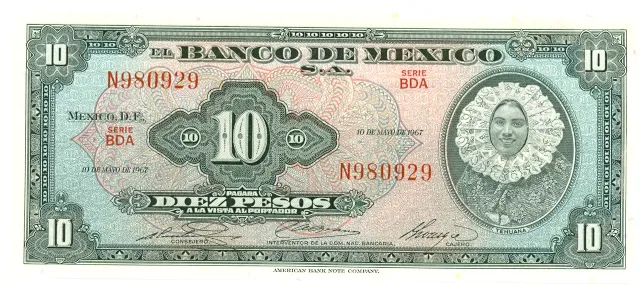
Obverse
Tehuana
Portrait of a Tehuana woman wearing the resplandor headdress of Tehuantepec
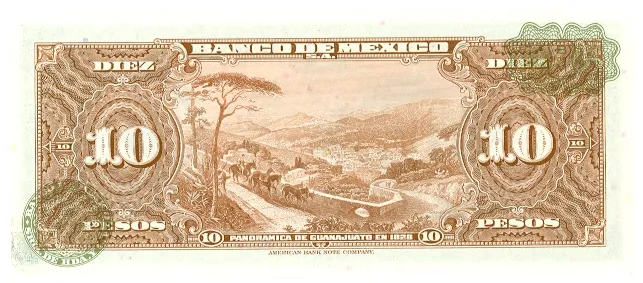
Reverse
A panoramic view of the city of Guanajuato from 1855
About this banknote
Most Mexican 10 pesos notes from 1967 are worth a few dollars in used condition. A crisp uncirculated example, a low or radar serial number, or a genuine printing error can push that to several times higher. Here is what actually drives the price, and how to check what yours is worth in US dollars.
This note is known to collectors as the Tehuana type, after the woman from the Isthmus of Tehuantepec on the front, shown wearing the starched lace headdress (the resplandor) that is a symbol of Oaxacan culture in southern Mexico. It is a Banco de México note from the mid-20th century, one of the most recognized designs of that era.
The back shows a panoramic view of the city of Guanajuato as it looked in 1855, with its maze of alleys winding between hills. That reverse is a big part of why this note stays popular with world paper money collectors.
What it's worth in 2026
This note is no longer in circulation, so its value is collector value, not face value. Condition drives almost everything.
- Circulated (folds, soft corners, light soiling): typically a few US dollars. Common dates and signature combinations are easy to find.
- Uncirculated (crisp, no folds, sharp corners, original paper): usually several times the circulated price. Grade is the single biggest factor.
- Special serial numbers: low serials (like 00000123), radar or palindrome serials (reads the same forwards and backwards, for example 1234321), and early series letters bring a premium.
- Genuine printing errors: misaligned cuts, ink smears, factory fold-overs, or off-center serials can be worth many times face. Everyday wear is not an error.
Exact hammer prices for this type vary by grade and by the specific series/family letter, so treat any single "guide price" you see online with caution. Inflated listings are common; a note that is offered for a high price is not the same as a note that sold for it. What matters is what graded, verified examples actually bring at sale.
| Type | Condition | Realistic value (USD) |
|---|---|---|
| Mexico 10 pesos 1967, Tehuana | Circulated | A few dollars |
| Mexico 10 pesos 1967, Tehuana | Uncirculated | Several times circulated |
| With low / radar serial | Uncirculated | Higher premium |
| Genuine printing error | Any | Many times face |
How to check what yours is worth
Start with condition. Lay the note flat under good light and look for folds, pinholes, tears, stains, and rounded corners. A single hard fold moves a note from uncirculated into a much lower value band.
Next, read the serial number. Low numbers, repeating patterns, and radar/palindrome serials are what collectors chase. Then check the series (family) letter printed with the serial, since earlier series are scarcer.
For a firm value, you can submit the note to a third-party grading service such as PMG (Paper Money Guaranty), which authenticates and assigns a numeric grade that the market recognizes. A graded, encapsulated note sells for more and sells faster.
How to tell if it's genuine
Compare your note against official Banco de México reference images. On authentic notes of this era, check the watermark held up to the light, the security thread, the feel of the paper, and the crispness of the printed lines and signatures. Reproductions and reprints usually show flat, printed-looking color, smooth modern paper, and no true watermark. If anything looks off, post clear photos of both sides in the Pesoteca forum and let the community weigh in.
If you want context on which Mexican notes are most often faked, see our breakdown of the most counterfeited banknotes in Mexico.
Where to sell it
For the best result, sell through channels built for collectors rather than dumping it to the first buyer on social media. Options include a verified dealer from the Pesoteca shop directory, who can value it on the spot, or the collector-to-collector buy and sell forum. Photograph both faces in good light and note any low serial, radar number, or error, since those raise the price.
Got one with an unusual serial or still in a sealed holder? Post it in the forum and let's take a look.
Historical context
This 10-peso note from 1967 belongs to a period far more stable than the Revolution: that of Banco de México already consolidated as the sole issuer, bringing order and confidence to Mexican money after the decades of monetary chaos at the start of the century.
The obverse features a tehuana, a woman of the Isthmus of Tehuantepec (Oaxaca) dressed in the traditional costume and the resplandor, that headdress of starched lace that frames the face. The image made the note an icon of Mexican identity and of pride in the cultures of the country's south. On the reverse, a panoramic view of Guanajuato, a mining city of colonial architecture and alleyways that, decades later, would become a World Heritage Site.
More than a war episode, this note tells the story of the era when the Mexican peso enjoyed stability and design was used to celebrate the cultural heritage and regions of the country. For its combination of Oaxacan tradition and colonial landscape, the 'Tehuana' is one of the most beloved and recognizable notes of twentieth-century Mexico.
Frequently asked questions
How much is the Mexico 10 pesos 1967 note worth?
In circulated condition, usually just a few US dollars. A crisp uncirculated example, a low or radar serial number, or a genuine printing error can be worth several times that. Condition and rarity drive the price, not age alone.
Is the 1967 10 pesos (Tehuana) note rare?
The type is common, so an ordinary circulated note is not rare. What makes a specific example scarce is high grade (uncirculated), an early series letter, a low or palindrome serial number, or a real factory error. Those are the notes that bring a premium.
Where can I sell my Mexico 10 pesos 1967 note?
The safest options are a verified dealer from the [Pesoteca directory](/tiendas), who can appraise it in person, or the collector [buy and sell forum](/foro/compra-venta). Photograph both sides clearly and flag any low serial, radar number, or error. Avoid selling to the first random buyer on social media.
How do I tell if my 1967 10 pesos note is genuine?
Check the watermark against the light, the security thread, the paper feel, and the crispness of the printing and signatures, then compare with official Banco de México images. Reproductions tend to have smooth paper and flat, printed-looking color. When in doubt, post photos in the [forum](/foro).
Familia MOD
This banknote belongs to the BIL-MOD family within the Sistema PSM . Explore all the banknotes that share origin, era and design with this piece.
Ver todos los billetes de la familia MOD →