
1 Peso Banknote (1914): Value & How to Sell
Familia PRIV · algodón
Period: Bancos privados de emisión
Design
Banxico
Obverse
Banco de Jalisco
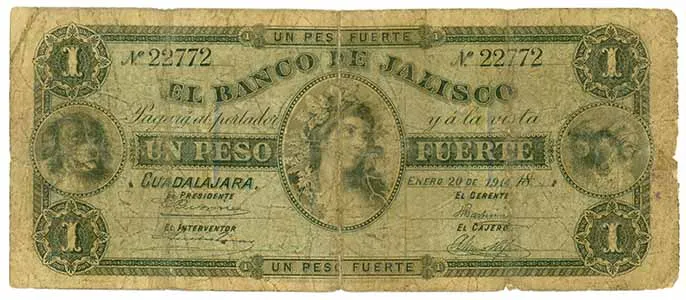
A female allegory in the center and two portraits in ovals on the sides
Reverse
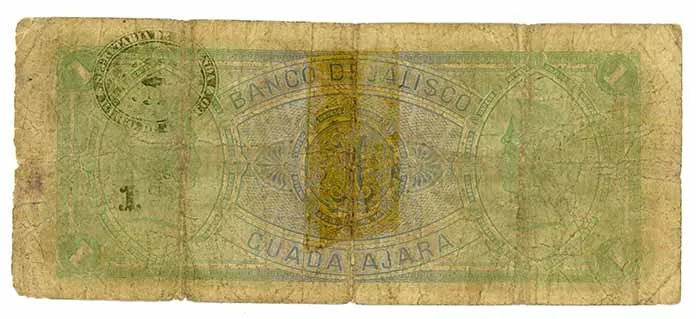
Engraved ornamental design with the denomination
About this banknote
Most old Mexican peso notes from the revolutionary era are worth a few dollars each, not a fortune. The 1914 1 peso note from the Banco de Jalisco falls into that category for common survivors, but condition and the issuing bank can push a rare, crisp example well past its face value. Here is what actually determines the price.
What this note actually is
This is a private bank note issued by the Banco de Jalisco in Guadalajara, denominated in Pesos Fuertes ("strong pesos"). During the Porfiriato (the long rule of Porfirio Díaz, roughly 1876 to 1911), "peso fuerte" was the term for a full-weight silver peso, used to distinguish it from other coins in circulation.
The Banco de Jalisco was one of several regional banks authorized to issue their own paper money before Mexico centralized its currency system under a single bank. Guadalajara was already a major economic hub in western Mexico, which is why the bank existed at all. This is not a Banco de México note; it predates that institution.
Design details: the face (anverso) shows a female allegorical figure in the center with two portraits in oval frames on either side. The back (reverso) carries an engraved ornamental design with the denomination.
How much is a 1914 1 peso note worth?
This is genuine historical paper money, over a century old, so its value is entirely as a collectible. Face value is meaningless here; you cannot spend it. What matters is condition, the issuing bank, and how many survived.
Mexican private-bank notes from the Porfiriato and the local scrip issued during the Revolution have their own active collecting market, especially among world paper money (notaphily) collectors in the US and Europe. Some issues are common and trade for a few dollars. Others are genuinely scarce because they circulated hard, were redeemed and destroyed, or were printed in small numbers for a single region.
As an honest range, a well-worn, common Banco de Jalisco 1 peso note typically sells in the low tens of dollars. A crisp, uncirculated example, or one with an unusual serial or printing feature, can command several times that. Truly rare regional issues in top grade climb higher, but the 1 peso denomination is one of the more accessible pieces from this era, not one of the record-breakers.
| Feature | Effect on value |
|---|---|
| Heavy wear, folds, tears | Low end (a few dollars) |
| Clean, minimal handling | Mid range |
| Uncirculated, crisp paper | Top of the range for the type |
| Low or repeating (radar) serial number | Premium above type |
| Genuine printing error | Premium above type |
| Cancellation stamps / punch holes | Usually lowers value |
What drives the price
Three things decide whether your note is worth 5 dollars or 50:
- Grade. Paper money grades on crispness and lack of folds. A note with no creases, sharp corners, and bright paper is worth far more than the same note with a soft, limp body and hard folds.
- Rarity of the specific issue. Not all Banco de Jalisco notes are equally common. Some series and dates survived in quantity; others are hard to find at all.
- Special serials and errors. A low serial number (like 000123), a radar/palindrome serial, or a genuine factory printing error (misaligned cut, ink smear, off-center print) turns a common note into something collectors chase.
Normal wear from circulation is not an error and does not add value. If anything, it lowers it.
Notes people think are worth a fortune but usually aren't
Being a century old does not make a note valuable on its own. Millions of small-denomination revolutionary and Porfiriato notes survive because families kept them as keepsakes. Age plus a low denomination usually means modest value. The pieces that break records are large-denomination, top-grade, or from banks with almost no surviving examples, not the everyday 1 peso notes.
How to check what yours is worth
- Photograph both sides in good, even light, flat on a neutral background.
- Note the serial number and look for anything unusual (low, repeating, or reversed digits).
- Assess condition honestly: count the folds, check the corners, look for tears, stains, or tape.
- Compare against verified images of Banco de Jalisco issues to confirm the exact type and date.
For a real appraisal, ask a serious dealer or the collector community rather than trusting the first internet listing you find. You can post clear images in the Pesoteca forum and have experienced collectors weigh in.
How to tell if it's genuine
With century-old private-bank notes, authentication comes down to the paper, the printing, and the design. Genuine notes were printed on quality banknote paper with fine engraved detail and often visible plate lines. Reproductions and reprints tend to have smooth, modern paper, flat colors, and soft, printed-looking detail instead of true engraving. Compare the design, signatures, and paper texture against confirmed originals. When in doubt, post it in the forum before you buy or sell.
Where to sell it
To sell a 1914 Banco de Jalisco 1 peso note safely, use a verified numismatic dealer from the Pesoteca shop directory, who can appraise it in person, or the Pesoteca buy-and-sell forum where collectors of Mexican paper money gather. Both routes get you a fair, informed price. Avoid dumping it to the first bidder on social media, where regional bank notes are routinely underpriced by people who don't know what they're looking at.
Got one of these tucked away, or a whole stack of old Mexican bank notes? Post your photos in the Pesoteca forum and let the community tell you what you're actually holding.
Historical context
The Banco de Jalisco opened its doors in Guadalajara on November 28, 1898, in a building on López Cotilla street. It was born during the so-called era of the private banks of issue, when the General Law of Credit Institutions of 1897 allowed one bank per state to print its own paper money, backed by specie and with circulation restricted to its region. At first it struggled to gain a foothold: the branches of the Banco Nacional de México and the Banco de Londres y México refused to accept its notes.
This 1-peso note of 1914 belongs to the bank's final years; it suspended operations in Guadalajara in early June of that same year, in the midst of the Revolution. Its design combines a central female allegory flanked by two portraits in ovals, a nineteenth-century visual language common to issues engraved by New York firms such as the American Bank Note Company. In 1921, by decree of Obregón, the bank was able to resume operations, though it never issued notes again: that right would be reserved for the Banco de México starting in 1925.
Frequently asked questions
How much is a 1914 1 peso Mexican banknote worth?
As historical paper money, its value is purely for collectors. A common, worn Banco de Jalisco 1 peso note usually sells in the low tens of dollars. A crisp, uncirculated example, or one with a special serial number or a genuine printing error, can be worth several times that. Condition and rarity decide the price.
Is the 1914 1 peso banknote rare?
The 1 peso denomination is one of the more accessible pieces from this era, so most examples are not rare. Value climbs sharply for uncirculated notes, low or palindrome serial numbers, and genuine factory errors. Some Banco de Jalisco series survived in far smaller numbers than others, so the exact issue matters.
Where can I sell my 1914 1 peso banknote?
The safest options are a verified dealer from the [Pesoteca shop directory](/tiendas), who can appraise it on the spot, or the [Pesoteca buy-and-sell forum](/foro/compra-venta) among collectors. Photograph both sides in good light and note any low serial, repeating serial, or error before selling. Skip quick social-media sales where regional notes get underpriced.
How do I know if my 1 peso banknote is genuine?
Check the paper and the printing. Real notes used quality banknote paper with fine engraved detail; reproductions tend to have smooth modern paper and flat, printed-looking colors. Compare the design, signatures, and texture against confirmed original Banco de Jalisco notes. When unsure, post clear photos in the [forum](/foro) for expert review.
Características Banxico
Peso fuerte
Familia PRIV
This banknote belongs to the BIL-PRIV family within the Sistema PSM . Explore all the banknotes that share origin, era and design with this piece.
Ver todos los billetes de la familia PRIV →